


Wydawcy
Katalog tematyczny
- Archeologia (109)
- Ekonomia, finanse, business (13704)
- Filozofia (1445)
- Historia (3040)
- Języki i językoznawstwo (2356)
- Lifestyle, hobby i rozrywka (475)
- Medycyna (9704)
- Nauki humanistyczne (4)
- Nauki o Ziemi i środowisku (2638)
- Nauki ścisłe (20412)
- Nauki społeczne (8486)
- Nauki techniczne (13450)
- Budownictwo lądowe (1045)
- Chemia przemysłowa (2258)
- Elektronika i telekomunikacja (3287)
- Energetyka (1122)
- Inne nauki stosowane (363)
- Inżynieria biochemiczna (507)
- Inżynieria transportu (232)
- Mechanika i materiały (3316)
- Nauka o środowisku (321)
- Rolnictwo (507)
- Technika, ogólnie (475)
- Prawo (1696)
- Publikacje informacyjne i interdyscyplinarne (1288)
- Religia i wierzenia (917)
- Technika komputerowa (4067)
- Zdrowie, relacje międzyludzkie i rozwój osobisty (657)





Informacje szczegółowe o książce
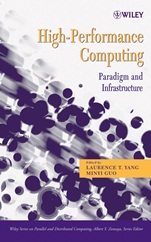
High–Performance Computing: Paradigm and Infrastructure
ISBN 9780471654711
Autor: Laurence T. Yang, Minyi Guo
Wydawca: Wiley
Dostępność: 3-6 tygodni
Cena: 930,30 zł
Przed złożeniem zamówienia prosimy o kontakt mailowy celem potwierdzenia ceny.
ISBN13: |
9780471654711 |
ISBN10: |
047165471X |
Autor: |
Laurence T. Yang, Minyi Guo |
Oprawa: |
Hardback |
Rok Wydania: |
2005-12-02 |
Ilość stron: |
816 |
Wymiary: |
238x164 |
Tematy: |
TJ |
The state of the art of high–performance computing
Prominent researchers from around the world have gathered to present the state–of–the–art techniques and innovations in high–performance computing (HPC), including:Programming models for parallel computing: graph–oriented programming (GOP), OpenMP, the stages and transformation (SAT) approach, the bulk–synchronous parallel (BSP) model, Message Passing Interface (MPI), and CilkArchitectural and system support, featuring the code tiling compiler technique, the MigThread application–level migration and checkpointing package, the new prefetching scheme of atomicity, a new "receiver makes right" data conversion method, and lessons learned from applying reconfigurable computing to HPCScheduling and resource management issues with heterogeneous systems, bus saturation effects on SMPs, genetic algorithms for distributed computing, and novel task–scheduling algorithmsClusters and grid computing: design requirements, grid middleware, distributed virtual machines, data grid services and performance–boosting techniques, security issues, and open issuesPeer–to–peer computing (P2P) including the proposed search mechanism of hybrid periodical flooding (HPF) and routing protocols for improved routing performanceWireless and mobile computing, featuring discussions of implementing the Gateway Location Register (GLR) concept in 3G cellular networks, maximizing network longevity, and comparisons of QoS–aware scatternet scheduling algorithmsHigh–performance applications including partitioners, running Bag–of–Tasks applications on grids, using low–cost clusters to meet high–demand applications, and advanced convergent architectures and protocols
High–Performance Computing: Paradigm and Infrastructure is an invaluable compendium for engineers, IT pr
ofessionals, and researchers and students of computer science and applied mathematics.
Spis treści:
Preface.
Contributors.
PART 1. PROGRAMMING MODEL.
1. ClusterGOP: A High–Level Programming Environment for Clusters (Fan Chan, Jiannong Cao and Minyi Guo).
1.1 Introduction.
1.2 GOP Model and ClusterGOP Architecture.
1.3 VisualGOP.
1.4 The ClusterGOP Library.
1.5 MPMD Programming Support.
1.6 Programming Using ClusterGOP.
1.7 Summary.
2. The Challenge of Providing A High–Level Programming Model for High–Performance Computing (Barbara Chapman).
2.1 Introduction.
2.2 HPC Architectures.
2.3 HPC Programming Models: The First Generation.
2.4 The Second generation of HPC Programming Models.
2.5 OpenMP for DMPs.
2.6 Experiments with OpenMP on DMPs.
2.7 Conclusions.
3. SAT: Toward Structured Parallelism Using Skeletons (Sergei Gorlatch).
3.1 Introduction.
3.2 SAT: A Methodology Outline.
3.3 Skeletons and Collective Operations.
3.4 Case Study: Maximum Segment SUM (MSS).
3.5 Performance Aspect in SAT.
3.6 Conclusions and Related Work.
4. Bulk–Synchronous Parallelism: An Emerging Paradigm of High–Performance Computing (Alexander Tiskin).
4.1 The BSP Model.
4.2 BSP Programming.
4.3 Conclusions.
5. Cilk Versus MPI: Comparing Two Parallel Programming Styles on Heterogenous Systems (John Morris, KyuHo Lee and JunSeong Kim).
5.1 Introduction.
5.2 Experiments.
5.3 Results.
5.4 Conclusion.
6. Nested Parallelism and Pipelining in OpenMP (Marc Gonzalez, E. Ayguade, X. Martorell and J. Labarta).
6.1 Introduction.
6.2 OpenMP Extensions for Nested Parallelism.
6.3 OpenMP Extensions for Thread Synchronization.
6.4 Summary.
7. OpenMP for Chip Multiprocessors (Feng Liu and Vipin Chaudhary).
7.1 Introduction.
7.2 3SoC Architecture Overview.
7.3 The OpenMP Conpil
er/Translator.
7.4 Extensions to OpenMP for DSEs.
7.5 Optimization for OpenMP.
7.6 Implementation.
7.7 Performance Evaluation.
7.8 Conclusions.
PART 2. ARCHITECTURAL AND SYSTEM SUPPORT.
8. Compiler and Run–Time Parallelization Techniques for Scientific Computations on Distributed–Memory Parallel Computers (PeiZong Lee, Cheien–Min Wang and Jan–Jan Wu).
8.1 Introduction.
8.2 Background Material.
8.3 Compiling Regular Programs on DMPCs.
8.4 Compiler and Run–Time Support for Irregular Programs.
8.5 Library Support for Irregular Applications.
8.6 Related Works.
8.7 Concluding Remarks.
9. Enabling Partial–Cache Line Prefetching Through Data Compression (Youtao Zhang and Rajiv Gupta).
9.1 Introduction.
9.2 Motivation of Partial Cache–Line Perfetching.
9.3 Cache Design Details.
9.4 Experimental Results.
9.5 Related Work.
9.6 Conclusion.
10. MPI Atomicity and Concurrent Overlapping I/O (Wei–Keng Liao, Alok Choudhary, Kenin Coloma, Lee Ward, Eric Russell and Neil Pundit).
10.1 Introduction.
10.2 Concurrent Overlapping I/O.
10.3 Implementation Strategies.
10.4 Experiment Results.
10.5 Summary.
11. Code Tiling: One Size Fits All (Jingling Xue and Qingguang Huang).
11.1 Introduction.
11.2 Cache Model.
11.3 Code Tiling.
11.4 Data Tiling.
11.5 Finding Optimal Tile Sizes.
11.6 Experimental Results.
11.7 Related Work.
11.8 Conclusion.
12. Data Conversion for Heterogeneous Migration/Checkpointing (Hai Jiang, Vipin Chaudhary and John Paul Walters).
12.1 Introduction.
12.2 Migration and Checkpointing.
12.3 Data Conversion.
12.4 Coarse–Grain Tagged RMR in MigThread.
12.5 Microbenchmarks and Experiments.
12.6 Related Work.
12.7 Conclusions and Future Work.
13. Receiving–Message Prediction and Its Speculative Execution (Takanobu Baba, Takashi Yokota, K
amemitsu Ootsu, Fumihitto Furukawa and Yoshiyuki Iwamoto).
13.1 Background.
13.2 Receiving–Message Prediction Method.
13.3 Implementation of the Method in the MIPI Libraries.
13.4 Experimental Results.
13.5 Conclusing Remarks.
14. An Investigation of the Applicability of Distributed FPGAs to High–Performance Computing (John P. Morrison, Padraig O’Dowd and Philip D. Healy).
14.1 Introduction.
14.2 High Performance Computing with Cluster Computing.
14.3 Reconfigurable Computing with EPGAs.
14.4 DRMC: A Distributed Reconfigurable Metacomputer.
14.5 Algorithms Suited to the Implementation on FPGAs/DRMC.
14.6 Algorithms Not Suited to the Implementation on FPGAs/DRMC.
14.7 Summary.
PART 3. SCHEDULING AND RESOURCE MANAGEMENT.
15. Bandwidth–Aware Resource Allocation for Heterogeneous Computing Systems to Maximize Throughput (Bo Hong and Viktor K. Prasanna).
15.1 Introduction.
15.2 Related Work.
15.3 Systems Model and Problem Statement.
15.4 Resource Allocation to Maximize System Throughput.
15.5 Experimental Results.
15.6 Conclusion.
16. Scheduling Algorithms with Bus Bandwidth Considerations for SMPs (Christos D. Antonopoulos, Dimitrios S., Nikolopoulos and Theeodore S. Papatheodorou).
16.1 Introduction.
16.2 Related Work.
16.3 The Implications of Bus Bandwidth for Application Performance.
16.4 Scheduling Policies for Preserving Bus Bandwidth.
16.5 Experimental Evaluation.
16.6 Conclusions.
17. Toward Performance Guarantee of Dynamic Task Scheduling of a Parameter–Sweep Application onto a Computational Grid (Noriyuki Fujimoto and Kenichi Hagihara).
17.1 Introduction.
17.2 A Grid Scheduling Model.
17.3 Related Works.
17.4 The Proposed Algorithm RR.
17.5 The Performance Guarantee of the Proposed Algorithm.
17.6 Conclusion.
18. Performance Study of Reliability Maximization and Turnaround Minimizati
Koszyk
Książek w koszyku: 0 szt.
Wartość zakupów: 0,00 zł
Informacje


Kontakt
Gambit
Centrum Oprogramowania
i Szkoleń Sp. z o.o.
Al. Pokoju 29b/22-24
31-564 Kraków
Siedziba Księgarni
ul. Kordylewskiego 1
31-542 Kraków
+48 12 410 5991
+48 12 410 5987
+48 12 410 5989
Subskrypcje
Administratorem danych osobowych jest firma Gambit COiS Sp. z o.o. Na podany adres będzie wysyłany wyłącznie biuletyn informacyjny.
Autoryzacja płatności

Informacje na temat autoryzacji płatności poprzez PayU.

© Copyright 2012: GAMBIT COiS Sp. z o.o. Wszelkie prawa zastrzeżone.
Projekt i wykonanie: Alchemia Studio Reklamy