


Wydawcy
Katalog tematyczny
- Archeologia (109)
- Ekonomia, finanse, business (13704)
- Filozofia (1445)
- Historia (3040)
- Języki i językoznawstwo (2356)
- Lifestyle, hobby i rozrywka (475)
- Medycyna (9704)
- Nauki humanistyczne (4)
- Nauki o Ziemi i środowisku (2638)
- Nauki ścisłe (20412)
- Astronomia (294)
- Biologia (5119)
- Chemia (6540)
- Fizyka (3309)
- Elektryczność i magnetyzm (90)
- Fizyka atomowa i molekularna (110)
- Fizyka cząstek elementarnych (36)
- Fizyka jądra atomowego (36)
- Fizyka kwantowa (210)
- Fizyka matematyczna (121)
- Fizyka relatywistyczna (36)
- Fizyka statystyczna (51)
- Fizyka stosowana (498)
- Mechanika klasyczna (186)
- Optyka i światło (133)
- Stany materii (202)
- Matematyka (4574)
- Nauki ścisłe, ogólnie (503)
- Nauki społeczne (8486)
- Nauki techniczne (13450)
- Prawo (1696)
- Publikacje informacyjne i interdyscyplinarne (1288)
- Religia i wierzenia (917)
- Technika komputerowa (4067)
- Zdrowie, relacje międzyludzkie i rozwój osobisty (657)





Informacje szczegółowe o książce
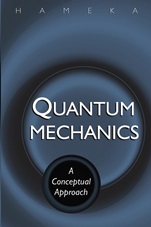
Quantum Mechanics: A Conceptual Approach
ISBN 9780471649656
Autor: Hendrik F. Hameka
Wydawca: Wiley
Dostępność: 3-6 tygodni
Cena: 484,05 zł
Przed złożeniem zamówienia prosimy o kontakt mailowy celem potwierdzenia ceny.
ISBN13: |
9780471649656 |
ISBN10: |
0471649651 |
Autor: |
Hendrik F. Hameka |
Oprawa: |
Paperback |
Rok Wydania: |
2004-04-23 |
Ilość stron: |
208 |
Wymiary: |
232x158 |
Tematy: |
PH |
A unique introductory text on quantum mechanics
Albert Einstein famously expressed his dismay at the implications of quantum mechanics (QM) when he protested, "God does not play dice with the universe." Theology aside, QM theory has held up as a scientific explanation of matter and radiation at the atomic level. Along with Einstein’s Theory of General Relativity, QM comprises the backbone of modern physics and plays a majo role in our understanding of chemistry.
Quantum Mechanics: A Conceptual Approach offers students an easy–to–understand introduction to this essential field. Assuming no prior knowledge on the part of its reader, this text emphasizes the basic concepts that provide a solid foundation for the future study of quantum chemistry. Beginning with a description of the historical developments that led to the discovery of QM, a feature often neglected in other texts, Quantum Mechanics moves on to cover:Mathematics of QM ApplicationsClassical mechanicsThe hydrogen atomWave mechanics of a free particleAtomic structureThe Schrödinger equationMolecular structure
Written in a student–friendly style by experienced author and professor Hendrik Hameka, this text also includes problem sets to reinforce the concepts outlined. Both comprehensive and accessible, Quantum Mechanics: A Conceptual Approach provides all those interested in the field with an invaluable introduction to this important topic.
Spis treści:
Preface.
1. The Discovery of Quantum Mechanics.
I Introduction.
II Planck and Quantization.
III Bohr and the Hydrogen Atom.
IV Matrix Mechanics.
V The Uncertainty Relations.
VI Wave Mechanics.
VII The Final Touches of Quantum Mechanics.
VIII Concluding Remarks.
2. The Mathematics of Quantum Mechanics.
I Introduction.
II Differential Equations.
III Kummer’s Fu
nction.
IV Matrices.
V Permutations.
VI Determinants.
VII Properties of Determinants.
VIII Linear Equations and Eigenvalues.
IX Problems.
3. Classical Mechanics.
I Introduction.
II Vectors and Vector Fields.
III Hamiltonian Mechanics.
IV The Classical Harmonic Oscillator.
V Angular Momentum.
VI Polar Coordinates.
VII Problems.
4. Wave Mechanics of a Free Particle.
I Introduction.
II The Mathematics of Plane Waves.
III The Schrödinger Equation of a Free Particle.
IV The Interpretation of the Wave Function.
V Wave Packets.
VI Concluding Remarks.
VII Problems.
5. The Schrödinger Equation.
I Introduction.
II Operators.
III The Particle in a Box.
IV Concluding Remarks.
V Problems.
6. Applications.
I Introduction.
II A Particle in a Finite Box.
III Tunneling.
IV The Harmonic Oscillator.
V Problems.
7. Angular Momentum.
I Introduction.
II Commuting Operators.
III Commutation Relations of the Angular Momentum.
IV The Rigid Rotor.
V Eigenfunctions of the Angular Momentum.
VI Concluding Remarks.
VII Problems.
8. The Hydrogen Atom.
I Introduction.
II Solving the Schrödinger Equation.
III Deriving the Energy Eigenvalues.
IV The Behavior of the Eigenfunctions.
V Problems.
9. Approximate Methods.
I Introduction.
II The Variational Principle.
III Applications of the Variational Principle.
IV Perturbation Theory for a Nondegenerate State.
V The Stark Effect of the Hydrogen Atom.
VI Perturbation Theory for Degenerate States.
VII Concluding Remarks.
VIII Problems.
10. The Helium Atom.
I Introduction.
II Experimental Developments.
III Pauli’s Exclusion Principle.
IV The Discovery of the Electron Spin.
V The Mathematical Description of the Electron Spin.
VI The Exclusion Principle Revisited.
VI
I Two–Electron Systems.
VIII The Helium Atom.
IX The Helium Atom Orbitals.
X Concluding Remarks.
XI Problems.
11 Atomic Structure.
I Introduction.
II Atomic and Molecular Wave Function.
III The Hartree–Fock Method.
IV Slater Orbitals.
V Multiplet Theory.
VI Concluding Remarks.
VII Problems.
12 Molecular Structure.
I Introduction.
II The Born–Oppenheimer Approximation.
III Nuclear Motion of Diatomic Molecules.
IV The Hydrogen Molecular Ion.
V The Hydrogen Molecule.
VI The Chemical Bond.
VII The Structures of Some Simple Polyatomic Molecules.
VIII The Hückel Molecular Orbital Method.
IX Problems.
Index.
Nota biograficzna:
HENDRIK F. HAMEKA is Professor of Theoretical Chemistry in the Department of Chemistry at the University of Pennsylvania. Originally trained as a theoretical physicist, he studied quantum mechanics under H. A. Kramers (who in turn had studied under Niels Bohr). This study sparked his interest in chemical applications of quantum mechanics, which subsequently became his principal research specialty. He has written four previous textbooks on this subject, the last of which was published by Wiley.
Okładka tylna:
A unique introductory text on quantum mechanics
Albert Einstein famously expressed his dismay at the implications of quantum mechanics (QM) when he protested, "God does not play dice with the universe." Theology aside, QM theory has held up as a scientific explanation of matter and radiation at the atomic level. Along with Einstein’s Theory of General Relativity, QM comprises the backbone of modern physics and plays a majo role in our understanding of chemistry.
Quantum Mechanics: A Conceptual Approach offers students an easy–to–understand introduction to this essential field. Assuming no prior knowledge on the part of its reader, this text emphasizes the
basic concepts that provide a solid foundation for the future study of quantum chemistry. Beginning with a description of the historical developments that led to the discovery of QM, a feature often neglected in other texts, Quantum Mechanics moves on to cover:Mathematics of QM ApplicationsClassical mechanicsThe hydrogen atomWave mechanics of a free particleAtomic structureThe Schrödinger equationMolecular structure
Written in a student–friendly style by experienced author and professor Hendrik Hameka, this text also includes problem sets to reinforce the concepts outlined. Both comprehensive and accessible, Quantum Mechanics: A Conceptual Approach provides all those interested in the field with an invaluable introduction to this important topic.
Koszyk
Książek w koszyku: 0 szt.
Wartość zakupów: 0,00 zł
Informacje


Kontakt
Gambit
Centrum Oprogramowania
i Szkoleń Sp. z o.o.
Al. Pokoju 29b/22-24
31-564 Kraków
Siedziba Księgarni
ul. Kordylewskiego 1
31-542 Kraków
+48 12 410 5991
+48 12 410 5987
+48 12 410 5989
Subskrypcje
Administratorem danych osobowych jest firma Gambit COiS Sp. z o.o. Na podany adres będzie wysyłany wyłącznie biuletyn informacyjny.
Autoryzacja płatności

Informacje na temat autoryzacji płatności poprzez PayU.

© Copyright 2012: GAMBIT COiS Sp. z o.o. Wszelkie prawa zastrzeżone.
Projekt i wykonanie: Alchemia Studio Reklamy