


Wydawcy
Katalog tematyczny
- Archeologia (109)
- Ekonomia, finanse, business (13704)
- Filozofia (1445)
- Historia (3040)
- Języki i językoznawstwo (2356)
- Lifestyle, hobby i rozrywka (475)
- Medycyna (9704)
- Nauki humanistyczne (4)
- Nauki o Ziemi i środowisku (2638)
- Nauki ścisłe (20412)
- Astronomia (294)
- Biologia (5119)
- Chemia (6540)
- Chemia analityczna (361)
- Chemia fizyczna (346)
- Chemia nieorganiczna (137)
- Chemia organiczna (535)
- Krystalografia (27)
- Minerologia (46)
- Fizyka (3309)
- Matematyka (4574)
- Nauki ścisłe, ogólnie (503)
- Nauki społeczne (8486)
- Nauki techniczne (13450)
- Prawo (1696)
- Publikacje informacyjne i interdyscyplinarne (1288)
- Religia i wierzenia (917)
- Technika komputerowa (4067)
- Zdrowie, relacje międzyludzkie i rozwój osobisty (657)







Informacje szczegółowe o książce
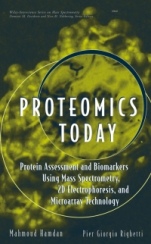
Proteomics Today: Protein Assessment and Biomarkers Using Mass Spectrometry, 2D Electrophoresis,and Microarray Technology
ISBN 9780471648178
Autor: Mahmoud H. Hamdan, Pier G. Righetti
Wydawca: Wiley
Dostępność: 3-6 tygodni
Cena: 730,80 zł
Przed złożeniem zamówienia prosimy o kontakt mailowy celem potwierdzenia ceny.
ISBN13: |
9780471648178 |
ISBN10: |
0471648175 |
Autor: |
Mahmoud H. Hamdan, Pier G. Righetti |
Oprawa: |
Hardback |
Rok Wydania: |
2005-03-11 |
Ilość stron: |
448 |
Wymiary: |
239x163 |
Tematy: |
PN |
The latest and most effective uses of mass spectrometry, 2D electrophoresis, and microarray technology for protein analysis
The first step in analyzing complex biochemical systems involves determining the molecular masses of interacting proteins, peptides, and other components. Proteomics, the study of all proteins expressed by a genome, calls for a powerful tool—mass spectrometry—to identify these proteins. A full understanding of the vital role of mass spectrometry in proteomic research necessitates an illuminating text like Proteomics Today.
Over the last several years, new emphasis has been placed on the application of proteomics to perform demanding biomedical and biochemical tasks. Proteomics Today clearly describes the contributions of the latest approaches—separation techniques, modern mass spectrometry, two–dimensional electrophoresis, and microarray technology—in meeting these challenges. The emerging roles of imaging mass spectrometry and protein interaction maps are also addressed. In this single comprehensive source, you will find an invaluable examination of all the newest technologies related to:InstrumentationCurrent strategies for protein quantificationSDS–gel electrophoresisConventional isoelectric focusing in gel matrices, capillaries, and immobilized pH gradientsTwo–dimensional mapsProteomics in cancer research
A must–have guide for scientists and laboratory technicians who study proteins in the pharmaceutical and biotechnology industries, Proteomics Today includes helpful introductions to chapters, complete references, plus insights into future challenges. More than any other resource, Proteomics Today explains how mass spectrometry and its associated tools can turn today′s proteomic research challenges into tomorrow′s biomedical opportunities.
Spis treści:
PREFACE TO PART I.
ACKNOWLED
GMENT.
I: INTRODUCTION TO PART I.
1. INSTRUMENTATION AND DEVELOPMENTS.
1.1 Introduction.
1.2 Ionization Techniques for Macromolecules.
1.3 Examples on Analytical Solutions Based on FAB–MS.
1.4 Electrospray Ionization.
1.5 Matrix–Assisted Laser Desorption Ionization.
1.6 Ion Detection.
1.7 Types of Analyzers.
1.8 Hybrid Analyzers.
1.9 Tandem Mass Spectrometry.
1.10 Current MS Instrumentation in Proteome Analyses.
1.11 Current MS–Based Proteomics.
1.12 Recent Achievements and Future Challenges.
1.13 Concluding Remarks.
References.
2. PROTEOMICS IN CANCER RESEARCH.
2.1 Introduction.
2.2 Pancreatic Ductal Adenocarcinoma.
2.3 Proteomic Analysis of Human Breast Carcinoma.
2.4 Proteomic Profiling of Chemoresistant Cancer Cells.
2.5 Signal Pathway Profiling of Prostate Cancer.
2.6 Emerging Role of Functional and Activity–Based Proteomics in Disease Understanding.
2.7 Activity–Based Protein Profiling.
2.8 Probing Protein Functions Using Chromophore–Assisted Laser Inactivation.
2.9 Role of Protein–Tyrosine Kinases.
2.10 Concluding Remarks and Future Prospects.
References.
3. CURRENT STRATEGIES FOR PROTEIN QUANTIFICATION.
3.1 Introduction.
3.2 Global Internal Standard Technology.
3.3 Differential In–Gel Electrophoresis.
3.4 Quantification of Modified Proteins.
3.5 Comments and Considerations.
3.6 Other Approaches.
3.7 Emerging Role of Microfluidic Devices.
3.8 Concluding Remarks.
References.
II: PROTEOMICS TODAY: SEPARATION SCIENCE AT WORK.
4. CONVENTIONAL ISOELECTRIC FOCUSING IN GEL MATRICES AND CAPILLARIES AND IMMOBILIZED pH GRADIENTS.
4.1 Introduction.
4.2 Conventional Isoelectric Focusing in Amphoteric Buffers.
4.3 Immobilized pH Gradients.
4.4 Capillary Isoelectric Focusing.
4.5 Separation of Peptides and Proteins by CZE in Isoelectric Buffers.
4.6 Conclusions.
References.
5. SODIUM DODECYL SULFATE–POLYACRYLAMIDE GEL ELECTROPHORESIS.
5.1 Introduction.
5.2 SDS–Protein Complexes: a Refinement of the Model.
5.3 Theoretical Background of Mr Measurement by SDS–PAGE.
5.4 Methodology.
5.5 Gel Casting and Buffer Systems.
5.6 Blotting Procedures.
5.7 Conclusions.
References.
6. TWO–DIMENSIONAL MAPS.
6.1 Introduction.
6.2 Some Basic Methodology Pertaining to 2D PAGE.
6.3 Prefractionation Tools in Proteome Analysis.
6.4 Multidimensional Chromatography Coupled to MS.
6.5 Protein Chips and Microarrays.
6.6 Nondenaturing Protein Maps.
6.7 Spot Matching in 2D Gels via Commercial Software.
6.8 Conclusions.
References.
INDEX.
Nota biograficzna:
MAHMOUD HAMDAN, PhD, is the head of Mass Spectrometry & Separation Technologies, GlaxoSmithKline, Verona, Italy.
PIER GIORGIO RIGHETTI, PhD, is Professor of Biochemistry and director of the Laboratory of Proteome Science at the University of Verona, Italy.
Okładka tylna:
The latest and most effective uses of mass spectrometry, 2D electrophoresis, and microarray technology for protein analysis
The first step in analyzing complex biochemical systems involves determining the molecular masses of interacting proteins, peptides, and other components. Proteomics, the study of all proteins expressed by a genome, calls for a powerful tool—mass spectrometry—to identify these proteins. A full understanding of the vital role of mass spectrometry in proteomic research necessitates an illuminating text like Proteomics Today.
Over the last several years, new emphasis has been placed on the application of proteomics to perform demanding biomedical and biochemical tasks. Proteomics Today clearly describes the contributions of the latest approaches—separation techniques, modern mass spectrometry, two–dimensional
electrophoresis, and microarray technology—in meeting these challenges. The emerging roles of imaging mass spectrometry and protein interaction maps are also addressed. In this single comprehensive source, you will find an invaluable examination of all the newest technologies related to:InstrumentationCurrent strategies for protein quantificationSDS–gel electrophoresisConventional isoelectric focusing in gel matrices, capillaries, and immobilized pH gradientsTwo–dimensional mapsProteomics in cancer research
A must–have guide for scientists and laboratory technicians who study proteins in the pharmaceutical and biotechnology industries, Proteomics Today includes helpful introductions to chapters, complete references, plus insights into future challenges. More than any other resource, Proteomics Today explains how mass spectrometry and its associated tools can turn today′s proteomic research challenges into tomorrow′s biomedical opportunities.
Koszyk
Książek w koszyku: 0 szt.
Wartość zakupów: 0,00 zł
Informacje


Kontakt
Gambit
Centrum Oprogramowania
i Szkoleń Sp. z o.o.
Al. Pokoju 29b/22-24
31-564 Kraków
Siedziba Księgarni
ul. Kordylewskiego 1
31-542 Kraków
+48 12 410 5991
+48 12 410 5987
+48 12 410 5989
Subskrypcje
Administratorem danych osobowych jest firma Gambit COiS Sp. z o.o. Na podany adres będzie wysyłany wyłącznie biuletyn informacyjny.
Autoryzacja płatności

Informacje na temat autoryzacji płatności poprzez PayU.

© Copyright 2012: GAMBIT COiS Sp. z o.o. Wszelkie prawa zastrzeżone.
Projekt i wykonanie: Alchemia Studio Reklamy