


Wydawcy
Katalog tematyczny
- Archeologia (109)
- Ekonomia, finanse, business (13704)
- Filozofia (1445)
- Historia (3040)
- Języki i językoznawstwo (2356)
- Lifestyle, hobby i rozrywka (475)
- Medycyna (9704)
- Nauki humanistyczne (4)
- Nauki o Ziemi i środowisku (2638)
- Nauki ścisłe (20412)
- Astronomia (294)
- Biologia (5119)
- Chemia (6540)
- Chemia analityczna (361)
- Chemia fizyczna (346)
- Chemia nieorganiczna (137)
- Chemia organiczna (535)
- Krystalografia (27)
- Minerologia (46)
- Fizyka (3309)
- Matematyka (4574)
- Nauki ścisłe, ogólnie (503)
- Nauki społeczne (8486)
- Nauki techniczne (13450)
- Prawo (1696)
- Publikacje informacyjne i interdyscyplinarne (1288)
- Religia i wierzenia (917)
- Technika komputerowa (4067)
- Zdrowie, relacje międzyludzkie i rozwój osobisty (657)





Informacje szczegółowe o książce
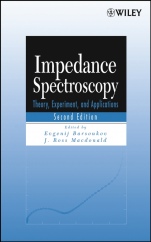
Impedance Spectroscopy: Theory, Experiment, and Applications
ISBN 9780471647492
Autor: Evgenij Barsoukov, J. Ross Macdonald
Wydawca: Wiley
Dostępność: 3-6 tygodni
Cena: 919,80 zł
Przed złożeniem zamówienia prosimy o kontakt mailowy celem potwierdzenia ceny.
ISBN13: |
9780471647492 |
ISBN10: |
0471647497 |
Autor: |
Evgenij Barsoukov, J. Ross Macdonald |
Oprawa: |
Hardback |
Rok Wydania: |
2005-04-08 |
Numer Wydania: |
2nd Edition |
Ilość stron: |
616 |
Wymiary: |
239x160 |
Tematy: |
PN |
A skillful balance of theoretical considerations and practical know–how
Backed by a team of expert contributors, the Second Edition of this highly acclaimed publication brings a solid understanding of impedance spectroscopy to students, researchers, and engineers in physical chemistry, electrochemistry, and physics. Starting with general principles, the book moves on to explain in detail practical applications for the characterization of materials in electrochemistry, semiconductors, solid electrolytes, corrosion, solid–state devices, and electrochemical power sources. The book covers all of the topics needed to help readers identify whether impedance spectroscopy may be an appropriate method for their particular research problem.
The book helps readers quickly grasp how to apply their new knowledge of impedance spectroscopy methods to their own research problems through the use of unique features such as:Step–by–step instructions for setting up experiments and then analyzing the resultsTheoretical considerations for dealing with modeling, equivalent circuits, and equations in the complex domainBest measurement methods for particular systems and alerts to potential sources of errorsEquations for the most widely used impedance modelsFigures depicting impedance spectra of typical materials and devicesExtensive references to the scientific literature for more information on particular topics and current research
This Second Edition incorporates the results of the last two decades of research on the theories and applications of impedance spectroscopy. Most notably, it includes new chapters on batteries, supercapacitors, fuel cells, and photochromic materials. A new chapter on commercially available measurement systems reflects the emergence of impedance spectroscopy as a mainstream research tool.
With its balanced focus on both theory and practical problem solving, Impedance Spectroscopy: Th
eory, Experiment, and Applications, Second Edition serves as an excellent graduate–level textbook as well as a hands–on guide and reference for researchers and engineers.
Spis treści:
Preface.
Preface to the First Edition.
Contributors.
Contributors to the First Edition.
Chapter 1. Fundamentals of Impedance Spectroscopy (J.Ross Macdonald and William B. Johnson).
1.1. Background, Basic Definitions, and History.
1.1.1 The Importance of Interfaces.
1.1.2 The Basic Impedance Spectroscopy Experiment.
1.1.3 Response to a Small–Signal Stimulus in the Frequency Domain.
1.1.4 Impedance–Related Functions.
1.1.5 Early History.
1.2. Advantages and Limitations.
1.2.1 Differences Between Solid State and Aqueous Electrochemistry.
1.3. Elementary Analysis of Impedance Spectra.
1.3.1 Physical Models for Equivalent Circuit Elements.
1.3.2 Simple RC Circuits.
1.3.3 Analysis of Single Impedance Arcs.
1.4. Selected Applications of IS.
Chapter 2. Theory (Ian D. Raistrick, Donald R. Franceschetti, and J. Ross Macdonald).
2.1. The Electrical Analogs of Physical and Chemical Processes.
2.1.1 Introduction.
2.1.2 The Electrical Properties of Bulk Homogeneous Phases.
2.1.2.1 Introduction.
2.1.2.2 Dielectric Relaxation in Materials with a Single Time Constant.
2.1.2.3 Distributions of Relaxation Times.
2.1.2.4 Conductivity and Diffusion in Electrolytes.
2.1.2.5 Conductivity and Diffusion—a Statistical Description.
2.1.2.6 Migration in the Absence of Concentration Gradients.
2.1.2.7 Transport in Disordered Media.
2.1.3 Mass and Charge Transport in the Presence of Concentration Gradients.
2.1.3.1 Diffusion.
2.1.3.2 Mixed Electronic–Ionic Conductors.
2.1.3.3 Concentration Polarization.
2.1.4 Interfaces and Boundary Conditions.
2.1.4.1 Reversible and Irreversible Interfaces.
2.1.4.2 Polarizable Electrodes.
2.1.4.3 Adsorption at th
e Electrode–Electrolyte Interface.
2.1.4.4 Charge Transfer at the Electrode–Electrolyte Interface.
2.1.5 Grain Boundary Effects.
2.1.6 Current Distribution, Porous and Rough Electrodes— the Effect of Geometry.
2.1.6.1 Current Distribution Problems.
2.1.6.2 Rough and Porous Electrodes.
2.2. Physical and Electrochemical Models.
2.2.1 The Modeling of Electrochemical Systems.
2.2.2 Equivalent Circuits.
2.2.2.1 Unification of Immitance Responses.
2.2.2.2 Distributed Circuit Elements.
2.2.2.3 Ambiguous Circuits.
2.2.3 Modeling Results.
2.2.3.1 Introduction.
2.2.3.2 Supported Situations.
2.2.3.3 Unsupported Situations: Theoretical Models.
2.2.3.4 Unsupported Situations: Equivalent Network Models.
2.2.3.5 Unsupported Situations: Empirical and Semiempirical Models.
Chapter 3. Measuring Techniques and Data Analysis.
3.1. Impedance Measurement Techniques (Michael C. H. McKubre and Digby D. Macdonald).
3.1.1 Introduction.
3.1.2 Frequency Domain Methods.
3.1.2.1 Audio Frequency Bridges.
3.1.2.2 Transformer Ratio Arm Bridges.
3.1.2.3 Berberian–Cole Bridge.
3.1.2.4 Considerations of Potentiostatic Control.
3.1.2.5 Oscilloscopic Methods for Direct Measurement.
3.1.2.6 Phase–Sensitive Detection for Direct Measurement.
3.1.2.7 Automated Frequency Response Analysis.
3.1.2.8 Automated Impedance Analyzers.
3.1.2.9 The Use of Kramers–Kronig Transforms.
3.1.2.10 Spectrum Analyzers.
3.1.3 Time Domain Methods.
3.1.3.1 Introduction.
3.1.3.2 Analog–to–Digital (A/D) Conversion.
3.1.3.3 Computer Interfacing.
3.1.3.4 Digital Signal Processing.
3.1.4 Conclusions.
3.2. Commercially Available Impedance Measurement Systems (Brian Sayers).
3.2.1 Electrochemical Impedance Measurement Systems.
3.2.1.1 System Configuration.
3.2.1.2 Why Use a Potentiostat?
3.2.1.3 Measurements Using 2, 3 or 4–Terminal Techniques.
3.2.1.4 Me
asurement Resolution and Accuracy.
3.2.1.5 Single Sine and FFT Measurement Techniques.
3.2.1.6 Multielectrode Techniques.
3.2.1.7 Effects of Connections and Input Impedance.
3.2.1.8 Verification of Measurement Performance.
3.2.1.9 Floating Measurement Techniques.
3.2.1.10 Multichannel Techniques.
3.2.2 Materials Impedance Measurement Systems.
3.2.2.1 System Configuration.
3.2.2.2 Measurement of Low Impedance Materials.
3.2.2.3 Measurement of High Impedance Materials.
3.2.2.4 Reference Techniques.
3.2.2.5 Normalization Techniques.
3.2.2.6 High Voltage Measurement Techniques.
3.2.2.7 Temperature Control.
3.2.2.8 Sample Holder Considerations.
3.3. Data Analysis (J. Ross Macdonald).
3.3.1 Data Presentation and Adjustment.
3.3.1.1 Previous Approaches.
3.3.1.2 Three–Dimensional Perspective Plotting.
3.3.1.3 Treatment of Anomalies.
3.3.2 Data Analysis Methods.
3.3.2.1 Simple Methods.
3.3.2.2 Complex Nonlinear Least Squares.
3.3.2.3 Weighting.
3.3.2.4 Which Impedance–Related Function to Fit?
3.3.2.5 The Question of “What to Fit” Revisited.
3.3.2.6 Deconvolution Approaches.
3.3.2.7 Examples of CNLS Fitting.
3.3.2.8 Summary and Simple Characterization Example.
Chapter 4. Applications of Impedance Spectroscopy.
4.1. Characterization of Materials (N. Bonanos, B. C. H. Steele, and E. P. Butler).
4.1.1 Microstructural Models for Impedance Spectra of Materials.
4.1.1.1 Introduction.
4.1.1.2 Layer Models.
4.1.1.3 Effective Medium Models.
4.1.1.4 Modeling of Composite Electrodes.
4.1.2 Experimental Techniques.
4.1.2.1 Introduction.
4.1.2.2 Measurement Systems.
4.1.2.3 Sample Preparation—Electrodes.
4.1.2.4 Problems Associated With the Measurement of Electrode Properties.
4.1.3 Interpretation of the Impedance Spectra of Ionic Conductors and Interfaces.
4.1.3.1 Introduction.
4.1.3.2 Characterization of Grain Boundaries by IS
Koszyk
Książek w koszyku: 0 szt.
Wartość zakupów: 0,00 zł
Informacje


Kontakt
Gambit
Centrum Oprogramowania
i Szkoleń Sp. z o.o.
Al. Pokoju 29b/22-24
31-564 Kraków
Siedziba Księgarni
ul. Kordylewskiego 1
31-542 Kraków
+48 12 410 5991
+48 12 410 5987
+48 12 410 5989
Subskrypcje
Administratorem danych osobowych jest firma Gambit COiS Sp. z o.o. Na podany adres będzie wysyłany wyłącznie biuletyn informacyjny.
Autoryzacja płatności

Informacje na temat autoryzacji płatności poprzez PayU.

© Copyright 2012: GAMBIT COiS Sp. z o.o. Wszelkie prawa zastrzeżone.
Projekt i wykonanie: Alchemia Studio Reklamy