


Wydawcy
Katalog tematyczny
- Archeologia (109)
- Ekonomia, finanse, business (13704)
- Filozofia (1445)
- Historia (3040)
- Języki i językoznawstwo (2356)
- Lifestyle, hobby i rozrywka (475)
- Medycyna (9704)
- Nauki humanistyczne (4)
- Nauki o Ziemi i środowisku (2638)
- Nauki ścisłe (20412)
- Astronomia (294)
- Biologia (5119)
- Chemia (6540)
- Chemia analityczna (361)
- Chemia fizyczna (346)
- Chemia nieorganiczna (137)
- Chemia organiczna (535)
- Krystalografia (27)
- Minerologia (46)
- Fizyka (3309)
- Matematyka (4574)
- Nauki ścisłe, ogólnie (503)
- Nauki społeczne (8486)
- Nauki techniczne (13450)
- Prawo (1696)
- Publikacje informacyjne i interdyscyplinarne (1288)
- Religia i wierzenia (917)
- Technika komputerowa (4067)
- Zdrowie, relacje międzyludzkie i rozwój osobisty (657)





Informacje szczegółowe o książce
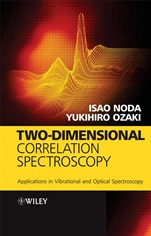
Two–Dimensional Correlation Spectroscopy: Applications in Vibrational and Optical Spectroscopy
ISBN 9780471623915
Autor: Isao Noda, Yukihiro Ozaki
Wydawca: Wiley
Dostępność: 3-6 tygodni
Cena: 1 001,70 zł
Przed złożeniem zamówienia prosimy o kontakt mailowy celem potwierdzenia ceny.
ISBN13: |
9780471623915 |
ISBN10: |
0471623911 |
Autor: |
Isao Noda, Yukihiro Ozaki |
Oprawa: |
Hardback |
Rok Wydania: |
2004-09-17 |
Ilość stron: |
310 |
Wymiary: |
237x153 |
Tematy: |
PN |
In the last decade or so, perturbation–based generalized two–dimensional (2D) correlation spectroscopy has become a powerful and versatile tool for the detailed analysis of various spectroscopic data. This seemingly straightforward idea of spreading the spectral information onto the second dimension, by applying the well–established classical correlation analysis methodology, has turned out to be very fertile ground for the development a new generation of modern spectral analysis techniques.
In Chapter 1, some historical perspectives and an overview of the field of perturbation–based 2D correlation spectroscopy is provided. Chapter 2 covers the central theoretical background of the two–dimensional correlation method. Chapter 3 provides a rapid and simple computational method for obtaining 2D correlation spectra from experimentally obtained spectral data set, followed by the practical considerations to be taken into account for the 2D correlation analysis of real–world spectral data in Chapter 4. The next three chapters deal with more advanced topics. Chapter 5 introduces the concept of sample–sample correlation and hybrid correlation, and Chapter 6 explores the relationship between 2D correlation spectroscopy and classical statistical and chemometrical treatments of data. Chapter 7 examines other types of 2D spectroscopy, such as nonlinear optical 2D spectroscopy based on ultra fast laser pulses, 2D mapping of correlation coefficient, and newly emerging variant forms of 2D correlation analyses, such as moving–window correlation and model based correlation method.
The remaining chapters of the book are devoted to specific application examples of 2D correlation spectroscopy illustrating how the technique can be utilized in various aspects of spectroscopic studies. These examples include:Generalized Two–Dimensional Correlation Studies of Polymers and Liquid CrystalsTwo–Dimensional Correlatio
n Spectroscopy and Chemical ReactionsProtein Research by Two–Dimensional Correlation SpectroscopyApplications of 2D Correlation Spectroscopy to Biological and Biomedical SciencesApplication of Hetero–spectral Correlation AnalysisExtension of Two–Dimensional Correlation Analysis to Other FieldThis book serves as an introductory text for newcomers to the field, as well as presents a survey of specific interest areas for the experienced practitioners.
Spis treści:
Preface.
Acknowledgements.
1 Introduction.
1.1 Two–dimensional Spectroscopy.
1.2 Overview of the Field.
1.3 Generalized Two–dimensional Correlation.
1.3.1 Types of Spectroscopic Probes.
1.3.2 External Perturbations.
1.4 Heterospectral Correlation.
1.5 Universal Applicability.
2 Principle of Two–dimensional Correlation Spectroscopy.
2.1 Two–dimensional Correlation Spectroscopy.
2.1.1 General Scheme.
2.1.2 Type of External Perturbations.
2.2 Generalized Two–dimensional Correlation.
2.2.1 Dynamic Spectrum.
2.2.2 Two–dimensional Correlation Concept.
2.2.3 Generalized Two–dimensional Correlation Function.
2.2.4 Heterospectral Correlation.
2.3 Properties of 2D Correlation Spectra.
2.3.1 Synchronous 2D Correlation Spectrum.
2.3.2 Asynchronous 2D Correlation Spectrum.
2.3.3 Special Cases and Exceptions.
2.4 Analytical Expressions for Certain 2D Spectra.
2.4.1 Comparison of Linear Functions.
2.4.2 2D Spectra Based on Sinusoidal Signals.
2.4.3 Exponentially Decaying Intensities.
2.4.4 Distributed Lorentzian Peaks.
2.4.5 Signals with more Complex Waveforms.
2.5 Cross–correlation Analysis and 2D Spectroscopy.
2.5.1 Cross–correlation Function and Cross Spectrum.
2.5.2 Cross–correlation Function and Synchronous Spectrum.
2.5.3 Hilbert Transform.
2.5.4 Orthogonal Correlation Func
tion and Asynchronous Spectrum.
2.5.5 Disrelation Spectrum.
3 Practical Computation of Two–dimensional Correlation Spectra.
3.1 Computation of 2D Spectra from Discrete Data.
3.1.1 Synchronous Spectrum.
3.1.2 Asynchronous Spectrum.
3.2 Unevenly Spaced Data.
3.3 Disrelation Spectrum.
3.4 Computational Efficiency.
4 Generalized Two–dimensional Correlation Spectroscopy in Practice.
4.1 Practical Example.
4.1.1 Solvent Evaporation Study.
4.1.2 2D Spectra Generated from Experimental Data.
4.1.3 Sequential Order Analysis by Cross Peak Signs.
4.2 Pretreatment of Data.
4.2.1 Noise Reduction Methods.
4.2.2 Baseline Correction Methods.
4.2.3 Other Pretreatment Methods.
4.3 Features Arising from Factors other than Band Intensity Changes.
4.3.1 Effect of Band Position Shift and Line Shape Change.
4.3.2 Simulation Studies.
4.3.3 2D Spectral Features from Band Shift and Line Broadening.
5 Further Expansion of Generalized Two–dimensional Correlation Spectroscopy – Sample–Sample Correlation and Hybrid Correlation.
5.1 Sample–Sample Correlation Spectroscopy.
5.1.1 Correlation in another Dimension.
5.1.2 Matrix Algebra Outlook of 2D Correlation.
5.1.3 Sample–Sample Correlation Spectra.
5.1.4 Application of Sample–Sample Correlation.
5.2 Hybrid 2D Correlation Spectroscopy.
5.2.1 Multiple Perturbations.
5.2.2 Correlation between Data Matrices.
5.2.3 Case Studies.
5.3 Additional Remarks.
6 Additional Developments in Two–dimensional Correlation Spectroscopy – Statistical Treatments, Global Phase Maps, and Chemometrics.
6.1 Classical Statistical Treatments and 2D Spectroscopy.
6.1.1 Variance, Covariance, and Correlation Coefficient.
6.1.2 Interpretation of 2D Disrelation Spectrum.
6.1.3 Coherence and Correlation Phase Angle.
6.1.4 Correlation Enhancement.
6.2 Global 2D Phase Maps.
6.2
.1 Further Discussion on Global Phase.
6.2.2 Phase Map with a Blinding Filter.
6.2.3 Simulation Study.
6.3 Chemometrics and 2D Correlation Spectroscopy.
6.3.1 Comparison between Chemometrics and 2D Correlation.
6.3.2 Factor Analysis.
6.3.3 Principal Component Analysis (PCA).
6.3.4 Number of Principal Factors.
6.3.5 PCA–reconstructed Spectra.
6.3.6 Eigenvalue Manipulating Transformation (EMT).
7 Other Types of Two–dimensional Spectroscopy.
7.1 Nonlinear Optical 2D Spectroscopy.
7.1.1 Ultrafast Laser Pulses.
7.1.2 Comparison with Generalized 2D Correlation Spectroscopy.
7.1.3 Overlap Between Generalized 2D Correlation and Nonlinear Spectroscopy.
7.2 Statistical 2D Correlation Spectroscopy.
7.2.1 Statistical 2D Correlation by Barton II et al.
7.2.2 Statistical 2D Correlation by ˇSaˇsic and Ozaki.
7.2.3 Other Statistical 2D Spectra.
7.2.4 Link to Chemometrics.
7.3 Other Developments in 2D Correlation Spectroscopy.
7.3.1 Moving–window Correlation.
7.3.2 Model–based 2D Correlation Spectroscopy.
8 Dynamic Two–dimensional Correlation Spectroscopy Based on Periodic Perturbations.
8.1 Dynamic 2D IR Spectroscopy.
8.1.1 Sinusoidal Signals
8.1.2 Small–amplitude Perturbation and Linear Response.
8.1.3 Dynamic IR Linear Dichroism (DIRLD).
8.1.4 2D Correlation Analysis of Dynamic IR Dichroism.
8.2 Dynamic 2D IR Dichroism Spectra of Polymers.
8.2.1 Polystyrene/Polyethylene Blend.
8.2.2 Polystyrene.
8.2.3 Poly(methyl methacrylate).
8.2.4 Human Skin Stratum Corneum.
8.2.5 Human Hair Keratin.
8.2.6 Toluene and Dioctylphthalate in a Polystyrene Matrix.
8.2.7 Polystyrene/Poly(vinyl methyl ether) Blend.
8.2.8 Linear Low Density Polyethylene.
8.2.9 Poly(hydroxyalkanoates).
8.2.10 Block Copolymers.
8.2.11 Summary.
8.3 Repetitive Perturbations Beyond DIRLD.
8.3.1 Time–resolved Small Angle X̵
Koszyk
Książek w koszyku: 0 szt.
Wartość zakupów: 0,00 zł
Informacje


Kontakt
Gambit
Centrum Oprogramowania
i Szkoleń Sp. z o.o.
Al. Pokoju 29b/22-24
31-564 Kraków
Siedziba Księgarni
ul. Kordylewskiego 1
31-542 Kraków
+48 12 410 5991
+48 12 410 5987
+48 12 410 5989
Subskrypcje
Administratorem danych osobowych jest firma Gambit COiS Sp. z o.o. Na podany adres będzie wysyłany wyłącznie biuletyn informacyjny.
Autoryzacja płatności

Informacje na temat autoryzacji płatności poprzez PayU.

© Copyright 2012: GAMBIT COiS Sp. z o.o. Wszelkie prawa zastrzeżone.
Projekt i wykonanie: Alchemia Studio Reklamy