


Wydawcy
Katalog tematyczny
- Archeologia (109)
- Ekonomia, finanse, business (13704)
- Filozofia (1445)
- Historia (3040)
- Języki i językoznawstwo (2356)
- Lifestyle, hobby i rozrywka (475)
- Medycyna (9704)
- Nauki humanistyczne (4)
- Nauki o Ziemi i środowisku (2638)
- Nauki ścisłe (20412)
- Nauki społeczne (8486)
- Edukacja (229)
- Kryminologia, opieka spełeczna (284)
- Obronność (10)
- Polityka (1389)
- Psychologia (777)
- Socjologia (410)
- Społeczeństwo i kultura (187)
- Nauki techniczne (13450)
- Prawo (1696)
- Publikacje informacyjne i interdyscyplinarne (1288)
- Religia i wierzenia (917)
- Technika komputerowa (4067)
- Zdrowie, relacje międzyludzkie i rozwój osobisty (657)





Informacje szczegółowe o książce
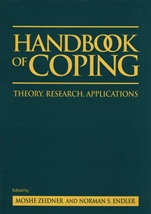
Handbook of Coping: Theory, Research, Applications
ISBN 9780471599463
Autor: Moshe Zeidner, Norman S. Endler
Wydawca: Wiley
Dostępność: 3-6 tygodni
Cena: 1 524,60 zł
Przed złożeniem zamówienia prosimy o kontakt mailowy celem potwierdzenia ceny.
ISBN13: |
9780471599463 |
ISBN10: |
0471599468 |
Autor: |
Moshe Zeidner, Norman S. Endler |
Oprawa: |
Hardback |
Rok Wydania: |
1996-01-09 |
Ilość stron: |
752 |
Wymiary: |
239x155 |
Tematy: |
JC |
"...how a man rallies to life′s challenges and weathers its storms tells everything of who he is and all that he is likely to become." —St. Augustine
It has long been understood that how a person adjusts to life stresses is a major component of his or her ability to lead a fulfilling life. Yet it wasn′t until the 1960s that coping became a discrete topic of psychological inquiry. Since then, coping has risen to a position of prominence in the modern psychological discourse—especially within the personality, cognitive, and behavioral spheres—and, within the past decade alone, many important discoveries have been made about its mechanisms and functioning, and its role in ongoing psychological and physical health and well–being.
A book whose time has come at last, the Handbook of Coping is the first professional reference devoted exclusively to the psychology of coping. Reporting the observations and insights of nearly sixty leading authorities in stress and coping from a wide range of affiliations and schools of thought, it brings readers the state of the art in coping theory, research, assessment, and applications. In orchestrating the book, the editors have scrupulously avoided imposing any particular slant or point of view, other than the need to foster greater eclecticism and cooperation between researchers and clinicians concerned with the phenomenon of coping.
The Handbook of Coping is divided into five overlapping parts, the first of which serves to lay the conceptual foundations of all that follows. It traces the history of coping from its origins in psychoanalytic theories of unconscious defense mechanisms, and provides an exhaustive review of the latest conceptualizations, models, and constructs. The following section provides an in–depth exploration of current research methodology, measurement, and assessment tools. Part Three explores key facets of coping in a broad range of specific domains,
including everyday hassles, chronic disease, cataclysmic events, and many others. The penultimate section focuses on individual differences. Among important topics covered here are coping styles and dispositions; the role of family, social support, and education; and coping behaviors across the life span. The final section, Part Five, is devoted to current applications. Clinical parameters are defined and a number of specific interventions are described, as are proven techniques for helping clients to improve their coping skills.
A comprehensive guide to contemporary coping theory, research, and applications, the Handbook of Coping is an indispensable resource for practitioners, researchers, students, and educators in psychology, the health sciences, and epidemiology.
Of related interest ...
EGO DEFENSES: Theory and Measurement —Edited by Hope R. Conte and Robert Plutchik
This book explores the nature and manifestations of defense mechanisms and traces ego defense theory and research from Freud′s initial conceptualization through recent work in object–relations theory and other psychoanalytically oriented approaches. It provides clinical guidelines for diagnosing, assessing, and dealing with defenses, reviews empirical research techniques, and indicates their value in development and in psychotherapy. This volume should be of value to theoreticians, clinicians, and researchers interested in finding appropriate tools for measurement of defense mechanisms. 1994
SOCIAL SUPPORT: An Interactional View —Edited by Barbara R. Sarason, Irwin G. Sarason, and Gregory R. Pierce
The study of social support and its relationship to personality, health, and adjustment is one of the fastest growing areas of research and application in psychology. This book contains integrative surveys of clinical and field studies, experimental investigations, and life–span explorations. It approaches social support as an important facet of in
terpersonal relationships and shows its undesirable, as well as its positive, features. 1990 (0–471–60624–3) 528 pp.
Spis treści:
Partial table of contents:
CONCEPTUAL ISSUES.
Coping and Defense: A Historical Overview (J. Parker & N. Endler).
Personality and Coping: A Reconceptualization (P. Costa, et al.).
ASSESSMENT AND RESEARCH METHODS.
The Interplay Among Design, Data Analysis, and Theory in the Measurement of Coping (J. Benson & K. Hagtvet).
An Approach to Assessing Daily Coping (L. Porter & A. Stone).
FACETS OF COPING.
Coping in Occupational Settings (S. Cartwright & C. Cooper).
Coping with Chronic Pain (J. Katz, et al.).
Coping with Multiple Stressors in the Environment (S. Lepore & G. Evans).
INDIVIDUAL DIFFERENCES.
Individual Differences in Coping (H. Krohne).
Age Differences, Coping, and the Adult Life Span (S. Strack & H. Feifel).
CLINICAL PARAMETERS: ADAPTIVE COPING AND INTERVENTIONS.
Adaptative and Maladaptative Coping (M. Zeidner & D. Saklofske).
Facilitating Coping with Chronic Physical Illness (G. Devins & Y. Binik).
Indexes.
Nota biograficzna:
MOSHE ZEIDNER, PhD, is Professor of Psychology at the University of Haifa School of Education, Israel. He also has faculty appointments at Stanford University and California State University at San Jose, and a visiting fellowship at Oxford University. His other books include Psychological Testing: An Inside View and International Handbook of Personality and Intelligence.
NORMAN S. ENDLER, PhD, is Professor of Psychology at York University, Ontario. He is a fellow of the Royal Society of Canada, the American Psychological Association, and the Canadian Psychological Association. His other books include the two–volume Personality and the Behavior Disorders (coedited with J. M. Hunt), Holiday of Darkness, and Depression: New Directions in Theory, Research, and Practi
ce.
Okładka tylna:
"...how a man rallies to life′s challenges and weathers its storms tells everything of who he is and all that he is likely to become." —St. Augustine
It has long been understood that how a person adjusts to life stresses is a major component of his or her ability to lead a fulfilling life. Yet it wasn′t until the 1960s that coping became a discrete topic of psychological inquiry. Since then, coping has risen to a position of prominence in the modern psychological discourse—especially within the personality, cognitive, and behavioral spheres—and, within the past decade alone, many important discoveries have been made about its mechanisms and functioning, and its role in ongoing psychological and physical health and well–being.
A book whose time has come at last, the Handbook of Coping is the first professional reference devoted exclusively to the psychology of coping. Reporting the observations and insights of nearly sixty leading authorities in stress and coping from a wide range of affiliations and schools of thought, it brings readers the state of the art in coping theory, research, assessment, and applications. In orchestrating the book, the editors have scrupulously avoided imposing any particular slant or point of view, other than the need to foster greater eclecticism and cooperation between researchers and clinicians concerned with the phenomenon of coping.
The Handbook of Coping is divided into five overlapping parts, the first of which serves to lay the conceptual foundations of all that follows. It traces the history of coping from its origins in psychoanalytic theories of unconscious defense mechanisms, and provides an exhaustive review of the latest conceptualizations, models, and constructs. The following section provides an in–depth exploration of current research methodology, measurement, and assessment tools. Part Three explores key facets of copi
ng in a broad range of specific domains, including everyday hassles, chronic disease, cataclysmic events, and many others. The penultimate section focuses on individual differences. Among important topics covered here are coping styles and dispositions; the role of family, social support, and education; and coping behaviors across the life span. The final section, Part Five, is devoted to current applications. Clinical parameters are defined and a number of specific interventions are described, as are proven techniques for helping clients to improve their coping skills.
A comprehensive guide to contemporary coping theory, research, and applications, the Handbook of Coping is an indispensable resource for practitioners, researchers, students, and educators in psychology, the health sciences, and epidemiology.
Of related interest ...
EGO DEFENSES: Theory and Measurement —Edited by Hope R. Conte and Robert Plutchik
This book explores the nature and manifestations of defense mechanisms and traces ego defense theory and research from Freud′s initial conceptualization through recent work in object–relations theory and other psychoanalytically oriented approaches. It provides clinical guidelines for diagnosing, assessing, and dealing with defenses, reviews empirical research techniques, and indicates their value in development and in psychotherapy. This volume should be of value to theoreticians, clinicians, and researchers interested in finding appropriate tools for measurement of defense mechanisms. 1994
SOCIAL SUPPORT: An Interactional View —Edited by Barbara R. Sarason, Irwin G. Sarason, and Gregory R. Pierce
The study of social support and its relationship to personality, health, and adjustment is one of the fastest growing areas of research and application in psychology. This book contains integrative surveys of clinical and field studies, experimental investigations, and life–span explorations. It approaches s
ocial support as an important facet of interpersonal relationships and shows its undesirable, as well as its positive, features. 1990 (0–471–60624–3) 528 pp.
Koszyk
Książek w koszyku: 0 szt.
Wartość zakupów: 0,00 zł
Informacje


Kontakt
Gambit
Centrum Oprogramowania
i Szkoleń Sp. z o.o.
Al. Pokoju 29b/22-24
31-564 Kraków
Siedziba Księgarni
ul. Kordylewskiego 1
31-542 Kraków
+48 12 410 5991
+48 12 410 5987
+48 12 410 5989
Subskrypcje
Administratorem danych osobowych jest firma Gambit COiS Sp. z o.o. Na podany adres będzie wysyłany wyłącznie biuletyn informacyjny.
Autoryzacja płatności

Informacje na temat autoryzacji płatności poprzez PayU.

© Copyright 2012: GAMBIT COiS Sp. z o.o. Wszelkie prawa zastrzeżone.
Projekt i wykonanie: Alchemia Studio Reklamy