


Wydawcy
Katalog tematyczny
- Archeologia (109)
- Ekonomia, finanse, business (13704)
- Filozofia (1445)
- Historia (3040)
- Języki i językoznawstwo (2356)
- Lifestyle, hobby i rozrywka (475)
- Medycyna (9704)
- Nauki humanistyczne (4)
- Nauki o Ziemi i środowisku (2638)
- Nauki ścisłe (20412)
- Nauki społeczne (8486)
- Nauki techniczne (13450)
- Budownictwo lądowe (1045)
- Chemia przemysłowa (2258)
- Elektronika i telekomunikacja (3287)
- Energetyka (1122)
- Inne nauki stosowane (363)
- Inżynieria biochemiczna (507)
- Inżynieria transportu (232)
- Mechanika i materiały (3316)
- Nauka o środowisku (321)
- Rolnictwo (507)
- Technika, ogólnie (475)
- Prawo (1696)
- Publikacje informacyjne i interdyscyplinarne (1288)
- Religia i wierzenia (917)
- Technika komputerowa (4067)
- Zdrowie, relacje międzyludzkie i rozwój osobisty (657)





Informacje szczegółowe o książce
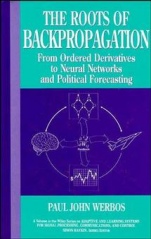
The Roots of Backpropagation: From Ordered Derivatives to Neural Networks and Political Forecasting
ISBN 9780471598978
Autor: Paul John Werbos
Wydawca: Wiley
Dostępność: 3-6 tygodni
Cena: 899,85 zł
Przed złożeniem zamówienia prosimy o kontakt mailowy celem potwierdzenia ceny.
ISBN13: |
9780471598978 |
ISBN10: |
0471598976 |
Autor: |
Paul John Werbos |
Oprawa: |
Hardback |
Rok Wydania: |
1994-03-04 |
Ilość stron: |
320 |
Wymiary: |
244x160 |
Tematy: |
TJ |
Now, for the first time, publication of the landmark work in backpropagation! Scientists, engineers, statisticians, operations researchers, and other investigators involved in neural networks have long sought direct access to Paul Werbos’s groundbreaking, much–cited 1974 Harvard doctoral thesis, The Roots of Backpropagation, which laid the foundation of backpropagation. Now, with the publication of its full text, these practitioners can go straight to the original material and gain a deeper, practical understanding of this unique mathematical approach to social studies and related fields. In addition, Werbos has provided three more recent research papers, which were inspired by his original work, and a new guide to the field. Originally written for readers who lacked any knowledge of neural nets, The Roots of Backpropagation firmly established both its historical and continuing significance as it:Demonstrates the ongoing value and new potential of backpropagationCreates a wealth of sound mathematical tools useful across disciplinesSets the stage for the emerging area of fast automatic differentiationDescribes new designs for forecasting and control which exploit backpropagationUnifies concepts from Freud, Jung, biologists, and others into a new mathematical picture of the human mind and how it worksCertifies the viability of Deutsch’s model of nationalism as a predictive tool—as well as the utility of extensions of this central paradigm"What a delight it was to see Paul Werbos rediscover Freud’s version of ‘back–propagation.’ Freud was adamant (in The Project for a Scientific Psychology) that selective learning could only take place if the presynaptic neuron was as influenced as is the postsynaptic neuron during excitation. Such activation of both sides of the contact barrier (Freud’s name for the synapse) was accomplished by reducing synaptic resistance by the absorption of ‘
energy’ at the synaptic membranes. Not bad for 1895! But Werbos 1993 is even better." —Karl H. Pribram Professor Emeritus, Stanford University
Spis treści:
THESIS.
Beyond Regression: New Tools for Prediction and Analysis in the Behavioral Sciences.
Dynamic Feedback, Statistical Estimation, and Systems Optimization: General Techniques.
The Multivariate ARMA(1,1) Model: Its Significance and Estimation.
Simulation Studies of Techniques of Time–Series Analysis.
General Applications of These Ideas: Practical Hazards and New Possibilities.
Nationalism and Social Communications: A Test Case for Mathematical Approaches.
APPLICATIONS AND EXTENSIONS.
Forms of Backpropagation for Sensitivity Analysis, Optimization, and Neural Networks.
Backpropagation Through Time: What It Does and How to Do It.
Neurocontrol: Where It Is Going and Why It Is Crucial.
Neural Networks and the Human Mind: New Mathematics Fits Humanistic Insight.
Index.
Nota biograficzna:
PAUL JOHN WERBOS is a Program Director in the Engineering Directorate of the National Science Foundation as well as Past President of the International Neural Network Society. Previously, he developed and evaluated large–scale forecasting models at the Energy Information Administration of the Department of Energy, using backpropagation and other techniques discussed in this book. He has contributed, as a writer or editor, to several books on neural networks and has published more than forty journal articles and conference papers on a wide range of subjects.
Okładka tylna:
Now, for the first time, publication of the landmark work in backpropagation! Scientists, engineers, statisticians, operations researchers, and other investigators involved in neural networks have long sought direct access to Paul Werbos’s groundbreaking, much–cited 1974 Harvard doctoral thesis, The Roots of Backpropagation, whic
h laid the foundation of backpropagation. Now, with the publication of its full text, these practitioners can go straight to the original material and gain a deeper, practical understanding of this unique mathematical approach to social studies and related fields. In addition, Werbos has provided three more recent research papers, which were inspired by his original work, and a new guide to the field. Originally written for readers who lacked any knowledge of neural nets, The Roots of Backpropagation firmly established both its historical and continuing significance as it:Demonstrates the ongoing value and new potential of backpropagationCreates a wealth of sound mathematical tools useful across disciplinesSets the stage for the emerging area of fast automatic differentiationDescribes new designs for forecasting and control which exploit backpropagationUnifies concepts from Freud, Jung, biologists, and others into a new mathematical picture of the human mind and how it worksCertifies the viability of Deutsch’s model of nationalism as a predictive tool—as well as the utility of extensions of this central paradigm"What a delight it was to see Paul Werbos rediscover Freud’s version of ‘back–propagation.’ Freud was adamant (in The Project for a Scientific Psychology) that selective learning could only take place if the presynaptic neuron was as influenced as is the postsynaptic neuron during excitation. Such activation of both sides of the contact barrier (Freud’s name for the synapse) was accomplished by reducing synaptic resistance by the absorption of ‘energy’ at the synaptic membranes. Not bad for 1895! But Werbos 1993 is even better." —Karl H. Pribram Professor Emeritus, Stanford University
Koszyk
Książek w koszyku: 0 szt.
Wartość zakupów: 0,00 zł
Informacje


Kontakt
Gambit
Centrum Oprogramowania
i Szkoleń Sp. z o.o.
Al. Pokoju 29b/22-24
31-564 Kraków
Siedziba Księgarni
ul. Kordylewskiego 1
31-542 Kraków
+48 12 410 5991
+48 12 410 5987
+48 12 410 5989
Subskrypcje
Administratorem danych osobowych jest firma Gambit COiS Sp. z o.o. Na podany adres będzie wysyłany wyłącznie biuletyn informacyjny.
Autoryzacja płatności

Informacje na temat autoryzacji płatności poprzez PayU.

© Copyright 2012: GAMBIT COiS Sp. z o.o. Wszelkie prawa zastrzeżone.
Projekt i wykonanie: Alchemia Studio Reklamy