


Wydawcy
Katalog tematyczny
- Archeologia (109)
- Ekonomia, finanse, business (13704)
- Filozofia (1445)
- Historia (3040)
- Języki i językoznawstwo (2356)
- Lifestyle, hobby i rozrywka (475)
- Medycyna (9704)
- Nauki humanistyczne (4)
- Nauki o Ziemi i środowisku (2638)
- Nauki ścisłe (20412)
- Nauki społeczne (8486)
- Edukacja (229)
- Kryminologia, opieka spełeczna (284)
- Obronność (10)
- Polityka (1389)
- Psychologia (777)
- Socjologia (410)
- Społeczeństwo i kultura (187)
- Nauki techniczne (13450)
- Prawo (1696)
- Publikacje informacyjne i interdyscyplinarne (1288)
- Religia i wierzenia (917)
- Technika komputerowa (4067)
- Zdrowie, relacje międzyludzkie i rozwój osobisty (657)





Informacje szczegółowe o książce
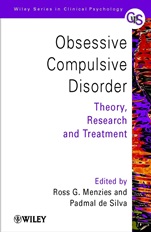
Obsessive–Compulsive Disorder: Theory, Research and Treatment
ISBN 9780471494454
Autor: Ross G. Menzies, Padmal de Silva
Wydawca: Wiley
Dostępność: 3-6 tygodni
Cena: 341,25 zł
Przed złożeniem zamówienia prosimy o kontakt mailowy celem potwierdzenia ceny.
ISBN13: |
9780471494454 |
ISBN10: |
0471494453 |
Autor: |
Ross G. Menzies, Padmal de Silva |
Oprawa: |
Paperback |
Rok Wydania: |
2003-02-07 |
Ilość stron: |
456 |
Wymiary: |
229x152 |
Tematy: |
JC |
Obsessive–Compulsive Disorder (OCD) is one of the most common of the emotional disorders. It involves habitual, repetitive behaviours that can be bizarre, disruptive and eventually disabling, which can destroy lives and relationships.
Ross Menzies and Padmal de Silva have brought together recognised international leaders in the field to provide an overview of current advances in knowledge, theory, assessment and treatment of OCD. Set out in five sections, the first explores the nature of OCD providing a solid foundation for the sections to follow. The second considers various conceptual and theoretical aspects of the disorder, including neuropsychological and cognitive models, individual differences and biological factors. The third section describes clinical presentations and subtypes, including washing and cleaning, checking, hoarding, slowness, atypical presentations, and the spectrum disorders. Assessment and treatment are dealt with extensively in the fourth section, providing a thorough review of all available treatments with known efficacy, including Exposure and Response Prevention (ERP), Danger Ideation Reduction Therapy (DIRT) and pharmacological interventions. Particular emphasis is given to treatment of complex and treatment–resistant cases. The final section concerns professional issues, such as training, resources and service provision.
This comprehensive but concise volume will provide practical guidance for trainees, as well as established practitioners in clinical psychology, psychiatry, and related disciplines such as mental health nursing, counselling and therapy.
Spis treści:
About the Editors.
List of Contributors.
Preface.
Acknowledgements.
Section I – The Nature of OCD.
Chapter 1 – The Classification and Diagnosis of OCD (A. Krochmalik and R. Menzies).
Chapter 2 – The Phenomenology of OCD (P. de Silva).
Section II – Theoretical Accounts of OCD.
Chapter 3
– Neuropsychological Models of OCD (I. Frampton).
Chapter 4 – Cognitive–behavioural Theory of OCD (P. Salkovskis and J. McGuire).
Chapter 5 – Repetitive and Iterative Thinking in Psychopathology: Anxiety–inducing Consequences and a Mood–As–Input Mechanism (G. Davey, et al.).
Chapter 6 – Personality and Individual Differences in OCD (A. Macdonald).
Section III – Clinical Presentations and Subtypes of OCD.
Chapter 7 – Obsessive–compulsive Washing (M. Jones and A. Krochmalik).
Chapter 8 – Compulsive Checking (S. Rachman).
Chapter 9 – Compulsive Hoarding (R. Frost and T. Hartl).
Chapter 10 – Primary Obsessional Slowness (S. Rachman).
Chapter 11 – Obsessions, Ruminations and Covert Compulsions (P. de Silva).
Ch apter 12 – Atypical Presentations (D. Einstein and R. Menzies).
Chapter 13 – The Obsessive–compulsive Spectrum and Body Dysmophic Disorder (D. Veale).
Section IV – Approaches to Assessment and Treatment in OCD.
Chapter 14 – Assessment Procedures (T. St. Clare).
Chapter 15 – Exposure and Response Prevention for OCD (M. Kyrios).
Chapter 16 – Cognitive Therapy for OCD (M. Marks).
Chapter 17 – Pharmacological and Neurosurgical Treatment of OCD (M. McDonough).
OCD in Children and Adolescents (R. Shafran).
Chapter 19 – The Management of Treatment–resistant Cases and other Difficult Clients (M. Bruch and A. Prioglio).
Section V – Professional Issues.
Chapter 20 – Training, Resources and Service Provision (L. Harris and R. Menzies).
References.
Author Index.
Subject Index.
Okładka tylna:
Obsessive–Compulsive Disorder (OCD) is one of the most common of the emotional disorders. It involves habitual, repetitive behaviours that can be bizarre, disruptive and eventually disabling, which can destroy lives and relat
ionships.
Ross Menzies and Padmal de Silva have brought together recognised international leaders in the field to provide an overview of current advances in knowledge, theory, assessment and treatment of OCD. Set out in five sections, the first explores the nature of OCD providing a solid foundation for the sections to follow. The second considers various conceptual and theoretical aspects of the disorder, including neuropsychological and cognitive models, individual differences and biological factors. The third section describes clinical presentations and subtypes, including washing and cleaning, checking, hoarding, slowness, atypical presentations, and the spectrum disorders. Assessment and treatment are dealt with extensively in the fourth section, providing a thorough review of all available treatments with known efficacy, including Exposure and Response Prevention (ERP), Danger Ideation Reduction Therapy (DIRT) and pharmacological interventions. Particular emphasis is given to treatment of complex and treatment–resistant cases. The final section concerns professional issues, such as training, resources and service provision.
This comprehensive but concise volume will provide practical guidance for trainees, as well as established practitioners in clinical psychology, psychiatry, and related disciplines such as mental health nursing, counselling and therapy.
Koszyk
Książek w koszyku: 0 szt.
Wartość zakupów: 0,00 zł
Informacje


Kontakt
Gambit
Centrum Oprogramowania
i Szkoleń Sp. z o.o.
Al. Pokoju 29b/22-24
31-564 Kraków
Siedziba Księgarni
ul. Kordylewskiego 1
31-542 Kraków
+48 12 410 5991
+48 12 410 5987
+48 12 410 5989
Subskrypcje
Administratorem danych osobowych jest firma Gambit COiS Sp. z o.o. Na podany adres będzie wysyłany wyłącznie biuletyn informacyjny.
Autoryzacja płatności

Informacje na temat autoryzacji płatności poprzez PayU.

© Copyright 2012: GAMBIT COiS Sp. z o.o. Wszelkie prawa zastrzeżone.
Projekt i wykonanie: Alchemia Studio Reklamy