


Wydawcy
Katalog tematyczny
- Archeologia (109)
- Ekonomia, finanse, business (13704)
- Filozofia (1445)
- Historia (3040)
- Języki i językoznawstwo (2356)
- Lifestyle, hobby i rozrywka (475)
- Medycyna (9704)
- Nauki humanistyczne (4)
- Nauki o Ziemi i środowisku (2638)
- Nauki ścisłe (20412)
- Astronomia (294)
- Biologia (5119)
- Chemia (6540)
- Chemia analityczna (361)
- Chemia fizyczna (346)
- Chemia nieorganiczna (137)
- Chemia organiczna (535)
- Krystalografia (27)
- Minerologia (46)
- Fizyka (3309)
- Matematyka (4574)
- Nauki ścisłe, ogólnie (503)
- Nauki społeczne (8486)
- Nauki techniczne (13450)
- Prawo (1696)
- Publikacje informacyjne i interdyscyplinarne (1288)
- Religia i wierzenia (917)
- Technika komputerowa (4067)
- Zdrowie, relacje międzyludzkie i rozwój osobisty (657)





Informacje szczegółowe o książce
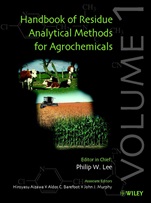
Handbook of Residue Analytical Methods for Agrochemicals
ISBN 9780471491941
Autor: Phillip W. Lee, Hiroyasu Aizawa, Aldos C. Barefoot, John J. Murphy
Wydawca: Wiley
Dostępność: 3-6 tygodni
Cena: 5 727,75 zł
Przed złożeniem zamówienia prosimy o kontakt mailowy celem potwierdzenia ceny.
ISBN13: |
9780471491941 |
ISBN10: |
0471491942 |
Autor: |
Phillip W. Lee, Hiroyasu Aizawa, Aldos C. Barefoot, John J. Murphy |
Oprawa: |
Hardback |
Rok Wydania: |
2003-02-21 |
Numer Wydania: |
2 Volume Set |
Ilość stron: |
1552 |
Wymiary: |
252x198 |
Tematy: |
PN |
This two–volume handbook uniquely brings together information on the key methodologies used in the analysis of agrochemical residues and current best practices, while also giving numerous examples of how these methodologies are applied in practice to a wide range of both individual compounds, and classes of agrochemical compounds.
Volume 1 describes some of the current regulatory considerations for residue analytical methods and discusses current methods for the generation and analysis of residues in crops, food and feed. Highly practical articles focus on the methods used for a range of individual herbicide compounds and classes of herbicide compounds.
Volume 2 presents some of the key recent advances in analytical technology in this field and discusses best practices for the generation and analysis of residues in environmental samples. Highly practical articles focus on the methods used for a range of individual fungicide and pesticide compounds, and classes of fungicide and pesticide compounds.
∗ Provides the latest information in one comprehensive source – saving time and money
∗ Written by leading practitioners in key industrial and government laboratories
An essential reference for residues chemists working with research and development agrochemical compounds and contract research laboratories.
Spis treści:
VOLUME 1.
Preface.
List of Contributors.
Introduction (J. Seiber).
REGULATORY GUIDANCE AND SCIENTIFIC CONSIDERATION FOR RESIDUE ANALYTICAL METHOD DEVELOPMENT AND VALIDATION.
Assessment of Residue Analytical Methods for Crops, Food, Feed, and Environmental Samples: The Approach of the European Union (J. Siebers & R. Hänel).
Regulatory Considerations for Residue Analysis and Methods on Crops and Food: The Approach of Japan (K. Ogura, et al.).
General Approaches for Residue Analytical Method Development and Validation (T. Class & R. Bacher).
Best P
ractices in Establishing Detection and Quantification Limits for Pesticide Residues in Foods (J. Corley).
The Process of Development and Validation of Animal Drug Residue Methods for US Food and Drug Administration Regulatory Use (P. Kijak & V. Reeves).
Validation of Analytical Methods for Post–Registration Control and Monitoring Purposes in the European Union (L. Alder).
BEST PRACTICES IN THE GENERATION AND ANALYSIS OF RESIDUES IN CROP, FOOD AND FEED.
Conducting Crop Residue Field Tri als in the USA (W. John).
Conducting Crop Residue Field Trials in Europe (J. Old).
Conducting Crop Residue Field Trials in Mexico and Latin America (L. Russo).
Food Processing of Raw Agricultural Commodities for Residue Analysis (W. Englar, et al.).
Best Practices in the Implementation of a Large–Scale Market Basket Residue Survey Study (D. Brookman, et al.).
Procedures and Best Practices for Conducting Residue Studies of Animal Health Drugs in Food Animals (D. Smith, et al.).
Sampling and Analyses of Foodstuffs from Animal Origin (R. Readnour, et al.).
COMPOUND CLASS.
Anilides (H. Kobayashi).
Chloroacetanilide Herbicides (A. Hackett, et al.).
Dinitroaniline Herbicides (M. Ueji).
Sulfonylurea Herbicides (C. Powley).
Triazine Herbicide Methodology (R. Yokley).
Diphenyl Ethers (M. Ueji).
INDIVIDUAL COMPOUNDS.
Bispyribac–sodium (Y. Saito, et al.).
Carfentrazone–ethyl (A. Chen).
Flucarbazone–sodium (T. Gould & C. Lam).
Flumetralin (R. Yokley).
Flumioxazin (T. Schreier).
Isoxaflutole (R. Seymour, et al.).
Orbencarb (M. Ikeda, et al.).
Prodiamine (R. Yokley).
Prohexadione–calcium (A. Yagi, et al.).
Pyraflufen–ethyl (Y. Ikemoto).
Pyriminobac–methyl (A. Yagi, et al.).
Pyrithiobac–sodium (Y. Saito, et al.).
Sulfentrazone (A. Chen).
Terbacil (
J. Rose).
Thenylchlor (H. Kobayashi).
Trinexapac–ethyl (Y. Lin).
Abbreviations and Acronyms.
Index.
VOLUME 2.
Preface.
List of Contributors.
RECENT ADVANCES IN ANALYTICAL TECHNOLOGY, IMMUNOASSAY AND OTHER NONCHROMATOGRAPHIC METHODS.
Regulatory Considerations for Environmental Analytical Methods for Environmental Fate and Water Quality Impact Assessments of Agrochemicals (M. Barrett & E. Behl).
Immunoassay, Biosensors and Other Nonchromatographic Methods (G. Shan, et al.).
Immunologically Based Assays for Pesticide/Veterinary Medicine Residues in Animal Products (W. Shelver & D. Smith).
Validated Immunoassay Methods (J. Brady).
Advances in Methods for Pesticide Residues in Food (M. Wilson, et al.).
Overview of Analytical Technologies Available to Regulatory Laboratories for the Determination of Pesticide Residues (A. Krynitsky & S. Lehotay).
BEST PRACTICES IN THE GENERATION AND ANALYSES OF RESIDUES IN ENVIRONMENTAL SAMPLES.
Best Practices in the Analysis of Residues in Environmental Samples: Groundwater and Soil–water Monitoring Procedures (L. Carver & J. Chepega).
Preparation and Instrumental Analysis of Agrochemical Residues in Water Samples (W. Leimkuehler).
Sampling and Analysis of Soil (J. Massey, et al.).
Sampling Sediment and Water in Rice Paddy Fields and Adjacent Water Bodies (H. Yamamoto & K. Nakamura).
Monitoring of Agrochemical Residues in Air (J. Woodrow, et al.).
Biological Sampling: Determining Routes of Wildlife Exposure to Pesticides (G. Cobb & T. Anderson).
Best Practices in Conducting Dislodgeable Foliar Residue Studies (J. McClory & D. Merricks).
Best Practices to Conduct Spray Drift Studies (A. Hewitt & D. Valcore).
Field Methods for Performing Farm Worker Exposure and Re–entry Studies (R. Honeycutt).
Electronic Record Keeping in a Regulated Environment (W.
Garner & C. Mentzer).
COMPOUND CLASS.
Alkylenebis(dithiocarbamates) (M. Cicotti).
Multi–residue Methods (S19) to Measure Azole Fungicides in Crop Samples (G. Kempe).
Neonicotinoids (H. Kobayashi).
Oxime Carbamates (M. Cabusas).
INDIVIDUAL COMPOUNDS.
Azoxystrobin (N. Robinson).
Famoxadone (K. Jernberg).
Fluthiacet–methyl (M. Ikeda, et al.).
Flutolanil (Y. Ikemoto).
Hymexazol (S. Sadakane, et al.).
Imibenconazole (F. Ishijima).
Mepanipyrim (M. Ikeda, et al.).
Mepronil (Y. Saito, et al.).
Tebuconazole (G. Mattern, et al.).
Acetamiprid (S. Sugimoto).
Alanycarb (K. Yagi & N. Umetsu).
Azinphos–methyl (S. Moore).
Benfuracarb (K. Yagi & N. Umetsu).
Buprofezin (Y. Ikemoto).
Cyfluthrin (C. Lam & S. Moore).
Fenothiocarb (A. Yagi, et al.).
Fenoxycarb (R. Yokley).
Fenpyroximate (Y. Ikemoto).
Hexythiazox (S. Sugimoto).
Imidacloprid (W. Leimkuehler & K. Billesbach).
Isoxathion (S. Sadakane, et al.).
Milbemectin (S. Sadakane, et al.).
Pyrimidifen (S. Sadakane, et al.).
Pyriproxyfen (C. Green).
Abbreviations and Acronyms.
Index.
Okładka tylna:
This two–volume handbook uniquely brings together information on the key methodologies used in the analysis of agrochemical residues and current best practices, while also giving numerous examples of how these methodologies are applied in practice to a wide range of both individual compounds, and classes of agrochemical compounds.
Volume 1 describes some of the current regulatory considerations for residue analytical methods and discusses current methods for the generation and analysis of residues in crops, food and feed. Highly practical articles focus on the methods used for a range of individual herbicide compounds and classes of herbicide compounds.
Volume 2 presents some of the key recent ad
Koszyk
Książek w koszyku: 0 szt.
Wartość zakupów: 0,00 zł
Informacje


Kontakt
Gambit
Centrum Oprogramowania
i Szkoleń Sp. z o.o.
Al. Pokoju 29b/22-24
31-564 Kraków
Siedziba Księgarni
ul. Kordylewskiego 1
31-542 Kraków
+48 12 410 5991
+48 12 410 5987
+48 12 410 5989
Subskrypcje
Administratorem danych osobowych jest firma Gambit COiS Sp. z o.o. Na podany adres będzie wysyłany wyłącznie biuletyn informacyjny.
Autoryzacja płatności

Informacje na temat autoryzacji płatności poprzez PayU.

© Copyright 2012: GAMBIT COiS Sp. z o.o. Wszelkie prawa zastrzeżone.
Projekt i wykonanie: Alchemia Studio Reklamy