


Wydawcy
Katalog tematyczny
- Archeologia (109)
- Ekonomia, finanse, business (13704)
- Filozofia (1445)
- Historia (3040)
- Języki i językoznawstwo (2356)
- Lifestyle, hobby i rozrywka (475)
- Medycyna (9704)
- Nauki humanistyczne (4)
- Nauki o Ziemi i środowisku (2638)
- Nauki ścisłe (20412)
- Nauki społeczne (8486)
- Nauki techniczne (13450)
- Prawo (1696)
- Publikacje informacyjne i interdyscyplinarne (1288)
- Religia i wierzenia (917)
- Technika komputerowa (4067)
- Zdrowie, relacje międzyludzkie i rozwój osobisty (657)








Informacje szczegółowe o książce
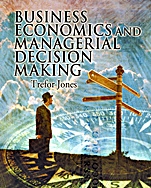
Business Economics and Managerial Decision Making
ISBN 9780471486749
Autor: Trefor Jones
Wydawca: Wiley
Dostępność: 3-6 tygodni
Cena: 360,15 zł
Przed złożeniem zamówienia prosimy o kontakt mailowy celem potwierdzenia ceny.
ISBN13: |
9780471486749 |
ISBN10: |
0471486744 |
Autor: |
Trefor Jones |
Oprawa: |
Paperback |
Rok Wydania: |
2004-04-26 |
Ilość stron: |
594 |
Wymiary: |
252x185 |
Tematy: |
KC |
Business Economics and Managerial Decision Making is an essential introduction to business economics. A core textbook for students with a grounding in introductory microeconomics, it examines the nature and structure of the firm, and explores the economic principles underlying major business decisions. This accessible text avoids overly mathematical analysis, using diagrams, graphs and tables to explain economic theory.
Trefor Jones draws upon current research and real–world examples from around the globe to illustrate the practical implications of economic theory for the business of the firm. In addition, a major chapter–length case study of a single enterprise (Stagecoach plc) provides an integrative real–world analysis of the core concepts and major theories developed throughout the book.
Extending the approach traditionally taken by business economics texts, Trefor Jones introduces material on the boundaries of the firm, including its growth and development, diversification and mergers.
Business Economics and Managerial Decision Making:discusses managers′ responsibilities to owners and/or stakeholdersanalyses the decision making of the firm in relation to the marketexamines why firms exist and how they determine their boundariesexplores the economics of growth, diversification and vertical integration of the firminvestigates decision making by private firms in government regulated industriesaddresses the reasons for the existence of public sector organisations and the differences in objectives and decision making.
Supplementary resources for lecturers and students can be found at www.wileyeurope.com/go/treforjones.
Spis treści:
Preface.
Acknowledgements.
I. Corporate Governance and Business Objectives.
1. Ownership control and corporate governance.
Introduction.
Ownership structures.
Patterns of shareholdi
ng.
Classifying firms as owner or management–controlled.
Case Study 1.1 Manchester United – owner or managerially controlled?
Systems of corporate control.
Constraints on managerial discretion.
Improving corporate governance in the UK.
Case Study 1.2 Ownership and governance structures in UK retailing.
Case Study 1.3 Corporate governance in English football.
Chapter summary.
Review questions.
2. Business objectives and theories of the firm.
Introduction.
Profit maximization.
Sales revenue maximization.
Williamson’s Managerial Utility Model.
Behavioural models.
Comparison of behavioural and traditional theories.
Corporate social responsibility.
Owners, managers and performance.
Case Study 2.1 Objectives in company annual reports.
Chapter summary.
Review questions.
3. Risk and uncertainty.
Introduction.
Risk versus uncertainty.
Sources of uncertainty.
Incorporating time and uncertainty into decision making.
Decision trees.
Attitudes to risk and uncertainty.
Case Study 3.1 UK Lottery and risk–loving behaviour.
Indifference curve analysis of risk and return.
Decision making and attitudes to risk.
Limiting the impact of uncertainty.
Case Study 3.2 Uncertainty and business decisions: buses and pharmaceuticals.
Chapter summary.
Review questions.
II Knowing the Market.
4. Consumer behaviour.
Introduction.
Indifference curve analysis.
Characteristics approach to consumer behaviour.
Case Study 4.1 The characteristics approach and the provision of airline services.
Hedonic prices.
Case Study 4.2 Estimating and using hedonic prices: cars and wine.
Behavioural approach to consumer behaviour.
Chapter summary.
Review questions.
5. Demand analysis.
Introduction.
The demand function.
The demand curve.
Market demand.
Demand and revenue.
Elasticity and revenue.
Own p
rice elasticity.
Own price elasticity and marginal revenue.
Case Study 5.1 Own price elasticity and rail travel pricing.
Factors affecting the own price elasticity of demand.
Income elasticity.
Advertising elasticity of demand.
Cross elasticity of demand.
Case Study 5.2 Estimating elasticities for petrol.
Demand elasticities and business.
Chapter summary.
Review questions.
6. Estimation of demand functions.
Introduction.
Estimating demand functions.
Interviews and survey methods.
Questionnaires.
Consumer experiments.
Market studies.
Statistical analysis.
Pitfalls using regression analysis.
The economic verification of regression models.
Statistical verification of regression models.
Econometric verification of the regression estimates.
Case Study 6.1 The demand for beer, wine and spirits.
Chapter summary.
Review questions.
III. Understanding Production and Costs.
7. Production and efficiency.
Introduction.
Production functions.
Isoquant analysis.
Optimal choice of factors.
Technical progress and the shape of isoquants.
Laws of production.
Total, average and marginal product curves.
Empirical production functions.
Case Study 7.1 Production function for a retail chain.
Measuring productivity.
Relative measures of e⁄ciency.
Case Study 7.2 Measuring relative efficiency.
Productivity differences.
Case Study 7.3 Explaining productivity differences in the biscuit industry.
Country differences in productivity.
Chapter summary.
Review questions.
8. Costs.
Introduction.
Short–run cost curves.
Long–run cost curves.
Costs and the multi–product firm.
Economics versus accounting cost concepts.
Empirical cost analysis.
Case Study 8.1 Estimating cost functions for hospitals.
Cost concepts and strategic advantage.
Case Study 8.2 Economies of scope in car production.
Ca
se Study 8.3 Economies of scale in building societies and insurance companies.
Management of costs.
Chapter summary.
Appendix: statistical cost functions.
Review questions.
IV. Pricing, Promotional and Investment Policies.
9. Pricing and market structure: theoretical considerations.
Introduction.
Perfect competition.
Monopolistic competition.
Oligopoly.
Kinked demand curve model.
Bertrand oligopoly.
Cournotoligopoly.
Collusion and cheating.
Gametheory.
Non–zero sum game.
Price stickiness.
Collusive oligopoly.
Cartels.
Case Study 9.1 The vitamin cartel and the EU.
Tacit collusion.
Case Study 9.2 Price leadership in the salt industry.
Case Study 9.3 UK digital television.
Chapter summary.
Review questions.
10. Pricing in practice.
Introduction.
The nature of price.
Dominant–firm pricing and consumer surplus.
Price discrimination.
Case Study 10.1 Licence auction: third–generation mobile phones.
Two–part tariffs.
Peak load pricing.
Case Study 10.2 BT’s pricing structure.
Pricing in imperfect markets.
Studies of pricing.
Analytics of average cost pricing.
Other considerations in setting price.
Chapter summary.
Review questions.
11. Advertising.
Introduction.
Roles of advertising.
Advertising and changing consumer preferences.
Advertising: price and demand.
Advertising and costs.
Sales and advertising.
Optimal level of advertising.
Which products do firms advertise?
Advertising and market structure.
Advertising as investment.
Branding.
Case Study 11.1 Tobacco advertising.
Chapter summary.
Review questions.
12. Investment appraisal.
Introduction.
Basic steps in investment appraisal.
Estimating cash flows.
Time and the value of money.
Discounting and present value.
Ranking of projects and the capital–spending plan.
No
Koszyk
Książek w koszyku: 0 szt.
Wartość zakupów: 0,00 zł
Informacje


Kontakt
Gambit
Centrum Oprogramowania
i Szkoleń Sp. z o.o.
Al. Pokoju 29b/22-24
31-564 Kraków
Siedziba Księgarni
ul. Kordylewskiego 1
31-542 Kraków
+48 12 410 5991
+48 12 410 5987
+48 12 410 5989
Subskrypcje
Administratorem danych osobowych jest firma Gambit COiS Sp. z o.o. Na podany adres będzie wysyłany wyłącznie biuletyn informacyjny.
Autoryzacja płatności

Informacje na temat autoryzacji płatności poprzez PayU.

© Copyright 2012: GAMBIT COiS Sp. z o.o. Wszelkie prawa zastrzeżone.
Projekt i wykonanie: Alchemia Studio Reklamy