


Wydawcy
Katalog tematyczny
- Archeologia (109)
- Ekonomia, finanse, business (13704)
- Filozofia (1445)
- Historia (3040)
- Języki i językoznawstwo (2356)
- Lifestyle, hobby i rozrywka (475)
- Medycyna (9704)
- Nauki humanistyczne (4)
- Nauki o Ziemi i środowisku (2638)
- Nauki ścisłe (20412)
- Nauki społeczne (8486)
- Nauki techniczne (13450)
- Prawo (1696)
- Publikacje informacyjne i interdyscyplinarne (1288)
- Religia i wierzenia (917)
- Technika komputerowa (4067)
- Zdrowie, relacje międzyludzkie i rozwój osobisty (657)





Informacje szczegółowe o książce
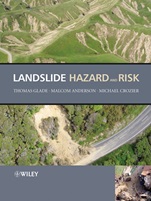
Landslide Hazard and Risk
ISBN 9780471486633
Autor: Thomas Glade, Malcolm G. Anderson, Michael J. Crozier
Wydawca: Wiley
Dostępność: 3-6 tygodni
Cena: 1 241,10 zł
Przed złożeniem zamówienia prosimy o kontakt mailowy celem potwierdzenia ceny.
ISBN13: |
9780471486633 |
ISBN10: |
0471486639 |
Autor: |
Thomas Glade, Malcolm G. Anderson, Michael J. Crozier |
Oprawa: |
Hardback |
Rok Wydania: |
2005-02-25 |
Ilość stron: |
824 |
Wymiary: |
251x181 |
Tematy: |
AT |
Impacts of landslides range from site destruction, through problems for the maintenance of buildings and infrastructure, to an impediment for economic development. Previous attempts to address landslide risk have either treated components of the problem in isolation or characterised the wider issue from just a single discipline perspective. This book takes a holistic view of landslide hazard and risk through the development of integrated approaches to analysis, perception and management.
Landslide Hazard and Risk brings together a wide range of experience, covering the social, economic and cultural context, management options, and the application of science and technology, for the reduction of risk from landslides. This book is divided into four major parts covering conceptual models in approaching landslide risk, evaluation of risk, management of risk and end–to–end solutions of risk. It examines risk assessment and management from theory to practice, from conventional methodology to future possibilities.Provides a range of multidisciplinary approaches and guidance on their appropriate use.Presents specifications and contexts for the next generation of process models.Focuses on the means and methods of investigation, and the treatment of data to represent the probabilities and uncertainties of hazard and risk.Evaluates state–of–the–art techniques and future directions.This book is essential reading for professionals and practitioners in landscape, watershed and hazard management, as well as risk analysts, geomorphologists, hydrologists, foresters and environmental consultants. Would be excellent background reading for researchers and graduate students interested in landslides, hazards, risk assessment and slope stability in Departments of Geography, Earth Science, Environmental Science, Civil Engineering and Planning.
Spis treści:
List of Contributors.
Preface.
1. Landslid
e Hazard and Risk: Issues, Concepts, and Approach (M. J. Crozier and T. Glade).
Part I: Conceptual Models in Approaching Landslide Risk.
2. The nature of landslide hazard impact (T. Glade & M. Crozier).
3. A review of scale dependency in landslide hazard and risk (T. Glade & M. Crozier).
4. Systematic procedures of landslide–hazard mapping for risk assessment using spatial prediction models (Chang–Jo F. Chung & Andrea G. Fabbri).
5.Vulnerability to landslides (David Alexander).
Part II: Evaluation of Risk.
6. Landslide risk perception, knowledge, and associated risk management: Case studies and general lessons from Glacier National Park, Montana, USA (David R. Butler & Lisa M. DeChano).
7. Cultural consideration in landslide risk perception (Garth Harmsworth & Bill Raynor).
8 Reply of insurance industry to landslide risk (Hans–Leo Paus).
9. The role of administrative bodies in landslide risk assessment (Kurt Hollenstein).
10. Addressing landslide hazards: Towards a knowledge management perspective (S. Michaels).
Part III: Management of Landslide Risk.
11. Management frameworks for landslide hazard and risk: issues and options (M. J. Crozier).
12. Reducing landslide hazards and risk in the United States: The role of the U. S. Geological Survey (G. F. Wieczorek, P. L. Gori & L. M. Highland).
13. Basic data and decision support for landslide management: A conceptual framework (Walter Pfluegner).
14. Instability management from policy to practice (R. McInnes).
15. Geomorphologic mapping to assess landslide risk: concepts, methods and applications in the Umbria Region of central Italy (Paola Reichenbach, Mirco Galli, Mauro Cardinali, Fausto Guzzetti & Francesca Ardizzone).
16. Remote sensing of landslides (Vern Singhr
oy).
17. The rise and fall of a debris–flow warning system for the San Francisco Bay Region, California (Raymond C. Wilson).
18. Reforestation schemes to manage regional landslide risk (Chris Phillips & Michael Marden).
19. Geotechnical structures for landslide risk reduction (Edward Nicholas Bromhead).
Part IV: ‘End–to–End Solutions’ for Landslide Risk Assessment.
20. Towards the development of a landslide risk assessment for rural roads in Nepal (D. Petley, G. J. Hearn & A. Hart).
21. Quantitative landslide risk assessment of Cairns, Australia (Marion Michael–Leiba, Fred Baynes, Greg Scott & Ken Granger).
22. The story of quantified risk and its place in slope safety policy in Hong Kong (A. W. Malone).
23. Rockfall risk management in high density urban areas. The Andorran experience (Ramon Copons, Joan Manuel Vilaplana, Jordi Corominas, Joan Altimir & Jordi Amigó).
24. Landslide risk assessment in Italy (Marino Sorriso–Valvo).
25. An initial approach to identifying slope stability controls in southern Java and to providing community–based landslide warning information (D. Karnawati, I. Ibriam, M. G. Anderson, E. A. Holcombe, G. T. Mummery, J–P. Renaud & Y. Wang).
Part V: Synopsis.
26. Landslide hazard and risk – concluding comment and perspectives (T. Glade & M. Crozier).
Glossary.
Thematic Index.
Locations/regions.
Okładka tylna:
Impacts of landslides range from site destruction, through problems for the maintenance of buildings and infrastructure, to an impediment for economic development. Previous attempts to address landslide risk have either treated components of the problem in isolation or characterised the wider issue from just a single discipline perspective. This book takes a holistic view o
f landslide hazard and risk through the development of integrated approaches to analysis, perception and management.
Landslide Hazard and Risk brings together a wide range of experience, covering the social, economic and cultural context, management options, and the application of science and technology, for the reduction of risk from landslides. This book is divided into four major parts covering conceptual models in approaching landslide risk, evaluation of risk, management of risk and end–to–end solutions of risk. It examines risk assessment and management from theory to practice, from conventional methodology to future possibilities.Provides a range of multidisciplinary approaches and guidance on their appropriate use.Presents specifications and contexts for the next generation of process models.Focuses on the means and methods of investigation, and the treatment of data to represent the probabilities and uncertainties of hazard and risk.Evaluates state–of–the–art techniques and future directions.This book is essential reading for professionals and practitioners in landscape, watershed and hazard management, as well as risk analysts, geomorphologists, hydrologists, foresters and environmental consultants. Would be excellent background reading for researchers and graduate students interested in landslides, hazards, risk assessment and slope stability in Departments of Geography, Earth Science, Environmental Science, Civil Engineering and Planning.
Koszyk
Książek w koszyku: 0 szt.
Wartość zakupów: 0,00 zł
Informacje


Kontakt
Gambit
Centrum Oprogramowania
i Szkoleń Sp. z o.o.
Al. Pokoju 29b/22-24
31-564 Kraków
Siedziba Księgarni
ul. Kordylewskiego 1
31-542 Kraków
+48 12 410 5991
+48 12 410 5987
+48 12 410 5989
Subskrypcje
Administratorem danych osobowych jest firma Gambit COiS Sp. z o.o. Na podany adres będzie wysyłany wyłącznie biuletyn informacyjny.
Autoryzacja płatności

Informacje na temat autoryzacji płatności poprzez PayU.

© Copyright 2012: GAMBIT COiS Sp. z o.o. Wszelkie prawa zastrzeżone.
Projekt i wykonanie: Alchemia Studio Reklamy