


Wydawcy
Katalog tematyczny
- Archeologia (109)
- Ekonomia, finanse, business (13704)
- Filozofia (1445)
- Historia (3040)
- Języki i językoznawstwo (2356)
- Lifestyle, hobby i rozrywka (475)
- Medycyna (9704)
- Nauki humanistyczne (4)
- Nauki o Ziemi i środowisku (2638)
- Nauki ścisłe (20412)
- Nauki społeczne (8486)
- Nauki techniczne (13450)
- Prawo (1696)
- Publikacje informacyjne i interdyscyplinarne (1288)
- Religia i wierzenia (917)
- Technika komputerowa (4067)
- Zdrowie, relacje międzyludzkie i rozwój osobisty (657)





Informacje szczegółowe o książce
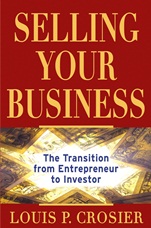
Selling Your Business: The Transition from Entrepreneur to Investor
ISBN 9780471486237
Autor: Louis P. Crosier
Wydawca: Wiley
Dostępność: 3-6 tygodni
Cena: 241,50 zł
Przed złożeniem zamówienia prosimy o kontakt mailowy celem potwierdzenia ceny.
ISBN13: |
9780471486237 |
ISBN10: |
047148623X |
Autor: |
Louis P. Crosier |
Oprawa: |
Hardback |
Rok Wydania: |
2004-05-24 |
Ilość stron: |
352 |
Wymiary: |
257x162 |
Tematy: |
KJ |
Praise for Selling Your Business
"After selling the business, an entrepreneur suddenly becomes the newly appointed CEO of ‘My Wealth Inc.’ To avoid being a sitting duck for the skilled sales pitch, this book should prove invaluable. The experts assembled by Louis Crosier address all the key challenges, and importantly, avoid pat answers–instead they provide the entrepreneur with the right questions to ask."
––Charlotte B. Beyer, Founder and CEO
The Institute for Private Investors
"An outstanding personal–wealth–management handbook for entrepreneurs. I will give it to founders and early employees of my portfolio companies."
––A. Dana Callow Jr., Managing General Partner
Boston Millennia Partners
"Successful entrepreneurship does not imply expertise in personal financial planning. Twenty–five years of experience as a planner has convinced me that even the best and brightest will be well served by an education in personal planning. Selling Your Business delivers a terrific educational guide for anyone transitioning from entrepreneur to investor. In business terms, Selling Your Business’s return on investment is first–class."
––Harold R. Evensky, Chairman
Evensky, Brown & Katz
"This is a terrific, no–holds–barred manual on how to sell your business and manage financial success. Many have written about how to put money into a company. Selling Your Business describes the nuts and bolts of something more important–how to get your money back out and what to do once you’ve gotten it."
––David Roux, Managing Director
Silver Lake Partners
"This book should be required reading for entrepreneurs and family business owners. As Louis Crosier points out so well, preparing for wealth is a complex process and should begin early. If you are a senior level manager or a founder of a venture–backed company, yo
u will benefit from the collective wisdom of this book. It is an excellent resource–one you will refer to time and again."
––Alan Spoon, Managing General Partner
Polaris Venture Partners
Spis treści:
Foreword (Edward I. Rudman, Co–Founder and Chairman, Pell Rudman, now Atlantic Trust Pell Rudman).
Introduction (Louis P. Crosier).
Part I: Before Selling Your Business.
Chapter 1: Pre–IPO/Presale Planning (William R. Fleming, Director; and Daniel Carbonneau, Senior Manager; with Richard L. Kohan, Partner, PricewaterhouseCoopers).
Setting the Stage.
Choosing a Business Structure.
Building a Professional Service Team.
Obtaining Financing.
Sharing Ownership with Employees.
Company Benefits and Policies.
Conclusion.
Chapter 2: Trust and Estate Basics (A. Silvana Giner, Senior Partner; and Kimberly Cohen, Junior Partner, Hale & Dorr).
Basic Wealth Transfer Tools.
Presale and Pre–IPO Planning.
Complex Wealth Transfer and Estate Planning Issues.
Summary.
Chapter 3: Life Insurance: From the Basics to the Advanced (Herbert K. Daroff, J.D., CFP®, Baystate Financial Services).
Permanent Insurance.
Term Insurance.
What Product Is Best?
Buying Term and Investing the Difference, but in a Tax–Advantaged Manner.
How Your Money Gets Invested.
Expenses.
Assessing Cash Value During Lifetime.
Selecting the Right Premium Amount.
Selecting the Right Premium Payer.
Who Should Own the Insurance?
Who Should Be Insured?
Conclusion.
Chapter 4: Negotiating the Deal (F. George Davitt, Partner, Testa, Hurwitz & Thibeault; and Barry Nalebuff, Ph.D., Milton Steinbach Professor of Management, Yale University School of Management).
Sell Your Company Right.
An Open Selling Process.
A Closed Selling Process.
Paying Bidders to Play.
Right of Firs
t Refusal.
Right of First Offer.
An Offer You Can’t Refuse.
Professional Help.
Earn–Outs.
Earn–Ins.
Commonly Mistaken Assumptions.
Sale or IPO?
The IPO Route.
Selling Rather Than Going Public.
Sale for Cash or Stock.
Conclusion.
Part II: After Selling Your Business.
Chapter 5: How Your Life Changes: Psychology of a Windfall (Marty Carter, Family Wealth Counselor, Charles D. Haines LLC; and Charles W. Collier, Senior Philanthropic Advisor, Harvard University).
Impact of the Sale on the Entrepreneur.
Impact of Wealth on the Entire Family.
Conclusion.
Chapter 6: Overview of the Wealth Management Industry (David M. Spungen, Managing Partner, Hillview Capital Advisors).
Investment Office.
One–Stop Shop.
Hybrid.
How to Evaluate Wealth Management Firms.
Chapter 7: Managing Concentrated and Restricted Stock Positions (David N. Elan, CFA).
Restricted Stock and Equity Risk Management.
Definitions and Examples.
Public Policy and Rule 144 of the Securities Act of 1933.
Registration Rights.
Hedging and Taxation.
Derivative Strategies.
Nonderivative Strategies.
Negotiating with Broker–Dealers and Finding the Best Counterparty.
Philanthropic Strategies.
Professional Advice.
Chapter 8: Asset Allocation (Stephen J. Cucchiaro, President and Chief Investment Officer, Windward Investment Management).
Conclusion.
Chapter 9: Developing an Investment Policy Statement (Ramelle M. Hieronymus, Principal, Prime, Buchholz & Associates).
Investment Objectives.
Spending Guidelines.
Asset Allocation.
Rebalancing.
Manager Selection and Evaluation.
Limitations and Restrictions.
Communication and Reporting.
Summary.
Sample Statement of Investment Objectives, Goals, and Policy Guidelines.
Part III: Investing for the Long Term.
Chapter 10: Selecting Investment Managers (Paul Greenwood, Director of US Equity Investment Management & Research, Russell Investment Group).
Active or Passive?
Four Ps.
People and Organization.
Portfolios.
Performance 163
Summary 164
Chapter 11: Risk: How Much Should You Take? (Paula Boyer Kennedy, CPA, CFP®).
Risks of Specific Asset Classes.
Market Timing.
Measuring Risk.
Risk–Adjusted Returns.
Tax Risk.
How Do You Minimize Risk?
How Do You Maximize Return While Minimizing Risk?
Time and Risk.
The Psychology of Risk.
How Much Risk Should You Take?
Chapter 12: Fixed Income (Peter B. Coffin, President, Breckinridge Capital Advisors).
Municipal Market Inefficiencies.
Portfolio Construction.
Duration—A Portfolio’s Sensitivity to Changes in Interest Rates.
Ladders versus Barbells.
Credit Quality and Default Risk.
Ratings and Bond Insurance.
Pre–Refunded/Escrowed Municipal Bonds.
High–Yield Municipal Bonds.
Premium versus Discount Bonds.
Call (Early Redemption).
Conclusion.
Chapter 13: Global Investing (Lindsey A. Richardson, Principal, State Street Global Advisors).
Theoretical Benefits of Non–U.S. Investing.
Forces of Globalization.
American Depository Receipts versus Local Stocks.
Diversification and Returns.
Opportunity Set.
Global Mandates.
Currency.
Selecting Managers.
Conclusion.
Chapter 14: Real Estate (Nicholas Bienstock, Managing Partner, Savanna Partners; with Laura Corwin Burkhart, Founder, Slate Capital).
Why Invest in Real Estate?
Real Estate Asset Classes.
Real Estate Investment Options.
Conclusion.
Chapter 15: Private Equity (Sallie Shuping Russell, General Partner, Intersouth Partners).
Types of Private Equity Investments.
Who Will Invest My Money?
Common Terms and Conditions.
Por
Koszyk
Książek w koszyku: 0 szt.
Wartość zakupów: 0,00 zł
Informacje


Kontakt
Gambit
Centrum Oprogramowania
i Szkoleń Sp. z o.o.
Al. Pokoju 29b/22-24
31-564 Kraków
Siedziba Księgarni
ul. Kordylewskiego 1
31-542 Kraków
+48 12 410 5991
+48 12 410 5987
+48 12 410 5989
Subskrypcje
Administratorem danych osobowych jest firma Gambit COiS Sp. z o.o. Na podany adres będzie wysyłany wyłącznie biuletyn informacyjny.
Autoryzacja płatności

Informacje na temat autoryzacji płatności poprzez PayU.

© Copyright 2012: GAMBIT COiS Sp. z o.o. Wszelkie prawa zastrzeżone.
Projekt i wykonanie: Alchemia Studio Reklamy