


Wydawcy
Katalog tematyczny
- Archeologia (109)
- Ekonomia, finanse, business (13704)
- Filozofia (1445)
- Historia (3040)
- Języki i językoznawstwo (2356)
- Lifestyle, hobby i rozrywka (475)
- Medycyna (9704)
- Nauki humanistyczne (4)
- Nauki o Ziemi i środowisku (2638)
- Nauki ścisłe (20412)
- Nauki społeczne (8486)
- Nauki techniczne (13450)
- Budownictwo lądowe (1045)
- Chemia przemysłowa (2258)
- Elektronika i telekomunikacja (3287)
- Energetyka (1122)
- Inne nauki stosowane (363)
- Inżynieria biochemiczna (507)
- Inżynieria transportu (232)
- Mechanika i materiały (3316)
- Nauka o środowisku (321)
- Rolnictwo (507)
- Technika, ogólnie (475)
- Prawo (1696)
- Publikacje informacyjne i interdyscyplinarne (1288)
- Religia i wierzenia (917)
- Technika komputerowa (4067)
- Zdrowie, relacje międzyludzkie i rozwój osobisty (657)





Informacje szczegółowe o książce
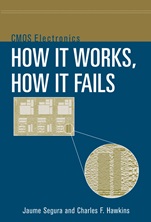
CMOS Electronics: How It Works, How It Fails
ISBN 9780471476696
Autor: Jaume Segura, Charles F. Hawkins
Wydawca: Wiley
Dostępność: 3-6 tygodni
Cena: 730,80 zł
Przed złożeniem zamówienia prosimy o kontakt mailowy celem potwierdzenia ceny.
ISBN13: |
9780471476696 |
ISBN10: |
0471476692 |
Autor: |
Jaume Segura, Charles F. Hawkins |
Oprawa: |
Hardback |
Rok Wydania: |
2004-04-20 |
Ilość stron: |
368 |
Wymiary: |
261x187 |
Tematy: |
TJ |
Get a better understanding of how CMOS circuits work and, more importantly, how they fail!
CMOS manufacturing environments are rife with symptoms that can indicate serious test, design, or reliability problems. CMOS Electronics: How It Works, How It Fails provides both practitioners and students in the industry with the electronic knowledge that relates not just to the design of a product, but other important aspects of manufacturing such as testing, reliability, failure analysis, yield–quality issues, and common problems that may occur during production.
The majority of those who work in the CMOS integrated circuit (IC) industry have educational backgrounds other than electrical engineering. The first part of the book assumes little knowledge of circuitry and transistors, covering the relevant basic electronics of CMOS ICs at a tutorial level or as a quick review for electrical engineers. The second half offers thorough descriptions of failure mechanisms that both audiences can appreciate.
A valuable addition to the CMOS literature, CMOS Electronics addresses such common questions as:Is the symptom an outcome of random defects, or is it symptomatic with a common failure signature?Why doesn’t my test program detect certain defects?Are my test escapes a reliability problem?Is the defect a bridging problem, an open circuit problem, or a subtle speed–related problem?
Providing rapid guidance to the nature of these problems and offering unique descriptions of many circuit failure mechanisms found previously only in research papers, CMOS Electronics is an essential text for practitioners in the CMOS industry, or students headed there.
Spis treści:
Foreword.
Preface.
PART I: CMOS FUNDAMENTALS.
1 Electrical Circuit Analysis.
1.1 Introduction.
1.2 Voltage and Current Laws.
1.3 Capacitors.
1.4 Diodes.
1.5 Summary.
Bibliography.
E
xercises.
2 Semiconductor Physics.
2.1 Semiconductor Fundamentals.
2.2 Intrinsic and Extrinsic Semiconductors.
2.3 Carrier Transport in Semiconductors.
2.4 The pn Junction.
2.5 Biasing the pn Junction: I–V Characteristics.
2.6 Parasitics in the Diode.
2.7 Summary.
Bibliography.
Exercises.
3 MOSFET Transistors.
3.1 Principles of Operation: Long–Channel Transistors.
3.2 Threshold Voltage in MOS Transistors.
3.3 Parasitic Capacitors in MOS Transistors.
3.4 Device Scaling: Short–Channel MOS Transistors.
3.5 Summary.
References.
Exercises.
4 CMOS Basic Gates.
4.1 Introduction.
4.2 The CMOS Inverter.
4.3 NAND Gates.
4.4 NOR Gates.
4.5 CMOS Transmission Gates.
4.6 Summary.
Bibliography.
Exercises.
5 CMOS Basic Circuits.
5.1 Combinational logic.
5.2 Sequential Logic.
5.3 Input–Output (I/O) Circuitry.
5.4 Summary.
References.
Exercises.
PART II FAILURE MODES, DEFECTS, AND TESTING OF CMOS Ics.
6 Failure Mechanisms in CMOS IC Materials.
6.1 Introduction.
6.2 Materials Science of IC Metals.
6.3 Metal Failure Modes.
6.4 Oxide Failure Modes.
6.5 Conclusion.
Acknowledgments.
Bibliography.
Exercises.
7 Bridging Defects.
7.1 Introduction.
7.2 Bridges in ICs: Critical Resistance and Modeling.
7.3 Gate Oxide Shorts (GOS).
7.4 Bridges in Combinational Circuits.
7.5 Bridges in Sequential Circuits.
7.6 Bridging Faults and Technology Scaling.
7.7 Conclusion.
References.
Exercises.
8 Open Defects.
8.1 Introduction.
8.2 Modeling Floating Nodes in ICs.
8.3 Open Defect Classes.
8.4 Summary.
References.
Exercises.
9 Parametric Failures.
9.1 Introduction.
9.2 Intrinsic Parametric Failures.
9.3 Intrinsic Parametric Failure Impact on IC Behavior.
9.4 Extrinsic Parametric Failure.
9.5 Conclusion.
References.
Exercises.
10 Defect–Based Testing.
10.1 Introduction.
10.2 Digital IC Testing: The Basics.
10.3 Design for Test.
10.4 Defect–Based Testing (DBT).
10.5 Testing Nanometer ICs.
10.6 Conclusions.
Bibliography.
References.
Exercises.
Appendix A: Solutions to Self–Exercises.
A.1 Chapter 1.
A.2 Chapter 3.
A.3 Chapter 4.
A.4 Chapter 5.
A.5 Chapter 6.
A.6 Chapter 7.
A.8 Chapter 8.
A.8 Chapter 10.
Index.
About the Authors.
Nota biograficzna:
JAUME SEGURA, PhD, is an Associate Professor of Electrical Engineering at the Balearic Islands University, Spain, where he has been a member of the faculty since 1993. He has been a visiting researcher at Philips Semiconductors and Intel Corporation, working on design and test issues. He is a member of the IEEE, the Chairman of the IEEE–CAS Spanish Chapter, and serves on the technical program committees of such conferences as ITC, DATE, and VTS.
CHARLES F. HAWKINS, PhD, is a Professor of Electrical Engineering at the University of New Mexico at Albuquerque, where he has been a member of the faculty since 1972. He is also a research contract engineer with the Sandia National Laboratories IC Group and has consulted with Intel Corporation, AMD Corporation, and Philips Research Labs on issues of quality, reliability, testability research, and testing. Professor Hawkins is a Member of IEEE and a member of the Electronic Device Failure Analysis Society (EDFAS) of ASM, as well as the editor of EDFAS Magazine. Professor Hawkins frequently teaches short courses and industrial seminars to leading chip manufacturers worldwide.
Okładka tylna:
Get a better understanding of how CMOS circuits work and, more importantly, how they fail!
CMOS manufacturing environments are rife with symptoms that can indicate serious test, design, or reliability problems. CMOS Electron
ics: How It Works, How It Fails provides both practitioners and students in the industry with the electronic knowledge that relates not just to the design of a product, but other important aspects of manufacturing such as testing, reliability, failure analysis, yield–quality issues, and common problems that may occur during production.
The majority of those who work in the CMOS integrated circuit (IC) industry have educational backgrounds other than electrical engineering. The first part of the book assumes little knowledge of circuitry and transistors, covering the relevant basic electronics of CMOS ICs at a tutorial level or as a quick review for electrical engineers. The second half offers thorough descriptions of failure mechanisms that both audiences can appreciate.
A valuable addition to the CMOS literature, CMOS Electronics addresses such common questions as:Is the symptom an outcome of random defects, or is it symptomatic with a common failure signature?Why doesn’t my test program detect certain defects?Are my test escapes a reliability problem?Is the defect a bridging problem, an open circuit problem, or a subtle speed–related problem?
Providing rapid guidance to the nature of these problems and offering unique descriptions of many circuit failure mechanisms found previously only in research papers, CMOS Electronics is an essential text for practitioners in the CMOS industry, or students headed there.
Koszyk
Książek w koszyku: 0 szt.
Wartość zakupów: 0,00 zł
Informacje


Kontakt
Gambit
Centrum Oprogramowania
i Szkoleń Sp. z o.o.
Al. Pokoju 29b/22-24
31-564 Kraków
Siedziba Księgarni
ul. Kordylewskiego 1
31-542 Kraków
+48 12 410 5991
+48 12 410 5987
+48 12 410 5989
Subskrypcje
Administratorem danych osobowych jest firma Gambit COiS Sp. z o.o. Na podany adres będzie wysyłany wyłącznie biuletyn informacyjny.
Autoryzacja płatności

Informacje na temat autoryzacji płatności poprzez PayU.

© Copyright 2012: GAMBIT COiS Sp. z o.o. Wszelkie prawa zastrzeżone.
Projekt i wykonanie: Alchemia Studio Reklamy