


Wydawcy
Katalog tematyczny
- Archeologia (109)
- Ekonomia, finanse, business (13704)
- Filozofia (1445)
- Historia (3040)
- Języki i językoznawstwo (2356)
- Lifestyle, hobby i rozrywka (475)
- Medycyna (9704)
- Nauki humanistyczne (4)
- Nauki o Ziemi i środowisku (2638)
- Nauki ścisłe (20412)
- Nauki społeczne (8486)
- Nauki techniczne (13450)
- Budownictwo lądowe (1045)
- Chemia przemysłowa (2258)
- Elektronika i telekomunikacja (3287)
- Energetyka (1122)
- Inne nauki stosowane (363)
- Inżynieria biochemiczna (507)
- Inżynieria transportu (232)
- Mechanika i materiały (3316)
- Nauka o środowisku (321)
- Rolnictwo (507)
- Technika, ogólnie (475)
- Prawo (1696)
- Publikacje informacyjne i interdyscyplinarne (1288)
- Religia i wierzenia (917)
- Technika komputerowa (4067)
- Zdrowie, relacje międzyludzkie i rozwój osobisty (657)





Informacje szczegółowe o książce
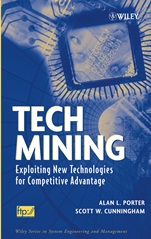
Tech Mining: Exploiting New Technologies for Competitive Advantage
ISBN 9780471475675
Autor: Alan L. Porter, Scott W. Cunningham
Wydawca: Wiley
Dostępność: 3-6 tygodni
Cena: 681,45 zł
Przed złożeniem zamówienia prosimy o kontakt mailowy celem potwierdzenia ceny.
ISBN13: |
9780471475675 |
ISBN10: |
047147567X |
Autor: |
Alan L. Porter, Scott W. Cunningham |
Oprawa: |
Hardback |
Rok Wydania: |
2004-11-23 |
Ilość stron: |
408 |
Wymiary: |
244x175 |
Tematy: |
TJ |
How to dig out the gems from the world′s vast trove of technological information
A business′s competitiveness depends on the effective use of the vast amounts of information available. Tech Mining: Exploiting New Technologies for Competitive Advantage shows technology managers and other professionals not only how to sift through the chaff and get to the key kernels that lead to innovation—in short, information management—but how to make better use of information leads in order to make better decisions.
Tech Mining explains how to use the available software tools, including generic search engines and standard MS Office capabilities, in conjunction with text mining software such as VantagePoint®, in order to quickly access the technological information needed to gain critical competitive advantage. With screen shots and charts throughout, the book shows the reader how to: Select and access the most valuable technology information resourcesSearch, retrieve, and clean information on topics of interestAnalyze huge quantities of information on emerging technologies to locate nuggets of value and to see the overall development profileIdentify technological trends and forecast likely future developmentsGauge prospects for successful technological innovation using tailoredinnovation indicatorsIntegrate empirical findings with expert opinion to provide compelling answers to managerial questions
With Web–based practice datasets and the VantagePoint reader software, Tech Mining will take managers and their enterprises beyond common information management to become wiser consumers—and exploiters—of today′s science and technology.
Spis treści:
List of Figures.
Preface.
Acknowledgments.
Acronyms & Shorthands—Glossary.
PART I. UNDERSTAND TECH MINING.
Chapter 1. Technological Innovation and th
e Need for Tech Mining.
1.1 Why Innovation is Significant.
1.2 Innovation Processes.
1.3 Innovation Institutions and Their Interests.
1.4 Innovators and Their Interests.
1.5 Technological Innovation in an Information Age.
1.6 Information About Emerging Technologies.
Chapter 1 Take–Home Messages.
Chapter Resources.
Chapter 2. How Tech Mining Works.
2.1 What is Tech Mining?
2.2 Why Do Tech Mining?
2.3 What Is Tech Mining’s Ancestry?
2.4 How to Conduct the Tech Mining Process?
2.5 Who Does Tech Mining?
2.6 Where Is Tech Mining Most Needed?
Chapter 2 Take–Home Messages.
Chapter Resources.
Chapter 3. What Tech Mining Can Do for You.
3.1 Tech Mining Basics.
3.2 Tech Mining Analyses.
3.3 Putting Tech Mining Information to Good Use.
3.4 Managing and Measuring Tech Mining.
Chapter 3 Take–Home Messages.
Chapter 4. Example Results: Fuel Cells Tech Mining.
4.1 Overview of Fuel Cells.
4.2 Tech Mining Analyses.
4.3 Tech Mining Results.
4.4 Tech Mining Information Processes.
4.5 Tech Mining Information Products.
Chapter 4 Take–Home Messages.
Chapter Resources.
Chapter 5. What to Watch For in Tech Mining.
5.1 Better Basics.
5.2 Research Profiling and Other Perspectives on the Data.
5.3 More Informative Products.
5.4 Knowledge Discovery.
5.5 Knowledge Management.
5.6 New Tech Mining Markets.
5.7 Dangers.
Chapter 5 Take–Home Messages.
Chapter Resources.
PART II. DOING TECH MINING.
Chapter 6. Finding the Right Sources.
6.1 R&D Activity.
6.2 R&D Output Databases.
6.3 Determining the Best Sources.
6.4 Arranging Access to Databases.
Chapter 6 Take–Home Messages.
Chapter Resources.
Chapter 7. Forming the Right Query.
7.1 An Iterative Process.
7.2 Queries Based on Substantive Terms.
7.3 Nominal Queries.
7.4 Tactics and S
trategies for Query Design.
7.5 Changing the Query.
Chapter 7 Take–Home Messages.
Chapter 8. Getting the Data.
8.1 Accessing Databases.
8.2 Search and Retrieval from a Database.
8.3 What to Do, and Not to Do.
Chapter 8 Take–Home Messages.
Chapter 9. Basic Analyses.
9.1 In the Beginning.
9.2 What You Can Do with the Data.
9.3 Relations Among Documents and Terms Occurring in Their Information Fields.
9.4 Relationships.
9.5 Helpful Basic Analyses.
Chapter 9 Take–Home Messages.
Chapter 10. Advanced Analyses.
10.1 Why Perform Advanced Analyses?
10.2 Data Representation.
10.3 Analytical Families.
Chapter 10 Take–Home Messages.
Chapter Resources.
Chapter 11. Trend Analyses.
11.1 Perspective.
11.2 An Example Time Series Description and Forecast.
11.3 Multiple Forecasts.
11.4 Research Fronts.
11.5 Novelty.
Chapter 11 Take–Home Messages.
Chapter Resources.
Chapter 12. Patent Analyses.
12.1 Why patent Analyses?
12.2 Getting Started.
12.3 The ‘What’ and ‘Why’ of patent Analysis.
12.4 Tech Mining Patent Analysis Case Illustration: Fuel Cells.
12.5 Patent Citation Analysis.
12.6 For Whom?
12.7 TRIZ.
12.8 Reflections.
Chapter 12 Take–Home Messages.
Chapter Resources.
Chapter 13. Generating and Presenting Innovation Indicators.
13.1 Expert Opinion in Tech Mining.
13.2 Innovation Indicators.
13.3 Information Representation and Packaging.
13.4 Examples of Putting Tech Mining Information Representation to Use.
13.5 Summing Up.
Chapter Resources.
Chapter 14. Managing the Tech Mining Process.
14.1 Tough Challenges.
14.2 Tech Mining Communities.
14.3 Process Management.
14.4 Enhancing the Prospects of Tech Mining Utilization.
14.5 Institutionalizing the Tech Mining Function.
14.6 The Learning Curve.
Chapter 14 Take–
;Home Messages.
Chapter 15. Measuring Tech Mining Results.
15.1 Why Measure?
15.2 What to Measure.
15.3 How to Measure.
15.4 Enabling Measurement.
15.5 Effective Measurement.
15.6 Using Measurements to Bolster Tech Mining.
Chapter 15 Take–Home Messages.
Chapter Resources.
Chapter 16. Examples Process: Tech Mining on Fuel Cells.
16.1 Introduction.
16.2 First Step: Issue Identification.
16.3 Second Step: Selection of Information Sources.
16.4 Third Step: Search Refinement and Data Retrieval.
16.5 Fourth Step: Data Cleaning.
16.6 Fifth Step: Basic Analyses.
16.7 Sixth Step: Advanced Analyses.
16.8 Seventh Step: Representation.
16.9 Eight Step: Interpretation.
16.10 Ninth Step: Utilization.
16.11 What Can We Learn.
Chapter 6 Take–Home Messages.
Chapter Resources.
Appendix A: Selected Publication and patent Databases.
Appendix B: Text Mining Software.
Appendix C: What You Can Do Without Tech Mining Software.
Appendix D: Statistics and Distributions for Analyzing Text Entities.
References.
Index.
Nota biograficzna:
ALAN L. PORTER′s major concentration is technology intelligence, forecasting, and assessment. He has led the development of "technology opportunity analysis"—mining electronic bibliographic data sources to generate intelligence on emerging technologies. He holds a BS in chemical engineering from the California Institute of Technology, and a PhD in engineering psychology from UCLA. He is currently Director, Research & Development, for Search Technology, Inc., in Norcross, Georgia.
SCOTT W. CUNNINGHAM worked for the Technology Policy & Assessment Center at the Georgia Institute of Technology. He has worked in industry as a data mining and machine learning consultant, working chiefly in the e–commerce and retail industries. He holds a BEng in engineering science and mechanics from
Georgia Tech and a DPhil in science, technology, and innovation policy from the University of Sussex, UK. He currently serves as an assistant professor on the Technology, Policy, and Management faculty of TU Delft.
Okładka tylna:
How to dig out the gems from the world′s vast trove of technological information
A business′s competitiveness depends on the effective use of the vast amounts of information available. Tech Mining: Exploiting New Technologies for Competitive Advantage shows technology managers and other professionals not only how to sift through the chaff and get to the key kernels that lead to innovation—in short, information management—but how to make better use of information leads in order to make better decisions.
Tech Mining explains how to use the available software tools, including generic search engines and standard MS Office capabilities, in conjunction with text mining software such as VantagePoint®, in order to quickly access the technological information needed to gain critical competitive advantage. With screen shots and charts throughout, the book shows the reader how to: Select and access the most valuable technology information resourcesSearch, retrieve, and clean information on topics of interestAnalyze huge quantities of information on emerging technologies to locate nuggets of value and to see the overall development profileIdentify technological trends and forecast likely future developmentsGauge prospects for successful technological innovation using tailoredinnovation indicatorsIntegrate empirical findings with expert opinion to provide compelling answers to managerial questions
With Web–based practice datasets and the VantagePoint reader software, Tech Mining will take managers and their enterprises beyond common information management to become wiser consumers—and exploiters—of todayR
42;s science and technology.
Koszyk
Książek w koszyku: 0 szt.
Wartość zakupów: 0,00 zł
Informacje


Kontakt
Gambit
Centrum Oprogramowania
i Szkoleń Sp. z o.o.
Al. Pokoju 29b/22-24
31-564 Kraków
Siedziba Księgarni
ul. Kordylewskiego 1
31-542 Kraków
+48 12 410 5991
+48 12 410 5987
+48 12 410 5989
Subskrypcje
Administratorem danych osobowych jest firma Gambit COiS Sp. z o.o. Na podany adres będzie wysyłany wyłącznie biuletyn informacyjny.
Autoryzacja płatności

Informacje na temat autoryzacji płatności poprzez PayU.

© Copyright 2012: GAMBIT COiS Sp. z o.o. Wszelkie prawa zastrzeżone.
Projekt i wykonanie: Alchemia Studio Reklamy