


Wydawcy
Katalog tematyczny
- Archeologia (109)
- Ekonomia, finanse, business (13704)
- Filozofia (1445)
- Historia (3040)
- Języki i językoznawstwo (2356)
- Lifestyle, hobby i rozrywka (475)
- Medycyna (9704)
- Nauki humanistyczne (4)
- Nauki o Ziemi i środowisku (2638)
- Nauki ścisłe (20412)
- Astronomia (294)
- Biologia (5119)
- Chemia (6540)
- Chemia analityczna (361)
- Chemia fizyczna (346)
- Chemia nieorganiczna (137)
- Chemia organiczna (535)
- Krystalografia (27)
- Minerologia (46)
- Fizyka (3309)
- Matematyka (4574)
- Nauki ścisłe, ogólnie (503)
- Nauki społeczne (8486)
- Nauki techniczne (13450)
- Prawo (1696)
- Publikacje informacyjne i interdyscyplinarne (1288)
- Religia i wierzenia (917)
- Technika komputerowa (4067)
- Zdrowie, relacje międzyludzkie i rozwój osobisty (657)








Informacje szczegółowe o książce
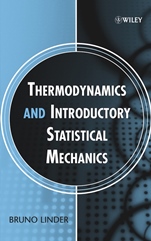
Thermodynamics and Introductory Statistical Mechanics
ISBN 9780471474593
Autor: Bruno Linder
Wydawca: Wiley
Dostępność: 3-6 tygodni
Cena: 606,90 zł
Przed złożeniem zamówienia prosimy o kontakt mailowy celem potwierdzenia ceny.
ISBN13: |
9780471474593 |
ISBN10: |
0471474592 |
Autor: |
Bruno Linder |
Oprawa: |
Hardback |
Rok Wydania: |
2004-10-29 |
Ilość stron: |
232 |
Wymiary: |
243x168 |
Tematy: |
PN |
A Clear and Concise Introduction to the Basic Theories of–and Linkages Between–Thermodynamics and Statistical Mechanics
Thermodynamics is concerned with the macroscopic properties of matter. Statistical mechanics, on the other hand, relates and interprets the properties of a macroscopic system in terms of its microscopic units. Thermodynamics and Introductory Statistical Mechanics covers the necessary mathematical tools and computational techniques for understanding both, first providing a separate overview of each and then illustrating and exploring the connections between the two.
Placing equal emphasis on fundamentals and applications, this clear and insightful text covers:Thermodynamics——basic concepts and definitions, laws, general conditions for equilibrium and stability, phase and chemical equilibriaIntroductory statistical mechanics——principles, thermodynamic connection, molecular partition function, statistical mechanical applicationsMathematical techniques for highlighting exact and inexact differentials, partial derivatives, Caratheodory’s theorem, Legendre transformation, and combinatory analysis
Subtleties and conceptual difficulties are addressed head–on, while ten problem sets and solutions reflect and illuminate the content covered.
For advanced undergraduate and graduate students as well as professionals, Thermodynamics and Introductory Statistical Mechanics provides an introduction and review that is both concise and comprehensive.
Spis treści:
PREFACE.
1 INTRODUCTORY REMARKS.
1.1 Scope and Objectives.
1.2 Level of Course.
1.3 Course Outline.
1.4 Books.
PART I: THERMODYNAMICS.
2 BASIC CONCEPTS AND DEFINITIONS.
2.1 Systems and Surroundings.
2.2 State Variables and Thermodynamic Properties.
2.3 Intensive and Extensive Variables.
2.4 Homogeneous and Heterogeneous Systems, Phases.
2.5 Work.
2.6 Reve
rsible and Quasi–Static Processes.
2.6.1 Quasi–Static Process.
2.6.2 Reversible Process.
2.7 Adiabatic and Diathermal Walls.
2.8 Thermal Contact and Thermal Equilibrium.
3 THE LAWS OF THERMODYNAMICS I.
3.1 The Zeroth Law—Temperature.
3.2 The First Law—Traditional Approach.
3.3 Mathematical Interlude I: Exact and Inexact Differentials.
3.4 The First Law—Axiomatic Approach.
3.5 Some Applications of the First Law.
3.5.1 Heat Capacity.
3.5.2 Heat and Internal Energy.
3.5.3 Heat and Enthalpy.
3.6 Mathematical Interlude II: Partial Derivatives.
3.6.1 Relations Between Partials of Dependent Variables.
3.6.2 Relations Between Partials with Different Subscripts.
3.7 Other Applications of the First Law.
3.7.1 C<sub>P</sub> &mdash; C<sub>V</sub>.
3.7.2 Isothermal Change, Ideal Gas.
3.7.3 Adiabatic Change, Ideal Gas.
3.7.4 The Joule and the Joule–Thomson Coefficients.
4 THE LAWS OF THERMODYNAMICS II.
4.1 The Second Law—Traditional Approach.
4.2 Engine Efficiency: Absolute Temperature.
4.2.1 Ideal Gas.
4.2.2 Coupled Cycles.
4.3 Generalization: Arbitrary Cycle.
4.4 The Clausius Inequality.
4.5 The Second Law—Axiomatic Approach (Carathe´odory).
4.6 Mathematical Interlude III: Pfaffian Differential Forms.
4.7 Pfaffian Expressions in Two Variables.
4.8 Pfaffian Expressions in More Than Two Dimensions.
4.9 Carathe´odory’s Theorem.
4.10 Entropy—Axiomatic Approach.
4.11 Entropy Changes for Nonisolated Systems.
4.12 Summary.
4.13 Some Applications of the Second Law.
4.13.1 Reversible Processes (PV Work Only).
4.13.2 Irreversible Processes.
5 USEFUL FUNCTIONS: THE FREE ENERGY FUNCTIONS.
5.1 Mathematical Interlude IV: Legendre Transformations.
5.1.1 Application of the Legendre Transformation.
5.2 Maxwell Relations.
5.3 The Gib
bs–Helmholtz Equations.
5.4 Relation of &Delta;A and &Delta;G to Work: Criteria for Spontaneity.
5.4.1 Expansion and Other Types of Work.
5.4.2 Comments.
5.5 Generalization to Open Systems and Systems of Variable Composition.
5.5.1 Single Component System.
5.5.2 Multicomponent Systems.
5.6 The Chemical Potential.
5.7 Mathematical Interlude V: Euler’s Theorem.
5.8 Thermodynamic Potentials.
6 THE THIRD LAW OF THERMODYNAMICS.
6.1 Statements of the Third Law.
6.2 Additional Comments and Conclusions.
7 GENERAL CONDITIONS FOR EQUILIBRIUM AND STABILITY.
7.1 Virtual Variations.
7.2 Thermodynamic Potentials—Inequalities.
7.3 Equilibrium Condition From Energy.
7.3.1 Boundary Fully Heat Conducting, Deformable, Permeable (Normal System).
7.3.2 Special Cases: Boundary Semi–Heat Conducting, Semi–Deformable, or Semi–Permeable.
7.4 Equilibrium Conditions From Other Potentials.
7.5 General Conditions for Stability.
7.6 Stability Conditions From E.
7.7 Stability Conditions From Cross Terms.
7.8 Stability Conditions From Other Potentials.
7.9 Derivatives of Thermodynamic Potentials With Respect to Intensive Variables.
8 APPLICATION OF THERMODYNAMICS TO GASES, LIQUIDS, AND SOLIDS.
8.1 Gases.
8.2 Enthalpy, Entropy, Chemical Potential, Fugacity.
8.2.1 Enthalpy.
8.2.2 Entropy.
8.2.3 Chemical Potential.
8.2.4 Fugacity.
8.3 Standard States of Gases.
8.4 Mixtures of Gases.
8.4.1 Partial Fugacity.
8.4.2 Free Energy, Entropy, Enthalpy, and Volume of Mixing of Gases.
8.5 Thermodynamics of Condensed Systems.
8.5.1 The Chemical Potential.
8.5.2 Entropy.
8.5.3 Enthalpy.
9 PHASE AND CHEMICAL EQUILIBRIA.
9.1 The Phase Rule.
9.2 The Clapeyron Equation.
9.3 The Clausius–Clapeyron Equation.
9.4 The Generalized Clapeyron Equation.
9.5 Chemical Equilibrium.
9.6 The Equilibrium Constant.
10 SOLUTIONS—NO
NELECTROLYTES.
10.1 Activities and Standard State Conventions.
10.1.1 Gases.
10.1.2 Pure Liquids and Solids.
10.1.3 Mixtures.
10.1.3.1 Liquid–Liquid Solutions—Convention I (Con I).
10.1.3.2 Solid–Liquid Solutions—Convention II (Con II).
10.2 Ideal and Ideally Dilute Solutions; Raoult’s and Henry’s Laws.
10.2.1 Ideal Solutions.
10.2.2 Ideally Dilute Solutions.
10.3 Thermodynamic Functions of Mixing.
10.3.1 For Ideal Solutions.
10.3.2 For Nonideal Solutions.
10.4 Colligative Properties.
10.4.1 Lowering of Solvent Vapor Pressure.
10.4.2 Freezing Point Depression.
10.4.3 Boiling Point Elevation.
10.4.4 Osmotic Pressure.
11 PROCESSES INVOLVING WORK OTHER THAN PRESSURE–VOLUME WORK.
11.1 P–V Work and One Other Type of Work.
11.2 P–V, &sigma;A, and fL Work.
12 PHASE TRANSITIONS AND CRITICAL PHENOMENA.
12.1 Stable, Metastable, and Unstable Isotherms.
12.2 The Critical Region.
PART II: INTRODUCTORY STATISTICAL MECHANICS.
13 PRINCIPLES OF STATISTICAL MECHANICS.
13.1 Introduction.
13.2 Preliminary Discussion—Simple Problem.
13.3 Time and Ensemble Averages.
13.4 Number of Microstates, &Omega;<sub>D</sub>, Distributions D<sub><I>I</I></sub>.
13.5 Mathematical Interlude VI: Combinatory Analysis.
13.6 Fundamental Problem in Statistical Mechanics.
13.7 Maxwell–Boltzmann, Fermi–Dirac, Bose–Einstein Statistics ‘‘Corrected’’ Maxwell–Boltzmann Statistics.
13.7.1 Maxwell–Boltzmann Statistics.
13.7.2 Fermi–Dirac Statistics.
13.7.3 Bose–Einstein Statistics
13.7.4 ‘‘Corrected’’ Maxwell–Boltzmann Statistics.
13.8 Systems of Distinguishable (Localized) and Indistinguishable (Nonlocalized) Particles.
13.9 Maximizing &Omeg
Koszyk
Książek w koszyku: 0 szt.
Wartość zakupów: 0,00 zł
Informacje


Kontakt
Gambit
Centrum Oprogramowania
i Szkoleń Sp. z o.o.
Al. Pokoju 29b/22-24
31-564 Kraków
Siedziba Księgarni
ul. Kordylewskiego 1
31-542 Kraków
+48 12 410 5991
+48 12 410 5987
+48 12 410 5989
Subskrypcje
Administratorem danych osobowych jest firma Gambit COiS Sp. z o.o. Na podany adres będzie wysyłany wyłącznie biuletyn informacyjny.
Autoryzacja płatności

Informacje na temat autoryzacji płatności poprzez PayU.

© Copyright 2012: GAMBIT COiS Sp. z o.o. Wszelkie prawa zastrzeżone.
Projekt i wykonanie: Alchemia Studio Reklamy