


Wydawcy
Katalog tematyczny
- Archeologia (109)
- Ekonomia, finanse, business (13704)
- Filozofia (1445)
- Historia (3040)
- Języki i językoznawstwo (2356)
- Lifestyle, hobby i rozrywka (475)
- Medycyna (9704)
- Nauki humanistyczne (4)
- Nauki o Ziemi i środowisku (2638)
- Nauki ścisłe (20412)
- Nauki społeczne (8486)
- Nauki techniczne (13450)
- Budownictwo lądowe (1045)
- Chemia przemysłowa (2258)
- Elektronika i telekomunikacja (3287)
- Energetyka (1122)
- Inne nauki stosowane (363)
- Inżynieria biochemiczna (507)
- Inżynieria transportu (232)
- Mechanika i materiały (3316)
- Nauka o środowisku (321)
- Rolnictwo (507)
- Technika, ogólnie (475)
- Prawo (1696)
- Publikacje informacyjne i interdyscyplinarne (1288)
- Religia i wierzenia (917)
- Technika komputerowa (4067)
- Zdrowie, relacje międzyludzkie i rozwój osobisty (657)





Informacje szczegółowe o książce
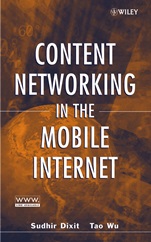
Content Networking in the Mobile Internet
ISBN 9780471466185
Autor: Sudhir Dixit, Tao Wu
Wydawca: Wiley
Dostępność: 3-6 tygodni
Cena: 811,65 zł
Przed złożeniem zamówienia prosimy o kontakt mailowy celem potwierdzenia ceny.
ISBN13: |
9780471466185 |
ISBN10: |
0471466182 |
Autor: |
Sudhir Dixit, Tao Wu |
Oprawa: |
Hardback |
Rok Wydania: |
2004-10-01 |
Ilość stron: |
548 |
Wymiary: |
237x164 |
Tematy: |
TJ |
A cutting–edge guide to the next generation Mobile Internet architecture and applications
The last several years have witnessed dramatic changes in the wireless Web interface environment, specifically in the way that content is stored, distributed, and checked for consistency while leveraging location awareness. This phenomenon is driving the need for increased bandwidth at the network and access level.
Content Networking in the Mobile Internet provides an integrated view of both content and wireless technologies, filling the gap between the material taught at the university and the knowledge and expertise needed to succeed in the industry. This title focuses not only on the latest technology that enables speedier content delivery on the mobile Internet, but also on how to integrate the technology to provide workable results–oriented solutions.
Written by industry leaders, the text examines such in–demand topics as:Mobile Internet architecture and protocols (GSM/GPRS/EDGE, IS–95,WCDMA, HSDPA, HTTP, and WAP)Mobile Web—location–based servicesContent adaptationDigital rights management (DRM) and securityMultimedia streaming (QoS, 3GPP Packet Switched Streaming Service)Content caching and multicast (IPDC, MBMS)Wireless Web workload characterization and content synchronizationCharging for mobile content
Packed with useful references, this comprehensive guide is a must–read that will appeal to professionals as well as graduate students in the field of wireless and mobile communications.
Spis treści:
PREFACE.
ACRONYMS.
1 CONTENT NETWORKING IN THE MOBILE INTERNET (Sudhir Dixit and Tao Wu).
1.1 Introduction.
1.2 Content Networking in the Mobile Internet.
1.3 Book Overview.
1.4 Concluding Remarks.
2 MOBILE INTERNET ARCHITECTURE OVERVIEW (Harri Holma and Antti Toskala).
2.1 Introduction.
2.2 Sta
ndardization Framework.
2.3 System Architecture and Core Network.
2.4 WCDMA Radio Access Network.
2.4.5 Evolution of WCDMA.
2.6 IS–95 Radio Access.
2.7 GSM/EDGE and WCDMA Operator Performance.
2.8 GSM/EDGE and WCDMA End–User Performance.
References.
3 PROTOCOLS FOR THE WEB AND THE MOBILE INTERNET (Mitri Abou–Rizk).
3.1 Introduction.
3.2 History of the World Wide Web.
3.3 The Web Today.
3.4 The Future Web.
3.5 HyperText Transfer Protocol.
3.6 Wireless Access Protocol (WAP).
References.
4 CONTENT CACHING AND MULTICAST (Dan Li).
4.1 Web–Based Applications.
4.2 Scalable Content Delivery via Multicast and Caching.
4.3 IP Multicast and Reliable Multicast.
4.4 Application Layer Multicast.
4.5 Web Proxy Caching.
4.6 Summary.
References.
5 CHARACTERIZING WEB WORKLOAD OF MOBILE CLIENTS (Atul Adya, Paramvir Bahl, and Lili Qiu).
5.1 Overview of Web Workload Characterization.
5.2 Overview of Previous Work.
5.3 Server Architecture and Data Gathering.
5.4 Characterizing Web Browsing Workload.
5.5 Characterizing Notification Workload.
5.6 Correlation between Web Browsing and Notification.
5.7 Comparison between Workload of Wireline Web and Mobile Web.
5.8 Summary.
References.
6 ACME: A NEW MOBILE CONTENT DELIVERY ARCHITECTURE (Tao Wu, Sadhna Ahuja, and Sudhir Dixit).
6.1 Introduction.
6.2 Mobile Content Delivery Techniques and Related Work.
6.3 ACME Performance Analysis.
6.4 Exploiting User Interest Correlation with ACME.
6.5 ACME in Radio Resource Management.
6.6 Conclusions.
References.
7 CONTENT ADAPTATION FOR THE MOBILE INTERNET (Stephane Coulombe, Oskari Koskimies, and Guido Grassel).
7.1 Motivation for Adaptation.
7.2 Multimedia Content Types.
7.3 Types of Adaptation.
7.4 Methods of Adaptation.
7.5 Capabilities and Metadata.
7.6 Adaptation Architectures.
7.7 Application Scenarios.
7.8 Standardization and
Future Work.
References.
8 CONTENT SYNCHRONIZATION (Ganesh Sivaraman).
8.1 Introduction.
8.2 Why Mobile Devices Need Synchronization.
8.3 Fundamental Principles of Synchronization.
8.4 Adoption of Synchronization for Mobile Devices.
8.5 Synchronization Standard.
8.6 Summary.
References.
9 MULTIMEDIA STREAMING IN MOBILE WIRELESS NETWORKS (Sanjeev Verma, Muhammad Mukarram bin Tariq, Takeshi Yoshimura, and Tao Wu).
9.1 Introduction.
9.2 QoS Issues for Streaming Applications.
9.3 Streaming Media Codecs.
9.4 End–to–End Architecture to Provide Streaming Services in Wireless Environments.
9.5 Protocols for Streaming Media Delivery.
9.6 3GPP Packet–Switched Streaming Service.
9.7 Multimedia Services in Mobile and Wireless Environments.
9.8 Conclusions.
References.
10 MULTICAST CONTENT DELIVERY FOR MOBILES (Rod Walsh, Antti–Pentti Vainio, and Janne Aaltonen).
10.1 Introduction.
10.2 Multicast Overview.
10.3 The Generic IP Multicast System.
10.4 IP Datacast (IPDC).
10.5 Multicast in Third–Generation Cellular (MBMS).
10.6 Multicast Content Delivery for Mobiles in Summary and in the Future.
References.
11 SECURITY AND DIGITAL RIGHTS MANAGEMENT FOR MOBILE CONTENT (Deepa Kundur, Heather Yu, and Ching–Yung Lin).
11.1 Introduction to Information Security and DRM Technologies.
11.2 MPEG Intellectual Property Management and Protection.
11.3 Emerging Technologies and Applications.
References.
12 CHARGING FOR MOBILE CONTENT (David Banjo).
12.1 Introduction.
12.2 Fixed–Line Telephony Charging.
12.3 Mobile Telephony Charging.
12.4 Aspects Pertinent to Mobile Content Charging.
12.4.5 Roaming.
12.4.6 Multiple Access.
12.4.7 Source of Charging Records.
12.4.8 Multiple Servers Involved in Delivery.
12.5 Charging Concepts and Mechanisms.
12.6 Charging Interfaces.
12.7 Charging Information.
12.8 Charging Architecture
and Scenarios.
12.9 Summary.
References.
13 ALGORITHMS AND INFRASTRUCTURES FOR LOCATION–BASED SERVICES (Gang Wu, Xia Gao, and Keisuke Suwa).
13.1 Introduction.
13.2 Taxonomy of Location.
13.3 Location Estimation Media.
13.4 Location Estimation Algorithms.
13.5 Location Estimation Systems.
13.6 Location Services Based on Cellular Systems.
References.
14 FIXED AND MOBILE WEB SERVICES (Michael Mahan).
14.1 Web Services Introduction.
14.2 Web Services Foundation Technologies.
14.3 Conclusion.
References.
INDEX.
Nota biograficzna:
Sudhir S. Dixit received his Ph.D. degree in EE from the University of Strathclyde, Glasgow, Scotland. He also received an M.B.A. degree from Florida Institute of Technology, Melbourne, Florida. Dr. Dixit is currently a Senior R&D; Manager and a Site Manager at Nokia Research Center in Burlington, Massachusetts. His main areas of interest are mobile/wireless Internet, optical networks, and content delivery networks. He has held various engineering and management positions at major companies, e.g., Verizon, GTE, Motorola, Wang, Harris, and STL (now Nortel Europe Labs). He has published or presented over 150 papers and has 27 patents either granted or pending. He has been a Technical co–Chair and a General Chair of the IEEE International Conference on Computer, Communications and Networks, a Technical co–Chair of the SPIE Conference Terabit Optical Networking, a General Chair of the Broadband Networking in the Next Millennium Conference in 2001, and a General co–Chair of the OptiComm 2002 conference. He has also been an ATM Forum Ambassador since 1996. He has served as a guest editor in IEEE Network, IEEE Communications Magazine, and Optical Networks Magazine published by SPIE/Kluwer. He has been a Lightwave Series editor of the IEEE Communications Magazine, and is currently on the editorial board of the newly announced IEEE Optical Communicat
Koszyk
Książek w koszyku: 0 szt.
Wartość zakupów: 0,00 zł
Informacje


Kontakt
Gambit
Centrum Oprogramowania
i Szkoleń Sp. z o.o.
Al. Pokoju 29b/22-24
31-564 Kraków
Siedziba Księgarni
ul. Kordylewskiego 1
31-542 Kraków
+48 12 410 5991
+48 12 410 5987
+48 12 410 5989
Subskrypcje
Administratorem danych osobowych jest firma Gambit COiS Sp. z o.o. Na podany adres będzie wysyłany wyłącznie biuletyn informacyjny.
Autoryzacja płatności

Informacje na temat autoryzacji płatności poprzez PayU.

© Copyright 2012: GAMBIT COiS Sp. z o.o. Wszelkie prawa zastrzeżone.
Projekt i wykonanie: Alchemia Studio Reklamy