


Wydawcy
Katalog tematyczny
- Archeologia (109)
- Ekonomia, finanse, business (13704)
- Filozofia (1445)
- Historia (3040)
- Języki i językoznawstwo (2356)
- Lifestyle, hobby i rozrywka (475)
- Medycyna (9704)
- Nauki humanistyczne (4)
- Nauki o Ziemi i środowisku (2638)
- Nauki ścisłe (20412)
- Nauki społeczne (8486)
- Nauki techniczne (13450)
- Budownictwo lądowe (1045)
- Chemia przemysłowa (2258)
- Elektronika i telekomunikacja (3287)
- Energetyka (1122)
- Inne nauki stosowane (363)
- Inżynieria biochemiczna (507)
- Inżynieria transportu (232)
- Mechanika i materiały (3316)
- Nauka o środowisku (321)
- Rolnictwo (507)
- Technika, ogólnie (475)
- Prawo (1696)
- Publikacje informacyjne i interdyscyplinarne (1288)
- Religia i wierzenia (917)
- Technika komputerowa (4067)
- Zdrowie, relacje międzyludzkie i rozwój osobisty (657)





Informacje szczegółowe o książce
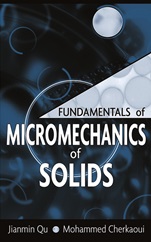
Fundamentals of Micromechanics of Solids
ISBN 9780471464518
Autor: Jianmin Qu, Mohammed Cherkaoui
Wydawca: Wiley
Dostępność: 3-6 tygodni
Cena: 675,15 zł
Przed złożeniem zamówienia prosimy o kontakt mailowy celem potwierdzenia ceny.
ISBN13: |
9780471464518 |
ISBN10: |
0471464511 |
Autor: |
Jianmin Qu, Mohammed Cherkaoui |
Oprawa: |
Hardback |
Rok Wydania: |
2006-09-01 |
Ilość stron: |
386 |
Wymiary: |
232x157 |
Tematy: |
TG |
The complete primer to micromechanics
Fundamentals of Micromechanics of Solids is the first book integrating various approaches in micromechanics into a unified mathematical framework, complete with coverage of both linear and nonlinear behaviors. Based on this unified framework, results from the authors′ own research, as well as existing results in the literature are re–derived in a logical, pedagogical, and understandable approach. It enables readers to follow the various developments of micromechanics theories and quickly understand its wide range of applications of micromechanics.
This helpful guide is a powerful tool for learning the most fundamental ideas and approaches, basic concepts, principles, and methodologies of micromechanics. Readers will find:Vigorous derivations of the mathematical frameworkIntroductions to both linear and nonlinear material behaviorUnique coverage of brittle damage, shape memory alloys, and TRIP steelsLarge numbers of problems and exercises to support teaching and learning the conceptsLists of references and suggested readings in each chapter
Spis treści:
Preface.
1 Introduction.
1.1 Background and Motivation.
1.2 Objectives.
1.3 Organization of Book.
1.4 Notation Conventions.
References.
2 Basic Equations of Continuum Mechanics.
2.1 Displacement and Deformation.
2.2 Stresses and Equilibrium.
2.3 Energy, Work, and Thermodynamic Potentials.
2.4 Constitutive Laws.
2.5 Boundary Value Problems for Small–Strain Linear Elasticity.
2.6 Integral Representations of Elasticity Solutions.
Problems.
Appendix 2.A.
Appendix 2.B.
Appendix 2.C.
References.
Suggested Readings.
3 Eigenstrains.
3.1 Definition of Eigenstrains.
3.2 Some Examples of Eigenstrains.
3.3 General Solutions of Eigenstrain Problems.
3.4 Examples.
Problems.
Appendix 3.A.
Appendix 3.B.
R
eferences.
Suggested Readings.
4 Inclusions and Inhomogeneities.
4.1 Definitions of Inclusions and Inhomogeneities.
4.2 Interface Conditions.
4.3 Ellipsoidal Inclusion with Uniform Eigenstrains (Eshelby Solution).
4.4 Ellipsoidal Inhomogeneities.
4.5 Inhomogeneous Inhomogeneities.
Problems.
Appendix 4.A.
Appendix 4.B.
Suggested Readings.
5 Definitions of Effective Moduli of Heterogeneous Materials.
5.1 Heterogeneity and Length Scales.
5.2 Representative Volume Element.
5.3 Random Media.
5.4 Macroscopic Averages.
5.5 Hill’s Lemma.
5.6 Definitions of Effective Modulus of Heterogeneous Media.
5.7 Concentration Tensors and Effective Properties.
Problems.
Suggested Readings.
6 Bounds for Effective Moduli.
6.1 Classical Variational Theorems in Linear Elasticity.
6.2 Voigt Upper Bound and Reuss Lower Bound.
6.3 Extensions of Classical Variational Principles.
6.4 Hashin–Shtrikman Bounds.
Problems.
Appendix 6.A.
References.
Suggested Readings.
7 Determination of Effective Moduli.
7.1 Basic Ideas of Micromechanics for Effective Properties.
7.2 Eshelby Method.
7.3 Mori–Tanaka Method.
7.4 Self–Consistent Methods for Composite Materials.
7.5 Self–Consistent Methods for Polycrystalline Materials.
7.6 Differential Schemes.
7.7 Comparison of Different Methods.
Problems.
Suggested Readings.
8 Determination of the Effective Moduli—Multiinclusion Approaches.
8.1 Composite–Sphere Model.
8.2 Three–Phase Model.
8.3 Four–Phase Model.
8.4 Multicoated Inclusion Problem.
Problems.
Appendix 8.A.
Appendix 8.B.
Appendix 8.C.
References.
Suggested Readings.
9 Effective Properties of Fiber–Reinforced Composite Laminates.
9.1 Unidirectional Fiber–Reinforced Composites.
9.2 Effective Properties of Multilayer Composites.
9.3 Effec
tive Properties of a Lamina.
9.4 Effective Properties of a Laminated Composite Plate.
Problems.
Appendix 9.A.
References.
Suggested Readings.
10 Brittle Damage and Failure of Engineering Composites.
10.1 Imperfect Interfaces.
10.2 Fiber Bridging.
10.3 Transverse Matrix Cracks.
Problems.
Appendix 10.A.
References.
Suggested Readings.
11 Mean Field Theory for Nonlinear Behavior.
11.1 Eshelby’s Solution and Kro¨ner’s Model.
11.2 Applications.
11.3 Time–Dependent Behavior of Polycrystalline Materials: Secant Approach.
Problems.
References.
12 Nonlinear Properties of Composites Materials: Thermodynamic Approaches.
12.1 Nonlinear Behavior of Constituents.
12.2 Effective Potentials.
12.3 The Secant Approach.
Problems.
Suggested Readings.
13 Micromechanics of Martensitic Transformation in Solids.
13.1 Phase Transformation Mechanisms at Different Scales.
13.2 Application: Thermodynamic Forces and Constitutive Equations for Single Crystals.
13.3 Overall Behavior of Polycrystalline Materials with Phase Transformation.
Problems.
References.
Suggested Readings.
Index.
Nota biograficzna:
Jianmin Qu is a professor in the G. W. Woodruff School of Mechanical Engineering at Georgia Institute of Technology in Atlanta.
Mohammed Cherkaoui, Phd, is a professor in the G. W. Woodruff School of Mechanical Engineering at Georgia Institute of Technology in Atlanta. He is formerly with the Université de Metz, France.
Okładka tylna:
The complete primer to micromechanics
Fundamentals of Micromechanics of Solids is the first book integrating various approaches in micromechanics into a unified mathematical framework, complete with coverage of both linear and nonlinear behaviors. Based on this unified framework, results from the authors′ own research, as well a
s existing results in the literature are re–derived in a logical, pedagogical, and understandable approach. It enables readers to follow the various developments of micromechanics theories and quickly understand its wide range of applications of micromechanics.
This helpful guide is a powerful tool for learning the most fundamental ideas and approaches, basic concepts, principles, and methodologies of micromechanics. Readers will find:Vigorous derivations of the mathematical frameworkIntroductions to both linear and nonlinear material behaviorUnique coverage of brittle damage, shape memory alloys, and TRIP steelsLarge numbers of problems and exercises to support teaching and learning the conceptsLists of references and suggested readings in each chapter
Koszyk
Książek w koszyku: 0 szt.
Wartość zakupów: 0,00 zł
Informacje


Kontakt
Gambit
Centrum Oprogramowania
i Szkoleń Sp. z o.o.
Al. Pokoju 29b/22-24
31-564 Kraków
Siedziba Księgarni
ul. Kordylewskiego 1
31-542 Kraków
+48 12 410 5991
+48 12 410 5987
+48 12 410 5989
Subskrypcje
Administratorem danych osobowych jest firma Gambit COiS Sp. z o.o. Na podany adres będzie wysyłany wyłącznie biuletyn informacyjny.
Autoryzacja płatności

Informacje na temat autoryzacji płatności poprzez PayU.

© Copyright 2012: GAMBIT COiS Sp. z o.o. Wszelkie prawa zastrzeżone.
Projekt i wykonanie: Alchemia Studio Reklamy