


Wydawcy
Katalog tematyczny
- Archeologia (109)
- Ekonomia, finanse, business (13704)
- Filozofia (1445)
- Historia (3040)
- Języki i językoznawstwo (2356)
- Lifestyle, hobby i rozrywka (475)
- Medycyna (9704)
- Nauki humanistyczne (4)
- Nauki o Ziemi i środowisku (2638)
- Nauki ścisłe (20412)
- Nauki społeczne (8486)
- Nauki techniczne (13450)
- Budownictwo lądowe (1045)
- Budownictwo komunikacyjne (9)
- Hydraulika (33)
- Konstrukcje budowlane (95)
- Mechanika konstrukcji (182)
- Przemysł budowlany (7)
- Chemia przemysłowa (2258)
- Elektronika i telekomunikacja (3287)
- Energetyka (1122)
- Inne nauki stosowane (363)
- Inżynieria biochemiczna (507)
- Inżynieria transportu (232)
- Mechanika i materiały (3316)
- Nauka o środowisku (321)
- Rolnictwo (507)
- Technika, ogólnie (475)
- Prawo (1696)
- Publikacje informacyjne i interdyscyplinarne (1288)
- Religia i wierzenia (917)
- Technika komputerowa (4067)
- Zdrowie, relacje międzyludzkie i rozwój osobisty (657)





Informacje szczegółowe o książce
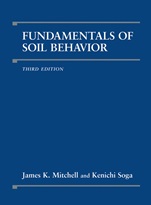
Fundamentals of Soil Behavior
ISBN 9780471463023
Autor: James K. Mitchell, Kenichi Soga
Wydawca: Wiley
Dostępność: 3-6 tygodni
Cena: 866,25 zł
Przed złożeniem zamówienia prosimy o kontakt mailowy celem potwierdzenia ceny.
ISBN13: |
9780471463023 |
ISBN10: |
0471463027 |
Autor: |
James K. Mitchell, Kenichi Soga |
Oprawa: |
Hardback |
Rok Wydania: |
2005-07-15 |
Numer Wydania: |
3rd Edition |
Ilość stron: |
592 |
Wymiary: |
284x225 |
Tematy: |
TN |
The improved, new edition of the classic book on the physical properties of soil
Fundamentals of Soil Behavior, Third Edition is the thoroughly updated, expanded, and revised edition of this highly distinguished publication in geotechnical engineering. Filled with useful tables and graphs illustrating correlations among composition, classification, state, and static and dynamic properties, this Third Edition continues the tradition of providing the latest information on the physical properties of soil and the fundamentals of its behavior over time.
Students and busy professionals will connect with this new edition′s timesaving, streamlined format and its greater emphasis on practical exercise problems involving advanced concepts of soil behavior. Other must–read features of this Third Edition include:New, expanded material on micro–mechanical behavior at the particulate level and its influences on engineering properties at the macro–scaleA new chapter on time effects on soil deformation at different stress and strain levelsNew coverage of such important topics as environmental geotechnics, biological influences on soil behavior, soil fracturing, the effects of time, and geochemical problemsSets of questions and problems at the end of each chapter, a feature not available in prior editions
Fundamentals of Soil Behavior, Third Edition is an essential text for graduate students and researchers as well as a peerless reference for geotechnical, environmental, and civil engineers and geologists.
Spis treści:
Preface.
CHAPTER 1: INTRODUCTION.
1.1 Soil Behavior in Civil and Environmental Engineering.
1.2 Scope and Organization.
1.3 Getting Started.
CHAPTER 2: SOIL FORMATION.
2.1 Introduction.
2.2 The Earth’s Crust.
2.3 Geologic Cycle and Geological Time.
2.4 Rock and Mineral Stability.
2.5 Weathering.
2.6 Origin of Clay M
inerals and Clay Genesis.
2.7 Soil Profiles and Their Development.
2.8 Sediment Erosion, Transport, and Deposition.
2.9 Postdepositional Changes in Sediments.
2.10 Concluding Comments.
Questions and Problems.
CHAPTER 3: SOIL MINERALOGY.
3.1 Importance of Soil Mineralogy in Geotechnical Engineering.
3.2 Atomic Structure.
3.3 Interatomic Bonding.
3.4 Secondary Bonds.
3.5 Crystals and Their Properties.
3.6 Crystal Notation.
3.7 Factors Controlling Crystal Structures.
3.8 Silicate Crystals.
3.9 Surfaces.
3.10 Gravel, Sand, and Silt Particles.
3.11 Soil Minerals and Materials Formed by Biogenic and Geochemical Processes.
3.12 Summary of Nonclay Mineral Characteristics.
3.13 Structural Units of the Layer Silicates.
3.14 Synthesis Pattern and Classification of the Clay Minerals.
3.15 Intersheet and Interlayer Bonding in the Clay Minerals.
3.16 The 1:1 Minerals.
3.17 Smectite Minerals.
3.18 Micalike Clay Minerals.
3.19 Other Clay Minerals.
3.20 Summary of Clay Mineral Characteristics.
3.21 Determination of Soil Composition.
3.22 X–ray Diffraction Analysis.
3.23 Other Methods for Compositional Analysis.
3.24 Quantitative Estimation of Soil Components.
3.25 Concluding Comments.
Questions and Problems.
CHAPTER 4: SOIL COMPOSITION AND ENGINEERING PROPERTIES.
4.1 Introduction.
4.2 Approaches to the Study of Composition and Property Interrelationships.
4.3 Engineering Properties of Granular Soils.
4.4 Dominating Influence of the Clay Phase.
4.5 Atterberg Limits.
4.6 Activity.
4.7 Influences of Exchangeable Cations and pH.
4.8 Engineering Properties of Clay Minerals.
4.9 Effects of Organic Matter.
4.10 Concluding Comments.
Questions and Problems.
CHAPTER 5: SOIL FABRIC AND ITS MEASUREMENT.
5.1 Introduction.
5.2 Definitions of Fabrics and Fabric Elements.
5.3 Single–Grain Fabrics.
5.4 Contact Force Chara
cterization Using Photoelasticity.
5.5 Multigrain Fabrics.
5.6 Voids and Their Distribution.
5.7 Sample Acquisition and Preparation for Fabric Analysis.
5.8 Methods for Fabric Study.
5.9 Pore Size Distribution Analysis.
5.10 Indirect Methods for Fabric Characterization.
5.11 Concluding Comments.
Questions and Problems.
CHAPTER 6: SOIL–WATER–CHEMICAL INTERACTIONS.
6.1 Introduction.
6.2 Nature of Ice and Water.
6.3 Influence of Dissolved Ions on Water.
6.4 Mechanisms of Soil–Water Interaction.
6.5 Structure and Properties of Adsorbed Water.
6.6 Clay–Water–Electrolyte System.
6.7 Ion Distributions in Clay–Water Systems.
6.8 Elements of Double–Layer Theory.
6.9 Influences of System Variables on the Double Layer.
6.10 Limitations of the Gouy–Chapman Diffuse Double Layer Model.
6.11 Energy and Force of Repulsion.
6.12 Long–Range Attraction.
6.13 Net Energy of Interaction.
6.14 Cation Exchange—General Considerations.
6.15 Theories for Ion Exchange.
6.16 Soil–Inorganic Chemical Interactions.
6.17 Clay–Organic Chemical Interactions.
6.18 Concluding Comments.
Questions and Problems.
CHAPTER 7: EFFECTIVE, INTERGRANULAR, AND TOTAL STRESS.
7.1 Introduction.
7.2 Principle of Effective Stress.
7.3 Force Distributions in a Particulate System.
7.4 Interparticle Forces.
7.5 Intergranular Pressure.
7.6 Water Pressures and Potentials.
7.7 Water Pressure Equilibrium in Soil.
7.8 Measurement of Pore Pressures in Soils.
7.9 Effective and Intergranular Pressure.
7.10 Assessment of Terzaghi’s Equation.
7.11 Water–Air Interactions in Soils.
7.12 Effective Stress in Unsaturated Soils.
7.13 Concluding Comments.
Questions and Problems.
CHAPTER 8: SOIL DEPOSITS—THEIR FORMATION, STRUCTURE, GEOTECHNICAL PROPERTIES, AND STABILITY.
8.1 Introduction.
8.2
Structure Development.
8.3 Residual Soils.
8.4 Surficial Residual Soils and Taxonomy.
8.5 Terrestrial Deposits.
8.6 Mixed Continental and Marine Deposits.
8.7 Marine Deposits.
8.8 Chemical and Biological Deposits.
8.9 Fabric, Structure, and Property Relationships: General Considerations.
8.10 Soil Fabric and Property Anisotropy.
8.11 Sand Fabric and Liquefaction.
8.12 Sensitivity and Its Causes.
8.13 Property Interrelationships in Sensitive Clays.
8.14 Dispersive Clays.
8.15 Slaking.
8.16 Collapsing Soils and Swelling Soils.
8.17 Hard Soils and Soft Rocks.
8.18 Concluding Comments.
Questions and Problems.
CHAPTER 9: CONDUCTION PHENOMENA.
9.1 Introduction.
9.2 Flow Laws and Interrelationships.
9.3 Hydraulic Conductivity.
9.4 Flows Through Unsaturated Soils.
9.5 Thermal Conductivity.
9.6 Electrical Conductivity.
9.7 Diffusion.
9.8 Typical Ranges of Flow Parameters.
9.9 Simultaneous Flows of Water, Current, and Salts Through Soil–Coupled Flows.
9.10 Quantification of Coupled Flows.
9.11 Simultaneous Flows of Water, Current, and Chemicals.
9.12 Electrokinetic Phenomena.
9.13 Transport Coefficients and the Importance of Coupled Flows.
9.14 Compatibility—Effects of Chemical Flows on Properties.
9.15 Electroosmosis.
9.16 Electroosmosis Efficiency.
9.17 Consolidation by Electroosmosis.
9.18 Electrochemical Effects.
9.19 Electrokinetic Remediation.
9.20 Self–Potentials.
9.21 Thermally Driven Moisture Flows.
9.22 Ground Freezing.
9.23 Concluding Comments.
Questions and Problems.
CHAPTER 10: VOLUME CHANGE BEHAVIOR.
10.1 Introduction.
10.2 General Volume Change Behavior of Soils.
10.3 Preconsolidation Pressure.
10.4 Factors Controlling Resistance to Volume Change.
10.5 Physical Interactions in Volume Change.
10.6 Fabric, Structure, and Volume Change.
10.7 Osmotic Pressure and Water Adsorption Influ
ences on Compression and Swelling.
10.8 Influences of Mineralogical Detail in Soil Expansion.
10.9 Consolidation.
10.10 Secondary Compression.
10.11 In Situ Horizontal Stress (K<sub>0</sub>).
10.12 Temperature–Volume Relationships.
10.13 Concluding Comments.
Questions and Problems.
CHAPTER 11 STRENGTH AND DEFORMATION BEHAVIOR.
11.1 Introduction.
11.2 General Characteristics of Strength and Deformation.
11.3 Fabric, Structure, and Strength.
11.4 Friction Between Solid Surfaces.
11.5 Frictional Behavior of Minerals.
11.6 Physical Interactions Among Particles.
11.7 Critical State: A Useful Reference Condition.
11.8 Strength Parameters for Sands.
11.9 Strength Parameters for Clays.
11.10 Behavior After Peak and Strain Localization.
11.11 Residual State and Residual Strength.
11.12 Intermediate Stress Effects and Anisotropy.
11.13 Resistance to Cyclic Loading and Liquefaction.
11.14 Strength of Mixed Soils.
11.15 Cohesion.
11.16 Fracturing of Soils.
11.17 Deformation Characteristics.
11.18 Linear Elastic Stiffness.
11.19 Transition from Elastic to Plastic States.
11.20 Plastic Deformation.
11.21 Temperature Effects.
11.22 Concluding Comments.
Questions and Problems.
CHAPTER 12: TIME EFFECTS ON STRENGTH AND DEFORMATION.
12.1 Introduction.
12.2 General Characteristics.
12.3 Time–Dependent Deformation–Structure Interaction.
12.4 Soil Deformation as a Rate Process.
12.5 Bonding, Effective Stresses, and Strength.
12.6 Shearing Resistance as a Rate Process.
12.7 Creep and Stress Relaxation.
12.8 Rate Effects on Stress–Strain Relationships.
12.9 Modeling of Stress–Strain–Time Behavior.
12.10 Creep Rupture.
12.11 Sand Aging Effects and Their Significance.
12.12 Mechanical Processes of Aging.
12.13 Chemical Processes of Aging.
12.14 Concluding Comments.
Que
stions and Problems.
List of Symbols.
References.
Index.
Nota biograficzna:
James K. Mitchell, ScD, is University Distinguished Professor Emeritus in Civil Engineering at the Virginia Polytechnic Institute and State University and Cahill Professor of Civil Engineering, Emeritus, University of California, Berkeley. He serves as a consultant on geotechnical problems and projects to many governmental and private organizations. He is an Honorary Member of the American Society of Civil Engineers and was elected to both the U.S. National Academy of Engineering and Academy of Sciences.
Kenichi Soga, PhD, is Reader in Geomechanics. He has been on the faculty at the University of Cambridge, United Kingdom, since 1994. He is an editorial board member of Géotechnique, Journal of Geotechnical and Geoenvironmental Engineering, and Soils and Foundations. He also serves as a member of Engineering and Physical Sciences Research Council Peer Review College and a core member of the Technical Committee on Geotechnics of Particulate Media of the International Society for Soil Mechanics and Geotechnical Engineering.
Okładka tylna:
The improved, new edition of the classic book on the physical properties of soil
Fundamentals of Soil Behavior, Third Edition is the thoroughly updated, expanded, and revised edition of this highly distinguished publication in geotechnical engineering. Filled with useful tables and graphs illustrating correlations among composition, classification, state, and static and dynamic properties, this Third Edition continues the tradition of providing the latest information on the physical properties of soil and the fundamentals of its behavior over time.
Students and busy professionals will connect with this new edition′s timesaving, streamlined format and its greater emphasis on practical exercise problems involving advanced concepts of soil behavior. Other must–read features of this Third
Edition include:New, expanded material on micro–mechanical behavior at the particulate level and its influences on engineering properties at the macro–scaleA new chapter on time effects on soil deformation at different stress and strain levelsNew coverage of such important topics as environmental geotechnics, biological influences on soil behavior, soil fracturing, the effects of time, and geochemical problemsSets of questions and problems at the end of each chapter, a feature not available in prior editions
Fundamentals of Soil Behavior, Third Edition is an essential text for graduate students and researchers as well as a peerless reference for geotechnical, environmental, and civil engineers and geologists.
Koszyk
Książek w koszyku: 0 szt.
Wartość zakupów: 0,00 zł
Informacje


Kontakt
Gambit
Centrum Oprogramowania
i Szkoleń Sp. z o.o.
Al. Pokoju 29b/22-24
31-564 Kraków
Siedziba Księgarni
ul. Kordylewskiego 1
31-542 Kraków
+48 12 410 5991
+48 12 410 5987
+48 12 410 5989
Subskrypcje
Administratorem danych osobowych jest firma Gambit COiS Sp. z o.o. Na podany adres będzie wysyłany wyłącznie biuletyn informacyjny.
Autoryzacja płatności

Informacje na temat autoryzacji płatności poprzez PayU.

© Copyright 2012: GAMBIT COiS Sp. z o.o. Wszelkie prawa zastrzeżone.
Projekt i wykonanie: Alchemia Studio Reklamy