


Wydawcy
Katalog tematyczny
- Archeologia (109)
- Ekonomia, finanse, business (13704)
- Filozofia (1445)
- Historia (3040)
- Języki i językoznawstwo (2356)
- Lifestyle, hobby i rozrywka (475)
- Medycyna (9704)
- Nauki humanistyczne (4)
- Nauki o Ziemi i środowisku (2638)
- Nauki ścisłe (20412)
- Nauki społeczne (8486)
- Edukacja (229)
- Kryminologia, opieka spełeczna (284)
- Obronność (10)
- Polityka (1389)
- Psychologia (777)
- Socjologia (410)
- Społeczeństwo i kultura (187)
- Nauki techniczne (13450)
- Prawo (1696)
- Publikacje informacyjne i interdyscyplinarne (1288)
- Religia i wierzenia (917)
- Technika komputerowa (4067)
- Zdrowie, relacje międzyludzkie i rozwój osobisty (657)





Informacje szczegółowe o książce
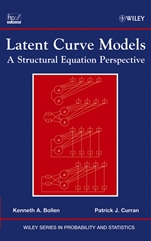
Latent Curve Models: A Structural Equation Perspective
ISBN 9780471455929
Autor: Kenneth A. Bollen, Patrick J. Curran
Wydawca: Wiley
Dostępność: 3-6 tygodni
Cena: 698,25 zł
Przed złożeniem zamówienia prosimy o kontakt mailowy celem potwierdzenia ceny.
ISBN13: |
9780471455929 |
ISBN10: |
047145592X |
Autor: |
Kenneth A. Bollen, Patrick J. Curran |
Oprawa: |
Hardback |
Rok Wydania: |
2006-01-31 |
Ilość stron: |
312 |
Wymiary: |
247x153 |
Tematy: |
JC |
An effective technique for data analysis in the social sciences
The recent explosion in longitudinal data in the social sciences highlights the need for this timely publication. Latent Curve Models: A Structural Equation Perspective provides an effective technique to analyze latent curve models (LCMs). This type of data features random intercepts and slopes that permit each case in a sample to have a different trajectory over time. Furthermore, researchers can include variables to predict the parameters governing these trajectories.
The authors synthesize a vast amount of research and findings and, at the same time, provide original results. The book analyzes LCMs from the perspective of structural equation models (SEMs) with latent variables. While the authors discuss simple regression–based procedures that are useful in the early stages of LCMs, most of the presentation uses SEMs as a driving tool. This cutting–edge work includes some of the authors′ recent work on the autoregressive latent trajectory model, suggests new models for method factors in multiple indicators, discusses repeated latent variable models, and establishes the identification of a variety of LCMs.
This text has been thoroughly class–tested and makes extensive use of pedagogical tools to aid readers in mastering and applying LCMs quickly and easily to their own data sets. Key features include:Chapter introductions and summaries that provide a quick overview of highlightsEmpirical examples provided throughout that allow readers to test their newly found knowledge and discover practical applicationsConclusions at the end of each chapter that stress the essential points that readers need to understand for advancement to more sophisticated topicsExtensive footnoting that points the way to the primary literature for more information on particular topics
With its emphasis on modeling and the use of numerous examples, t
his is an excellent book for graduate courses in latent trajectory models as well as a supplemental text for courses in structural modeling. This book is an excellent aid and reference for researchers in quantitative social and behavioral sciences who need to analyze longitudinal data.
Spis treści:
Preface.
1 Introduction.
1.1 Conceptualization and Analysis of Trajectories.
1.2 Three Initial Questions About Trajectories.
1.3 Brief History of Latent Curve Models.
1.4 Organization of the Remainder of the Book.
2 Unconditional Latent Curve Model.
2.1 Repeated Measures.
2.2 General Model and Assumptions.
2.3 Identification.
2.4 Case–By–Case Approach.
2.5 Structural Equation Model Approach.
2.6 Alternative Approaches to the SEM.
2.7 Conclusions.
Appendix 2A: Test Statistics, Nonnormality, and Statistical Power.
3 Missing Data and Alternative Metrics of Time.
3.1 Missing Data.
3.2 Missing Data and Alternative Metrics of Time.
3.3 Conclusions.
4 Nonlinear Trajectories and the Coding of Time.
4.1 Modeling Nonlinear Functions of Time.
4.2 Nonlinear Curve Fitting: Estimated Factor Loadings.
4.3 Piecewise Linear Trajectory Models.
4.4 Alternative Parametric Functions.
4.5 Linear Transformations of the Metric of Time.
4.6 Conclusions.
Appendix 4A: Identification of Quadratic and Piecewise Latent Curve Models.
4A.1 Quadratic LCM.
4A.2 Piecewise LCM.
5 Conditional Latent Curve Models.
5.1 Conditional Model and Assumptions.
5.2 Identification.
5.3 Structural Equation Modeling Approach.
5.4 Interpretation of Conditional Model Estimates.
5.5 Empirical Example.
5.6 Conclusions.
6 The Analysis of Groups.
6.1 Dummy Variable Approach.
6.2 Multiple–Group Analysis.
6.3 Unknown Group Membership.
6.4 Conclusions.
Appendix 6A: Case–by–Case Approach to Analysis of Various
Groups.
6A.1 Dummy Variable Method.
6A.2 Multiple–Group Analysis.
6A.3 Unknown Group Membership.
6A.4 Appendix Summary.
7 Multivariate Latent Curve Models.
7.1 Time–Invariant Covariates.
7.2 Time–Varying Covariates.
7.3 Simultaneous Inclusion of Time–Invariant and Time–Varying Covariates.
7.4 Multivariate Latent Curve Models.
7.5 Autoregressive Latent Trajectory Model.
7.6 General Equation for All Models.
7.7 Implied Moment Matrices.
7.8 Conclusions.
8 Extensions of Latent Curve Models.
8.1 Dichotomous and Ordinal Repeated Measures.
8.2 Repeated Latent Variables with Multiple Indicators.
8.3 Latent Covariates.
8.4 Conclusions.
References.
Author Index.
Subject Index.
Nota biograficzna:
KENNETH A. BOLLEN, PhD, is Henry Rudolph Immerwahr Distinguished Professor of Sociology, Director of the Odum Institute for Research in Social Science, and an Adjunct Professor of Statistics at The University of North Carolina at Chapel Hill. He is the author of two books, including Structural Equations with Latent Variables (Wiley), and more than 100 scholarly papers.
PATRICK J. CURRAN, PhD, is Associate Professor of Psychology in the L. L. Thurstone Psychometric Laboratory at The University of North Carolina at Chapel Hill. He has made contributions to the development and application of new quantitative methodologies in the social sciences through his integrated program of research, writing, and teaching.
Okładka tylna:
An effective technique for data analysis in the social sciences
The recent explosion in longitudinal data in the social sciences highlights the need for this timely publication. Latent Curve Models: A Structural Equation Perspective provides an effective technique to analyze latent curve models (LCMs). This type of data features random intercepts and slopes that permit each case in
a sample to have a different trajectory over time. Furthermore, researchers can include variables to predict the parameters governing these trajectories.
The authors synthesize a vast amount of research and findings and, at the same time, provide original results. The book analyzes LCMs from the perspective of structural equation models (SEMs) with latent variables. While the authors discuss simple regression–based procedures that are useful in the early stages of LCMs, most of the presentation uses SEMs as a driving tool. This cutting–edge work includes some of the authors′ recent work on the autoregressive latent trajectory model, suggests new models for method factors in multiple indicators, discusses repeated latent variable models, and establishes the identification of a variety of LCMs.
This text has been thoroughly class–tested and makes extensive use of pedagogical tools to aid readers in mastering and applying LCMs quickly and easily to their own data sets. Key features include:Chapter introductions and summaries that provide a quick overview of highlightsEmpirical examples provided throughout that allow readers to test their newly found knowledge and discover practical applicationsConclusions at the end of each chapter that stress the essential points that readers need to understand for advancement to more sophisticated topicsExtensive footnoting that points the way to the primary literature for more information on particular topics
With its emphasis on modeling and the use of numerous examples, this is an excellent book for graduate courses in latent trajectory models as well as a supplemental text for courses in structural modeling. This book is an excellent aid and reference for researchers in quantitative social and behavioral sciences who need to analyze longitudinal data.
Koszyk
Książek w koszyku: 0 szt.
Wartość zakupów: 0,00 zł
Informacje


Kontakt
Gambit
Centrum Oprogramowania
i Szkoleń Sp. z o.o.
Al. Pokoju 29b/22-24
31-564 Kraków
Siedziba Księgarni
ul. Kordylewskiego 1
31-542 Kraków
+48 12 410 5991
+48 12 410 5987
+48 12 410 5989
Subskrypcje
Administratorem danych osobowych jest firma Gambit COiS Sp. z o.o. Na podany adres będzie wysyłany wyłącznie biuletyn informacyjny.
Autoryzacja płatności

Informacje na temat autoryzacji płatności poprzez PayU.

© Copyright 2012: GAMBIT COiS Sp. z o.o. Wszelkie prawa zastrzeżone.
Projekt i wykonanie: Alchemia Studio Reklamy