


Wydawcy
Katalog tematyczny
- Archeologia (109)
- Ekonomia, finanse, business (13704)
- Filozofia (1445)
- Historia (3040)
- Języki i językoznawstwo (2356)
- Lifestyle, hobby i rozrywka (475)
- Medycyna (9704)
- Nauki humanistyczne (4)
- Nauki o Ziemi i środowisku (2638)
- Nauki ścisłe (20412)
- Nauki społeczne (8486)
- Nauki techniczne (13450)
- Budownictwo lądowe (1045)
- Chemia przemysłowa (2258)
- Elektronika i telekomunikacja (3287)
- Energetyka (1122)
- Inne nauki stosowane (363)
- Inżynieria biochemiczna (507)
- Inżynieria transportu (232)
- Mechanika i materiały (3316)
- Nauka o środowisku (321)
- Rolnictwo (507)
- Technika, ogólnie (475)
- Prawo (1696)
- Publikacje informacyjne i interdyscyplinarne (1288)
- Religia i wierzenia (917)
- Technika komputerowa (4067)
- Zdrowie, relacje międzyludzkie i rozwój osobisty (657)





Informacje szczegółowe o książce
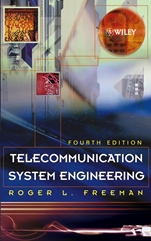
Telecommunication System Engineering
ISBN 9780471451334
Autor: Roger L. Freeman
Wydawca: Wiley
Dostępność: 3-6 tygodni
Cena: 995,40 zł
Przed złożeniem zamówienia prosimy o kontakt mailowy celem potwierdzenia ceny.
ISBN13: |
9780471451334 |
ISBN10: |
0471451339 |
Autor: |
Roger L. Freeman |
Oprawa: |
Hardback |
Rok Wydania: |
2004-06-25 |
Numer Wydania: |
4th Edition |
Ilość stron: |
1024 |
Wymiary: |
239x161 |
Tematy: |
TJ |
"A ‘must’ for anyone involved in the practical aspects of the telecommunications industry."
—Choice, on the Third Edition
A MAJOR NEW EDITION OF A LEADING REFERENCE ON TELECOMMUNICATION TECHNOLOGY
Through its three previous editions, Roger Freeman’s Telecommunication System Engineering has become a must–have reference on telecommunication networks. Since the third edition appeared in 1996, telecommunications has evolved exponentially, growing more multifaceted in its forms and applications, and more pervasive in everyday life.
This new edition of Telecommunication System Engineering answers the challenges of today’s telecommunication industry by presenting a technical overview of telecommunication networks from a system viewpoint, demonstrating how disciplines can interact to achieve desired goals. As in previous editions, Freeman covers all the concepts necessary for a complete understanding of the design of practical telecommunication networks, whether they carry voice, data, facsimile, telemetry, video, or any combination of these.
Approaching the information in a systematic and interactive way, the book:Uniquely covers both North American and ITU–T practiceDiscusses the dramatic changes that have taken place in the industry since the last editionIncludes new chapters on important hot topics such as asynchronous transfer mode, broadband technologies, network management, voice over IP, and connectivities of PCs via servers and networksDescribes the evolution of cellular radio from a mobile telephone service to mobile multimedia digital multi–access capability
Thoroughly up–to–date and comprehensive, Telecommunication System Engineering, Fourth Edition is an ideal reference or self–study source for telecommunications managers, technicians, engineers, and other practicing professionals as well as for advanced students in telecommunicatio
ns.
Spis treści:
Preface.
Chapter 1: Basic Telephony.
1 Definition and Concept.
1.1 Telecommunication Networks.
2 The Simple Telephone Connection.
3 Sources and Sinks.
4 Telephone Networks: Introductory Terminology.
5 Essentials of Traffic Engineering.
5.1 Introduction and Terminology.
5.2 Measurement of Telephone Traffic.
5.3 Blockage, Lost Calls, and Grade of Service.
5.4 Availability.
5.5 “Handling” of Lost Calls.
5.6 Infinite and Finite Sources.
5.7 Probability–Distribution Curves.
5.8 Smooth, Rough, and Random Traffic.
6 Erlang and Poisson Traffic Formulas.
6.1 Alternative Traffic Formula Conventions.
6.2 Computer Programs for Traffic Calculations.
7 Waiting Systems (Queueing).
7.1 Server–Pool Traffic.
8 Dimensioning and Efficiency.
8.1 Alternative Routing.
8.2 Efficiency versus Circuit Group Size.
9 Bases of Network Configurations.
9.1 Introductory Concepts.
9.2 Higher–Order Star Network.
10 Variations in Traffic Flow.
11 One–Way and Both–Way (Two–Way) Circuits.
12 Quality of Service.
Chapter 2: Local Networks.
1 Introduction.
2 Subscriber Loop Design.
2.1 General.
2.2 Quality of a Telephone Speech Connection.
2.3 Subscriber Loop Design Techniques.
3 Current Loop Design Techniques Used in North America.
3.1 Previous Design Rules.
3.2 Current Loop Design Rules.
4 Size of an Exchange Area Based on Number of Subscribers Served.
5 Shape of a Serving Area.
6 Exchange Location.
7 Design of Local Area Analog Trunks (Junctions).
8 Voice–Frequency Repeaters.
9 Tandem Routing.
10 Dimensioning of Trunks.
11 Community of Interest.
Chapter 3 Switching in an Analog Environment.
1 Introduction.
1.1 Background and Approach.
1.2 Switching in the Telephone Network.
2 Numbering, One Basis of Switching.
3 Concentration and
Expansion.
4 Basic Switching Functions.
5 Introductory Switching Concepts.
6 Electromechanical Switching.
7 Multiples and Links.
8 Definitions: Degeneration, Availability, and Grading.
8.1 Degeneration.
8.2 Availability.
8.3 Grading.
9 The Crossbar Switch.
10 System Control.
10.1 Introduction.
10.2 Interexchange Control Register.
10.3 Common Control (Hard–Wired).
11 Stored–Program Control.
11.1 Introduction.
11.2 Basic Functions of Stored–Program Control.
11.3 Evolutionary Stored Program Control and Distributed Processing.
12 Concentrators, Outside Plant Modules, Remote Switching, and Satellites.
13 Call Charging: European versus North American Approaches.
14 Transmission Factors in Switching.
14.1 Discussion.
15 Zero Test Level Point.
16 Numbering Concepts for Telephony.
16.1 Introduction.
16.2 Definitions.
16.3 Factors Affecting Numbering.
16.4 In–Dialing.
17 Telephone Traffic Measurement.
18 Dial–Service Observation.
Chapter 4: Signaling for Analog Telephone Networks.
1 Introduction.
2 Supervisory Signaling.
2.1 E and M Signaling.
3 AC Signaling.
3.1 General.
3.2 Low–Frequency AC Signaling Systems.
3.3 In–Band Signaling.
3.4 Out–of–Band Signaling.
4 Address Signaling: Introduction.
4.1 Two–Frequency Pulse Signaling.
4.2 Multifrequency Signaling.
5 Compelled Signaling.
6 Link–by–Link versus End–to–End Signaling.
7 The Effects of Numbering on Signaling.
8 Associated and Disassociated Channel Signaling.
9 Signaling in the Subscriber Loop.
9.1 Background and Purpose.
10 Metallic Trunk Signaling.
10.1 Basic Loop Signaling.
10.2 Reverse–Battery Signaling.
Chapter 5: Introduction to Transmission for Telephony.
1 Purpose and Scope.
2 The Three Basic Impairments to Voice Channel Transmission.
2.1 Attenuation D
istortion.
2.2 Phase Distortion.
2.3 Noise.
2.4 Level.
2.5 Signal–to–Noise Ratio.
3 Two–Wire and Four–Wire Transmission.
3.1 Two–Wire Transmission.
3.2 Four–Wire Transmission.
3.3 Operation of a Hybrid.
3.4 Notes on the Digital Network in the Local Area.
4 Multiplexing.
4.1 Definition and Introduction.
4.2 Frequency Division Multiplex (FDM).
5 Shaping of a Voice Channel and its Meaning in Noise Measurement Units.
Chapter 6: Long–Distance Networks.
1 General.
2 The Design Problem.
3 Link Limitation.
4 International Network.
5 Exchange Location (Toll/Long–Distance Network).
5.1 Toll Areas.
6 Network Design Procedures.
7 Traffic Routing in the National Network.
7.1 Objective of Routing.
7.2 Network Topology.
7.3 Routing Scheme.
7.4 Route Selection.
7.5 Call Control Procedures.
7.6 Applications.
8 Transmission Factors in Long–Distance Telephony.
8.1 Introduction.
8.2 Definition of Echo and Singing.
8.3 Causes of Echo and Singing.
8.4 Transmission Design to Control Echo and Singing.
8.5 Introduction to Transmission–Loss Engineering.
8.6 Loss Plan for the Evolving Digital Networks (United States).
Chapter 7: The Design of Long–Distance Links.
1 Introduction.
2 The Bearer.
3 Introduction to Radio Transmission.
4 Design Essentials for Line–of–Sight Microwave Systems.
4.1 Introduction.
4.2 Setting Performance Requirements.
4.3 Site Selection and Preparation of a Path Profile.
4.4 Path Analysis or Link Budget.
4.5 Running a Path/Site Survey.
4.6 System Test Prior to Cutover.
4.7 Fades, Fading, and Fade Margins.
4.8 Diversity and Hot–Standby Operation.
4.9 LOS Microwave Repeaters.
4.10 Frequency Planning and Frequency Assignment.
5 Satellite Communications.
5.1 Introduction.
5.2 Application.
5.3 Definition.
5.4 The Sa
Koszyk
Książek w koszyku: 0 szt.
Wartość zakupów: 0,00 zł
Informacje


Kontakt
Gambit
Centrum Oprogramowania
i Szkoleń Sp. z o.o.
Al. Pokoju 29b/22-24
31-564 Kraków
Siedziba Księgarni
ul. Kordylewskiego 1
31-542 Kraków
+48 12 410 5991
+48 12 410 5987
+48 12 410 5989
Subskrypcje
Administratorem danych osobowych jest firma Gambit COiS Sp. z o.o. Na podany adres będzie wysyłany wyłącznie biuletyn informacyjny.
Autoryzacja płatności

Informacje na temat autoryzacji płatności poprzez PayU.

© Copyright 2012: GAMBIT COiS Sp. z o.o. Wszelkie prawa zastrzeżone.
Projekt i wykonanie: Alchemia Studio Reklamy