


Wydawcy
Katalog tematyczny
- Archeologia (109)
- Ekonomia, finanse, business (13704)
- Filozofia (1445)
- Historia (3040)
- Języki i językoznawstwo (2356)
- Lifestyle, hobby i rozrywka (475)
- Medycyna (9704)
- Nauki humanistyczne (4)
- Nauki o Ziemi i środowisku (2638)
- Nauki ścisłe (20412)
- Astronomia (294)
- Biologia (5119)
- Chemia (6540)
- Chemia analityczna (361)
- Chemia fizyczna (346)
- Chemia nieorganiczna (137)
- Chemia organiczna (535)
- Krystalografia (27)
- Minerologia (46)
- Fizyka (3309)
- Matematyka (4574)
- Nauki ścisłe, ogólnie (503)
- Nauki społeczne (8486)
- Nauki techniczne (13450)
- Prawo (1696)
- Publikacje informacyjne i interdyscyplinarne (1288)
- Religia i wierzenia (917)
- Technika komputerowa (4067)
- Zdrowie, relacje międzyludzkie i rozwój osobisty (657)





Informacje szczegółowe o książce
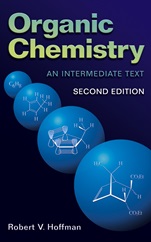
Organic Chemistry: An Intermediate Text
ISBN 9780471450245
Autor: Robert V. Hoffman
Wydawca: Wiley
Dostępność: 3-6 tygodni
Cena: 751,80 zł
Przed złożeniem zamówienia prosimy o kontakt mailowy celem potwierdzenia ceny.
ISBN13: |
9780471450245 |
ISBN10: |
0471450243 |
Autor: |
Robert V. Hoffman |
Oprawa: |
Hardback |
Rok Wydania: |
2004-09-21 |
Numer Wydania: |
2nd Edition |
Ilość stron: |
496 |
Wymiary: |
239x168 |
Tematy: |
PN |
A foundation for success in advanced organic chemistry courses–and careers
Graduate students taking advanced organic chemistry courses often need a refresher on the discipline before they can move on to more specialized topics. This is especially true of students whose last formal exposure to organic chemistry was during their undergraduate studies. Organic Chemistry: An Intermediate Text bridges this gap, reacquainting students with basic organic chemistry while introducing them to the most important advanced topics in the field today.
The book presents a principles–focused discussion of organic chemistry from a unique mechanistic and structural perspective. Beginning with the classification of functional groups by bonding patterns and oxidation levels, it describes general mechanistic considerations vital to the understanding of functional group transformations–from electron movement to stereoelectronic effects. Building on this mechanistic framework, the text then provides insight into synthetic transformations commonly employed in modern organic chemistry.
Updated and revised throughout, the Second Edition of Organic Chemistry: An Intermediate Text features: A stronger emphasis on mechanisms An expanded overview of resonance and aromaticityA new section on uses of organopalladium chemistry and olefin metathesis in carbon–carbon bond formationA revised examination of free radical reactions for carbon–carbon bond formationA fuller discussion of Diels–Alder chemistry
Chapter–ending problems, many of which are new to this edition, help to reinforce pivotal concepts required to fully comprehend the text material. This book is illustrated with abundant structures and figures that demonstrate these concepts.
Spis treści:
Preface.
Preface to the First Edition.
1 Functional Groups and Chemical Bonding.
Function
al Groups.
Orbitals.
Bonding Schemes.
Antibonding Orbitals.
Resonance.
Conjugated π Systems.
Aromaticity.
Bibliography.
Problems.
2 Oxidation States of Organic Compounds.
Oxidation Levels.
Oxidation States in Alkanes.
Oxidation States in Alkenes.
Oxidation States in Common Functional Groups.
Oxidation Level Changes During Reactions.
Bibliography.
Problems.
3 Acidity and Basicity.
Bronsted and Lewis Acids and Bases.
Acid Strength.
Acid–Base Equilibria.
Amphoteric Compounds.
Structural Effects on Acidity.
Electronegativity.
Inductive Effects.
Resonance Effects.
Bibliography.
Problems.
4 Curved–Arrow Notation.
Electron Movement.
Heterolytic Bond Cleavages.
Heterolytic Bond Formation.
Homolytic Bond Making and Bond Breaking.
Resonance Structures.
Depiction of Mechanism.
Bibliography.
Problems.
5 Mechanisms of Organic Reactions
Activation Energy.
Activated Complex.
Reaction Energetics.
Structure of the Activated Complex.
Hammond Postulate.
Reaction Kinetics.
Determining Activation Energies.
Isotope Effects.
Electronic Effects.
Hammett Equation.
Bibliography.
Problems.
6 Stereochemical and Conformational Isomerism.
Stereochemical Structures.
Chirality.
Configuration of Chiral Centers.
Multiple Stereocenters.
Optical Activity.
Absolute Configuration.
Physical Properties of Enantiomers.
Resolution of Enantiomers.
Stereoselective Reactions.
Formation of Enantiomers.
Formation of Diastereomers.
Stereochemistry to Deduce Mechanism.
Conformational Analysis.
Conformational Energies.
A Values.
Strain in Ring Systems.
Stereoelectronic Effects.
Bibliography.
Problems.
7 Functional Group Synthesis.
Functional Group Manipulation.
Carboxylic Acids.
Esters.
Amides.
Acid Chlorides.
Aldehyde
s.
Ketones.
Imines and Imine Derivatives.
Alcohols.
Amines.
Alkenes.
Alkanes.
Bibliography.
Problems.
8 Carbon–Carbon Bond Formation between Carbon Nucleophiles and Carbon Electrophiles.
Synthetic Strategy.
Nucleophilic Carbon.
Electrophilic Carbon.
Reactivity Matching.
Generation of Nucleophilic Carbon Reagents.
Generation of Electrophilic Carbon Reagents.
Matching Nucleophiles with Electrophiles.
Enolates.
Enolate Regioisomers.
Diastereoselection in Aldol Reactions.
Organometallic Compounds.
Neutral Carbon Nucleophiles.
C=C Formation.
Cyclopropanation Reactions.
Metal–Catalyzed Carbon–Carbon Bond Formation.
Pd(0)–Catalyzed Carbon–Carbon Bond Formation.
Heck Reaction.
Suzuki Coupling.
Stille Coupling.
Olefin Metathesis.
Bibliography.
Problems.
9 Carbon–Carbon Bond Formation by Free–Radical Reactions.
Free–Radical Reactions.
Free–Radical Polymerization.
Nonpolymerization Reactions.
Free–Radical Initiation.
Free–Radical Cyclization.
Bibliography.
Problems.
10 Planning Organic Syntheses.
Retrosynthetic Analysis.
Carbon Skeleton Synthesis.
Umpolung Synthons.
Acetylide Nucleophiles.
Ring Construction.
Robinson Annulation.
Diels–Alder Reaction.
HOMO–LUMO Interactions.
Stereoelectronic Factors.
1,3–Dipolar Cycloadditions.
Bibliography.
Problems.
11 Structure Determination of Organic Compounds.
Structure Determination.
Chromatographic Purification.
Instrumental Methods.
Nuclear Magnetic Resonance.
Chemical Shift.
Spin–Spin Coupling.
Descriptions of Spin Systems.
Second–Order Splitting.
Structure Identification by 1H NMR.
Carbon–13 NMR.
Infrared Spectroscopy.
IR Stretching Frequencies.
Use of IR Spectroscopy for Structure Determination.
Mass Spectr
ometry.
Fragmentation Processes.
Bibliography.
Problems.
Solutions to Chapter Problems.
Index.
Nota biograficzna:
ROBERT V. HOFFMAN, PhD, is Professor Emeritus of Chemistry at New Mexico State University in Las Cruces, New Mexico.
Okładka tylna:
A foundation for success in advanced organic chemistry courses–and careers
Graduate students taking advanced organic chemistry courses often need a refresher on the discipline before they can move on to more specialized topics. This is especially true of students whose last formal exposure to organic chemistry was during their undergraduate studies. Organic Chemistry: An Intermediate Text bridges this gap, reacquainting students with basic organic chemistry while introducing them to the most important advanced topics in the field today.
The book presents a principles–focused discussion of organic chemistry from a unique mechanistic and structural perspective. Beginning with the classification of functional groups by bonding patterns and oxidation levels, it describes general mechanistic considerations vital to the understanding of functional group transformations–from electron movement to stereoelectronic effects. Building on this mechanistic framework, the text then provides insight into synthetic transformations commonly employed in modern organic chemistry.
Updated and revised throughout, the Second Edition of Organic Chemistry: An Intermediate Text features: A stronger emphasis on mechanisms An expanded overview of resonance and aromaticityA new section on uses of organopalladium chemistry and olefin metathesis in carbon–carbon bond formationA revised examination of free radical reactions for carbon–carbon bond formationA fuller discussion of Diels–Alder chemistry
Chapter–ending problems, many of which are new to this edition, help to rei
nforce pivotal concepts required to fully comprehend the text material. This book is illustrated with abundant structures and figures that demonstrate these concepts.
Koszyk
Książek w koszyku: 0 szt.
Wartość zakupów: 0,00 zł
Informacje


Kontakt
Gambit
Centrum Oprogramowania
i Szkoleń Sp. z o.o.
Al. Pokoju 29b/22-24
31-564 Kraków
Siedziba Księgarni
ul. Kordylewskiego 1
31-542 Kraków
+48 12 410 5991
+48 12 410 5987
+48 12 410 5989
Subskrypcje
Administratorem danych osobowych jest firma Gambit COiS Sp. z o.o. Na podany adres będzie wysyłany wyłącznie biuletyn informacyjny.
Autoryzacja płatności

Informacje na temat autoryzacji płatności poprzez PayU.

© Copyright 2012: GAMBIT COiS Sp. z o.o. Wszelkie prawa zastrzeżone.
Projekt i wykonanie: Alchemia Studio Reklamy