


Wydawcy
Katalog tematyczny
- Archeologia (109)
- Ekonomia, finanse, business (13704)
- Filozofia (1445)
- Historia (3040)
- Języki i językoznawstwo (2356)
- Lifestyle, hobby i rozrywka (475)
- Medycyna (9704)
- Nauki humanistyczne (4)
- Nauki o Ziemi i środowisku (2638)
- Nauki ścisłe (20412)
- Nauki społeczne (8486)
- Nauki techniczne (13450)
- Prawo (1696)
- Publikacje informacyjne i interdyscyplinarne (1288)
- Religia i wierzenia (917)
- Technika komputerowa (4067)
- Zdrowie, relacje międzyludzkie i rozwój osobisty (657)





Informacje szczegółowe o książce
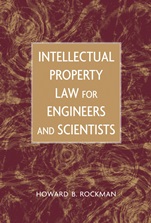
Intellectual Property Law for Engineers and Scientists
ISBN 9780471449980
Autor: Howard B. Rockman
Wydawca: Wiley
Dostępność: 3-6 tygodni
Cena: 595,35 zł
Przed złożeniem zamówienia prosimy o kontakt mailowy celem potwierdzenia ceny.
ISBN13: |
9780471449980 |
ISBN10: |
0471449989 |
Autor: |
Howard B. Rockman |
Oprawa: |
Hardback |
Rok Wydania: |
2004-06-25 |
Ilość stron: |
544 |
Wymiary: |
260x189 |
Tematy: |
LA |
" Today, IP is the currency of our new economy . "
–Forbes Asap
Protect your intellectual property rights
Knowledge is power and nowhere is that more apparent than in today’s information–driven, high technology economy. Fueled by the growing demand for new and improved technology, engineers, scientists, and the companies that employ them and manage technology have a vested interest in protecting the wealth generated by their innovative ideas and inventions.
Addressing this growing need, Intellectual Property Law for Engineers and Scientists avoids difficult legal jargon to clearly explain the fundamentals of patent, copyright, trade secret, trademark, mask work, and unfair competition laws, as they apply to the scientific and engineering community. To motivate readers, each chapter begins with an inspirational essay on a famous inventor and invention.
This is the book to read before consulting a lawyer. The author, an experienced patent attorney, educator, and former patent examiner, provides valuable and easy–to–access legal information on a variety of common professional concerns, such as:Maintaining confidentiality in new employment contractsObtaining software protection Applying for patents, trademarks, or copyrightsProtecting against unfair competitionEntering into contracts and employment agreementsStrategic use and management of intellectual propertyThe entrepreneurial use of intellectual property
Replete with sample forms of pertinent documents and helpful points to consider regarding all aspects of intellectual property, Intellectual Property Law for Engineers and Scientists provides valuable information every high–tech professional should read to protect themselves against potential loss or liability.
Spis treści:
Foreword.
Preface.
Acknowledgments.
Top Ten List of Int
ellectual Property Protection.
Eli Whitney.
1 Overview of Intellectual Property Law.
1.1 Defining “Intellectual Property”.
1.2 Specific Intellectual Property Vehicles.
1.2.1 Patents.
1.2.2 Trademarks and Service Marks.
1.2.3 Copyrights.
1.2.4 Trade Secrets.
1.2.5 Mask Works for Semiconductors.
1.3 Which Form of Intellectual Property Protection to Use?
Cyrus McCormick.
2 The Use of Intellectual Property in Business.
2.1 Introduction to Intellectual Property Strategies.
2.2 Objectives of Intellectual Property Management.
2.3 Sole Inventor in an Alien Field.
2.4 Strategic Development of Intellectual Property.
2.5 Disgorging Patentable Inventions.
2.6 Determining What and What Not to Patent.
2.6.1 Search Results.
2.6.2 Business Factors Determining Whether to Obtain Patent Protection.
2.7 Determining Who Would Be an Appropriate Licensee to Exploit Your Invention.
2.8 Drafting Strategic Patent Claims.
2.9 Determining Where to Obtain Patents.
2.10 Determining Other Industries Which May Benefit from a License.
2.11 Ensuring Your Product Does Not Violate the Patent Rights of Others.
2.12 Policing the Market for Potential Infringements of Your Patents
2.13 The Enforcement of Process Patent Claims Against an Importer of a Product Made Abroad.
2.14 Trimming the Intellectual Property Tree.
2.15 Essay on Innovation Management.
Charles Goodyear.
3 How to Read and Obtain Information from a Modern U.S. Patent.
3.1 Information Page.
3.2 Drawings.
3.3 Specification.
3.4 Claims.
3.5 Warning.
George Westinghouse.
4 Introduction to Patents.
4.1 Brief History of Patent Protection.
4.1.1 Early European Patent Custom.
4.1.2 British Patent System.
4.1.3 The U.S. Constitution and the Development of the Present U.S. Patent Examination System.
4.2 Types of Patent Coverage.
4.2.1 What Is a Pate
nt?
4.2.2 Article or Apparatus Patents.
4.2.3 Method or Process Patents.
4.2.4 Design Patents.
4.2.5 Plant Patents.
4.2.6 New Technologies.
4.3 How to Determine What to Patent and What Not to Patent.
4.3.1 Broadly, What Can and Cannot Be Patented Under the Law.
4.3.2 From a Business Standpoint, What Should Be Patented.
4.4 Broadly, What Data Goes Into a Patent.
4.4.1 Describing the Background and Essential Elements of the Invention.
4.4.2 Claiming the Invention.
4.5 What a Patent Is Not.
4.6 Inventions Relating to Atomic Weapons.
4.7 The U.S. Government’s Right to Practice Your Patented Invention.
John Deere.
5 Patentable Subject Matter and Utility.
5.1 What Constitutes Patentable Subject Matter.
5.1.1 Categories of Patentable Subject Matter.
5.1.2 The Invention Must Be Useful and Work for Its Intended Purpose.
5.1.3 The Invention Must Be Novel Compared to the Prior Art.
5.1.4 The Invention Must Be Non–Obvious Compared to the Prior Art.
5.1.5 Brief Commentary on Recent Developments in Categories of Patentable Subject Matter.
5.2 Utility—The Invention Must Be Useful.
Alfred Nobel.
6 Novelty—The Invention Must Be New.
6.1 Statutory Requirements.
6.1.1 Time Limits for Filing a Patent Application 81
6.1.2 Prior Art Activities of the Inventor and Others That Can Defeat Patent Rights.
6.1.3 Prior Publications, U.S. and Foreign, as Prior Art.
6.2 Protecting Foreign Patent Rights.
6.3 Experimental Use Versus Actual Use of the Invention.
Louis Pasteur.
7 Requirement of Non–Obviousness for Patentability.
7.1 Development of the Standard of Non–Obviousness.
7.2 Historical Background.
7.3 Supreme Court Cases Predating the Section 103 Non–Obviousness Test.
7.3.1 Hotchkiss v. Greenwood, Supreme Court, 1850 94
7.3.2 Atlantic Works v. Brady, Supreme Court, 1882 94
7.3.3
Goodyear Rubber and Tire Company v. Ray–O–Vac Company, Supreme Court, 1944.
7.3.4 Cuno Engineering Corporation v. Automatic Devices Corporation, Supreme Court, 1941.
7.3.5 The Great Atlantic and Pacific Tea Company v. Supermarket Equipment Corporation, Supreme Court, 1950.
7.4 The 1952 Patent Statute and the Case of Graham v. John Deere Company.
Alexander Graham Bell.
8 The Patenting Process.
8.1 Who May Obtain a Patent.
8.1.1 Inventorship and Ownership.
8.1.2 True Inventors Must Be Named.
8.2 Proper Documentation of the Invention.
8.2.1 Conception.
8.2.2 Reduction to Practice.
8.2.3 Witnesses.
8.3 The Invention Disclosure and Invention Disclosure Meeting.
8.3.1 Preparation of a Complete Description of the Invention, How the Invention Operates, and What Advantageous Results Are Obtained by the Invention.
8.3.2 Dates of First Public Disclosure, If Any, and What Was Disclosed.
8.3.3 Advantages of the Invention Over Known Devices/Processes.
8.3.4 What Prior Art Is the Inventor Aware of for Disclosure to the Patent Examiner.
8.3.5 Additional Matters Discussed During the Invention Disclosure Meeting Between the Inventor and the Patent Attorney.
8.3.6 Invention Disclosure Form.
Thomas Edison.
9 Novelty, Infringement, and Other Searches.
9.1 The Novelty Search.
9.2 Search Parameters.
9.3 Different Types of Searches.
9.3.1 Infringement Search.
9.3.2 State–of–the–Art Search.
9.3.3 Right to Use Search.
9.4 Database Searches.
9.4.1 U.S. Patent and Trademark Office Patent Classification System.
George Eastman.
10 Patent Application.
10.1 Introduction.
10.2 Registration System Evolving into an Examination System.
10.3 Goal of a Properly Prepared Patent Application.
10.4 Provisional Patent Applications.
10.5 Regular, Non–Provisional Patent Application.
10.6 Content
Koszyk
Książek w koszyku: 0 szt.
Wartość zakupów: 0,00 zł
Informacje


Kontakt
Gambit
Centrum Oprogramowania
i Szkoleń Sp. z o.o.
Al. Pokoju 29b/22-24
31-564 Kraków
Siedziba Księgarni
ul. Kordylewskiego 1
31-542 Kraków
+48 12 410 5991
+48 12 410 5987
+48 12 410 5989
Subskrypcje
Administratorem danych osobowych jest firma Gambit COiS Sp. z o.o. Na podany adres będzie wysyłany wyłącznie biuletyn informacyjny.
Autoryzacja płatności

Informacje na temat autoryzacji płatności poprzez PayU.

© Copyright 2012: GAMBIT COiS Sp. z o.o. Wszelkie prawa zastrzeżone.
Projekt i wykonanie: Alchemia Studio Reklamy