


Wydawcy
Katalog tematyczny
- Archeologia (109)
- Ekonomia, finanse, business (13704)
- Filozofia (1445)
- Historia (3040)
- Języki i językoznawstwo (2356)
- Lifestyle, hobby i rozrywka (475)
- Medycyna (9704)
- Nauki humanistyczne (4)
- Nauki o Ziemi i środowisku (2638)
- Nauki ścisłe (20412)
- Nauki społeczne (8486)
- Nauki techniczne (13450)
- Budownictwo lądowe (1045)
- Chemia przemysłowa (2258)
- Elektronika i telekomunikacja (3287)
- Energetyka (1122)
- Inne nauki stosowane (363)
- Inżynieria biochemiczna (507)
- Inżynieria transportu (232)
- Mechanika i materiały (3316)
- Nauka o środowisku (321)
- Rolnictwo (507)
- Technika, ogólnie (475)
- Prawo (1696)
- Publikacje informacyjne i interdyscyplinarne (1288)
- Religia i wierzenia (917)
- Technika komputerowa (4067)
- Zdrowie, relacje międzyludzkie i rozwój osobisty (657)





Informacje szczegółowe o książce
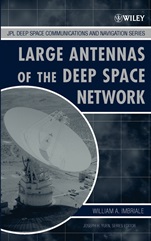
Large Antennas of the Deep Space Network
ISBN 9780471445371
Autor: William A. Imbriale, Joseph H. Yuen
Wydawca: Wiley
Dostępność: 3-6 tygodni
Cena: 1 113,00 zł
Przed złożeniem zamówienia prosimy o kontakt mailowy celem potwierdzenia ceny.
ISBN13: |
9780471445371 |
ISBN10: |
0471445371 |
Autor: |
William A. Imbriale, Joseph H. Yuen |
Oprawa: |
Hardback |
Rok Wydania: |
2003-02-25 |
Ilość stron: |
320 |
Wymiary: |
236x165 |
Tematy: |
TJ |
An important historical look at the space program’s evolving telecommunications systems
Large Antennas of the Deep Space Network traces the development of the antennas of NASA’s Deep Space Network (DSN) from the network’s inception in 1958 to the present. It details the evolution of the large parabolic dish antennas, from the initial 26–m operation at L–band (960 MHz) through the current Ka–band (32 GHz) systems. Primarily used for telecommunications, these antennas also support radar and radio astronomy observations in the exploration of the solar system and the universe. In addition, the author also offers thorough treatment of the analytical and measurement techniques used in design and performance assessment.
Large Antennas of the Deep Space Network represents a vital addition to the literature in that it includes NASA–funded research that significantly impacts on deep space telecommunications. Part of the prestigious JPL Deep Space Communications and Navigation Series, it captures fundamental principles and practices developed during decades of deep space exploration, providing information that will enable antenna professionals to replicate radio frequencies and optics designs.
Designed as an introduction for students in the field as well as a reference for advanced practitioners, the text assumes a basic familiarity with engineering and mathematical concepts and technical terms.
The Deep Space Communications and Navigation Series is authored by scientists and engineers with extensive experience in astronautics, communications, and related fields. It lays the foundation for innovation in the areas of deep space navigation and communications by disseminating state–of–the–art knowledge in key technologies.
Spis treści:
Foreword.
Preface.
Acknowledgments.
Chapter 1 : Introduction.
1.1 Technology Drivers.
1.1.1 Fre
quency Bands Allocated to the Deep Space Network.
1.2 Analysis Techniques for Designing Reflector Antennas.
1.2.1 Radiation–Pattern Analysis.
1.2.2 Feed–Horn Analysis.
1.2.3 Spherical–Wave Analysis.
1.2.4 Dual–Reflector Shaping.
1.2.5 Quasioptical Techniques.
1.2.6 Dichroic Analysis.
1.2.7 Antenna Noise–Temperature Determination.
1.3 Measurement Techniques.
1.3.1 Theodolite Measurements.
1.3.2 Microwave Holography.
1.3.3 Aperture Gain and Efficiency Measurements.
1.3.4 Noise–Temperature Measurements.
1.4 Techniques for Designing Beam–Waveguide Systems.
1.4.1 Highpass Design.
1.4.2 Focal–Plane Matching.
1.4.3 Gaussian–Beam Design.
1.4.4 High–Power Design.
1.5 Summary.
References.
Chapter 2: Deep Space Station 11: Pioneer–The First Large Deep Space Network Cassegrain Antenna.
2.1 Introduction to the Cassegrain Concept.
2.2 Factors Influencing Cassegrain Geometry.
2.3 The DSS–11, 26–Meter Cassegrain System.
References.
Chapter 3: Deep Space Station 12: Echo.
3.1 The S–Band Cassegrain Monopulse Feed Horn.
3.2 The 26–Meter S–/X–Band Conversion Project.
3.2.1 Performance Predictions.
3.2.2 Performance Measurements.
3.3 The Goldstone–Apple Valley Radio Telescope.
References.
Chapter 4: Deep Space Station 13: Venus.
4.1 The Dual–Mode Conical Feed Horn.
4.2 Gain Calibration.
References.
Chapter 5: Deep Space Station 14: Mars.
5.1 Antenna Structure.
5.2 S.Band. 1966.
5.3 Performance at X–Band.
5.3.1 Surface Tolerance.
5.3.2 Measured X–Band Performance.
5.4 Tricone Multiple Cassegrain Feed System.
5.4.1 Radio Frequency Performance.
5.4.2 New Wideband Feed Horns.
5.4.3 Dual–Hybrid–Mode Feed Horn.
5.5 Reflex–Dichroic Feed System.
5.6 L–Band.
5.6.1 Desi
gn Approach.
5.6.2 Performance Predictions and Measurements.
5.6.3 L–Band System Modifications.
5.7 The Upgrade from 64 Meters to 70 Meters.
5.7.1 Design and Performance Predictions.
5.7.2 S– and X–Band Performance.
5.7.3 Ka–Band Performance.
5.7.4 Adding X–Band Uplink.
5.8 Distortion Compensation.
5.8.1 Deformable Flat Plate.
5.8.2 Array–Feed Compensation System.
5.8.3 The Array–Feed Compensation System–Deformable Flat–Plate Experiment.
5.8.4 Projected Ka–Band Performance.
5.9 Future Interests and Challenges.
References.
Chapter 6: Deep Space Station 15: Uranus–The First 34–Meter High–Efficiency Antenna.
6.1 The Common–Aperture Feed.
6.2 Dual–Reflector Shaping.
6.3 Computed versus Measured Performance.
References.
Chapter 7: The 34–Meter Research and Development Beam–Waveguide Antenna.
7.1 New Analytical Techniques.
7.2 Beam–Waveguide Test Facility.
7.3 The New Antenna.
7.3.1 Antenna Design Considerations.
7.3.2 Upper–Mirror Optics Design.
7.3.3 Pedestal Room Optics Design.
7.3.4 Bypass Beam–Waveguide Design.
7.3.5 Theoretical Performance.
7.3.6 Dual–Shaped Reflector Design.
7.3.7 The Effect of Using the DSS–I 5 Main Reflector Panel Molds for Fabricating DSS–13 Panels.
7.4 Phase I Measured Results.
7.4.1 The X– and Ka–Band Test Packages.
7.4.2 Noise Temperature.
7.4.3 Efficiency Calibration at 8.45 and 32 GHz.
7.4.4 Optimizing the G/T Ratio of the Beam– Waveguide Antenna.
7.4.5 Beam–Waveguide Antenna Performance in the Bypass Mode.
7.5 Removal of the Bypass Beam Waveguide.
7.6 Multifrequency Operation.
7.6.1 X–IKa–Band System.
7.6.2 S–Band Design.
7.7 Bearn–Waveguide Versatility.
References.
Chapter 8: The 34–Meter Beam–
;Waveguide Operational Antennas.
8.1 Bearn–Waveguide Design.
8.2 Initial Testing.
8.2.1 Microwave Holography Measurements.
8.2.2 Efficiency Measurements.
8.2.3 Noise–Temperature Results.
8.2.4 Theshroud.
8.3 Adding Ka–Band to the Operational 34–Meter Bearn–Waveguide Antennas.
8.3.1 The Cassini Radio Science Ka–Band Ground System.
8.3.2 Ka–Band Upgrades–Receive–Only System.
References.
Chapter 9: The Antenna Research System Task.
9.1 Design of the Beam–Waveguide System.
9.2 Design of the Transmit Feed Horn.
9.3 Receive–System Design.
9.4 Dual–Vane Polarizers.
9.5 Uplink Arraying.
9.6 Deep Space Station 27.
References.
Chapter 10: The Next–Generation Deep Space Network.
10.1 The Study to Replace 70–Meter Antennas.
10.1 . 1 Extending the Life of the Existing 70–Meter Antennas.
10.1.2 Designing a New 70–Meter Single–Aperture Antenna.
10.1.3 Arraying Four 34–Meter Aperture Antennas.
10.1. 4 Arraying Small Antennas.
10.1.5 Arraying Flat–Plate Antennas.
10.1.6 Implementing a Spherical Pair of High–Efficiency Reflecting Elements Antenna Concept.
10.2 Towards the Interplanetary Network.
10.3 Final Thoughts.
References.
Acronyms and Abbreviations.
Nota biograficzna:
WILLIAM A. IMBRIALE is Senior Research Engineer at the California Institute of Technology’s Jet Propulsion Laboratory.
Okładka tylna:
An important historical look at the space program’s evolving telecommunications systems
Large Antennas of the Deep Space Network traces the development of the antennas of NASA’s Deep Space Network (DSN) from the network’s inception in 1958 to the present. It details the evolution of the large parabol
Koszyk
Książek w koszyku: 0 szt.
Wartość zakupów: 0,00 zł
Informacje


Kontakt
Gambit
Centrum Oprogramowania
i Szkoleń Sp. z o.o.
Al. Pokoju 29b/22-24
31-564 Kraków
Siedziba Księgarni
ul. Kordylewskiego 1
31-542 Kraków
+48 12 410 5991
+48 12 410 5987
+48 12 410 5989
Subskrypcje
Administratorem danych osobowych jest firma Gambit COiS Sp. z o.o. Na podany adres będzie wysyłany wyłącznie biuletyn informacyjny.
Autoryzacja płatności

Informacje na temat autoryzacji płatności poprzez PayU.

© Copyright 2012: GAMBIT COiS Sp. z o.o. Wszelkie prawa zastrzeżone.
Projekt i wykonanie: Alchemia Studio Reklamy