


Wydawcy
Katalog tematyczny
- Archeologia (109)
- Ekonomia, finanse, business (13704)
- Filozofia (1445)
- Historia (3040)
- Języki i językoznawstwo (2356)
- Lifestyle, hobby i rozrywka (475)
- Medycyna (9704)
- Nauki humanistyczne (4)
- Nauki o Ziemi i środowisku (2638)
- Nauki ścisłe (20412)
- Nauki społeczne (8486)
- Nauki techniczne (13450)
- Prawo (1696)
- Publikacje informacyjne i interdyscyplinarne (1288)
- Religia i wierzenia (917)
- Technika komputerowa (4067)
- Zdrowie, relacje międzyludzkie i rozwój osobisty (657)





Informacje szczegółowe o książce
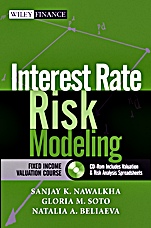
Interest Rate Risk Modeling: The Fixed Income Valuation Course
ISBN 9780471427247
Autor: Sanjay K. Nawalkha, Gloria M. Soto, Natalia A. Beliaeva
Wydawca: Wiley
Dostępność: 3-6 tygodni
Cena: 341,25 zł
Przed złożeniem zamówienia prosimy o kontakt mailowy celem potwierdzenia ceny.
ISBN13: |
9780471427247 |
ISBN10: |
0471427241 |
Autor: |
Sanjay K. Nawalkha, Gloria M. Soto, Natalia A. Beliaeva |
Oprawa: |
Hardback |
Rok Wydania: |
2005-06-03 |
Ilość stron: |
432 |
Wymiary: |
234x163 |
Tematy: |
KF |
Praise for Interest Rate Risk Modeling
"This first book in the fixed income valuation course provides a solid, up–to–date introduction to the field of interest rate risk, and covers all bases in leading up to the complex area of fixed–income option models. For the more experienced, this is an excellent guide to the state of the art, and provides models coupled with software to make the practical use of the ideas therein feasible."
—Sanjiv Ranjan Das, Co–Editor, Journal of Derivatives, and Associate Professor of Finance, Santa Clara University
"The trilogy on the fixed income course is the first one with hands on Excel/VBA software for fixed income professionals. These are terrific books for all fixed income practitioners."
—Frank J. Fabozzi, Editor, Journal of Portfolio Management, and Frederick Frank Adjunct Professor of Finance, Yale University .
"The authors are commended in expositing the many interest rate risk measures in a coherent way. This book describes the theories, implementations and applications of these measures with clarity and rigor. Further, the software assists students and practitioners alike to learn about them effectively."
—Thomas Ho, Co–Author, The Oxford Guide to Financial Modeling, and President, Thomas Ho Company
"Not only does the book provide an excellent explanation of interest rate risk models, but the included software is very comprehensive and easy to use. Excel is used as the user interface throughout. It is very easy to change the inputs and recalculate a wide variety of interest rate risk models. With simple menu choices, the student or practitioner can explore many different hedging or speculation strategies. The consistent approach used in the whole trilogy of fixed income books/software is a huge advantage."
—Craig Holden, Author, Excel Modeling in Investments, and Associate Professor of Finance, Indiana Univ
ersity , Bloomington
"A pedagogical and comprehensive treatment of interest rate dynamics. Extremely helpful to understand the theory and build applications."
—Nassim Nicholas Taleb, Author, Dynamic Hedging: Managing Vanilla and Exotic Options, and Fooled by Randomness
Spis treści:
List of Figures.
List of Tables.
Chapter 1: Interest Rate Risk Modeling: An Overview.
Duration and Convexity Models.
M–Absolute and M–Square Models.
Duration Vector Models.
Key Rate Duration Models.
Principal Component Duration Models.
Applications to Financial Institutions.
Interaction with Other Risks.
Notes.
Chapter 2: Bond Price, Duration, and Convexity.
Bond Price under Continuous Compounding.
Duration.
Convexity.
Common Fallacies Concerning Duration and Convexity.
Formulas for Duration and Convexity.
Appendix 2.1: Other Fallacies Concerning Duration and Convexity.
Notes.
Chapter 3: Estimation of the Term Structure of Interest Rates.
Bond Prices, Spot Rates, and Forward Rates.
Term Structure Estimation: The Basic Methods.
Advance Methods in Term Structure Estimation.
Notes.
Chapter 4: M–Absolute and M–Square Risk Measures.
Measuring Term Structure Shifts.
M–Absolute versus Duration.
M–Square versus Convexity.
Closed–Form Solutions for M–Square and M–Absolute.
Appendix 4.1: Derivation of the M–Absolute and M–Square Models.
Appendix 4.2: Two–Term Taylor–Series–Expansion Approach to the M–Square Model.
Notes.
Chapter 5: Duration Vector Models.
The Duration Vector Model.
Generalized Duration Vector Models.
Appendix 5.1: Derivation of the Generalized Duration Vector Models.
Notes.
Chapter 6: Hedging with Interest–Rate Futures.
Eurodollar Futures.
Treasury Bill Futures.
Treasury Bond Futu
res.
Treasury Note Futures.
Appendix 6.1: The Duration Vector of the Eurodollar Futures.
Appendix 6.2: The Duration Vector of the T–Bond Futures.
Notes.
Chapter 7: Hedging with Bond Options: A General Gaussian Framework.
A General Gaussian Framework for Pricing Zero–Coupon Bond Options.
The Duration Vectors of Bond Options.
The Duration Vector of Callable Bonds.
Estimation of Duration Vectors Using Non–Gaussian Term Structure Models.
The Durations of European Options on Coupon Bonds and Callable Coupon Bonds.
Chapter 8: Hedging with Swaps and Interest Rate Options Using the LIBOR Market Model.
A Simple Introduction to Interest Rate Swaps.
Motivations for Interest Rate Swaps.
Pricing and Hedging with Interest Rate Swaps.
Forward Rate Agreements.
Pricing and Hedging with Caps, Floors, and Collars Using the LIBOR Market Model.
Interest Rate Swaptions.
Numerical Analysis.
Notes.
Chapter 9: Key Rate Durations with VaR Analysis.
Key Rate Changes.
Key Rate Durations and Convexities.
Risk Measurement and Management.
Key Rate Durations and Value at Risk Analysis.
Limitations of the Key Rate Model.
Appendix 9.1: Computing Key Rate Risk Measures for Complex Securities and under Maturity Mismatches.
Notes.
Chapter 10: Principal Component Model with VaR Analysis.
From Term Structure Movements to Principal Components.
Principal Component Durations and Convexities.
Risk Measurement and Management with the Principal Component Model.
VaR Analysis Using the Principal Component Model.
Limitations of the Principal Component Model.
Applications to Mortgage Securities.
Appendix 10.1: Eigenvectors, Eigenvalues, and Principal Components.
Appendix 10.2: Computing Principal Component Risk Measures for Complex Securities and under Maturity Mismatches.
Notes.
Chapter 11: Duration Models for Default–Prone Securities.
Pri
cing and Duration of a Default–Free Zero–Coupon Bond under the Vasicek Model.
The Asset Duration.
Pricing and Duration of a Default–Prone Zero–Coupon Bond: The Merton Framework.
Pricing and Duration of a Default–Prone Coupon Bond: The First Passage Models.
Appendix 11.1: Collin–Dufresne and Goldstein Model.
Notes.
References.
About the CD–ROM.
Index.
Nota biograficzna:
Sanjay K. Nawalkha, PhD, is Associate Professor of Finance at the University of Massachusetts Amherst, where he teaches graduate courses in finance theory and fixed income. He has published extensively in academic and practitioner journals, especially in the areas of fixed income and asset pricing. He is the coeditor of the book Interest Rate Risk Measurement and Management, published by Institutional Investor. Dr. Nawalkha is also the President and founder of Nawalkha and Associates.
Gloria M. Soto, PhD, is Professor of Applied Economics and Finance at the University of Murcia, Spain. Dr. Soto has published extensively in both Spanish and international journals in finance, especially in the areas of interest rate risk management and related fixed income topics. She is also a partner at Nawalkha and Associates.
Natalia A. Beliaeva holds an MS in computer science (artificial intelligence) and expects to receive her PhD in finance from the University of Massachusetts Amherst in 2005. Ms. Beliaeva′s expertise is in the area of applied numerical methods for pricing fixed income derivatives.
Okładka tylna:
Praise for Interest Rate Risk Modeling
"This first book in the fixed income valuation course provides a solid, up–to–date introduction to the field of interest rate risk, and covers all bases in leading up to the complex area of fixed–income option models. For the more experienced, this is an excellent guide to the state of the art,
Koszyk
Książek w koszyku: 0 szt.
Wartość zakupów: 0,00 zł
Informacje


Kontakt
Gambit
Centrum Oprogramowania
i Szkoleń Sp. z o.o.
Al. Pokoju 29b/22-24
31-564 Kraków
Siedziba Księgarni
ul. Kordylewskiego 1
31-542 Kraków
+48 12 410 5991
+48 12 410 5987
+48 12 410 5989
Subskrypcje
Administratorem danych osobowych jest firma Gambit COiS Sp. z o.o. Na podany adres będzie wysyłany wyłącznie biuletyn informacyjny.
Autoryzacja płatności

Informacje na temat autoryzacji płatności poprzez PayU.

© Copyright 2012: GAMBIT COiS Sp. z o.o. Wszelkie prawa zastrzeżone.
Projekt i wykonanie: Alchemia Studio Reklamy