


Wydawcy
Katalog tematyczny
- Archeologia (109)
- Ekonomia, finanse, business (13704)
- Filozofia (1445)
- Historia (3040)
- Języki i językoznawstwo (2356)
- Lifestyle, hobby i rozrywka (475)
- Medycyna (9704)
- Nauki humanistyczne (4)
- Nauki o Ziemi i środowisku (2638)
- Nauki ścisłe (20412)
- Astronomia (294)
- Biologia (5119)
- Chemia (6540)
- Chemia analityczna (361)
- Chemia fizyczna (346)
- Chemia nieorganiczna (137)
- Chemia organiczna (535)
- Krystalografia (27)
- Minerologia (46)
- Fizyka (3309)
- Matematyka (4574)
- Nauki ścisłe, ogólnie (503)
- Nauki społeczne (8486)
- Nauki techniczne (13450)
- Prawo (1696)
- Publikacje informacyjne i interdyscyplinarne (1288)
- Religia i wierzenia (917)
- Technika komputerowa (4067)
- Zdrowie, relacje międzyludzkie i rozwój osobisty (657)





Informacje szczegółowe o książce
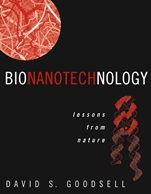
Bionanotechnology: Lessons from Nature
ISBN 9780471417194
Autor: David S. Goodsell
Wydawca: Wiley
Dostępność: 3-6 tygodni
Cena: 718,20 zł
Przed złożeniem zamówienia prosimy o kontakt mailowy celem potwierdzenia ceny.
ISBN13: |
9780471417194 |
ISBN10: |
047141719X |
Autor: |
David S. Goodsell |
Oprawa: |
Hardback |
Rok Wydania: |
2004-02-25 |
Ilość stron: |
350 |
Wymiary: |
259x208 |
Tematy: |
PN |
Biological molecules are themselves the premier, proven examples of the feasibility and utility of nanotechnology–in effect, "lessons from nature" informing the design of nanoscale machines. Bionanotechnology encompasses the study, creation, and illumination of the connections between structural molecular biology and molecular nanotechnology. The very first resource to address this discipline comprehensively and exclusively, Bionanotechnology: Lessons from Nature delivers an accessible overview that features a stunning set of original watercolor illustrations by the author.
Bionanotechnology: Lessons from Nature shows both students and practitioners how the lessons that may be learned from biology can be applied to nanotechnology today. The first part of the book explores the properties of nanomachines that are available in cells. The second looks to the structure and function of natural nanomachines for guidance in building nanomachinery.
The book then concludes with chapters on applications, surveying some of the exciting bionanotechnological tools and techniques that are currently in development, and speculating on those that may prove feasible in the not–too–distant future. Features of this one–of–a–kind reference include:High–quality illustrations produced by cutting–edge design programsDiscussions of basic structural, nanotechnological, and system engineering principlesNumerous real–world examples, such as applications in genetic engineering
Undergraduates, graduate students, practicing researchers, and policymakers will find David Goodsell’s Bionanotechnology an accessible, visually compelling introduction to this exciting field.
Spis treści:
1. The Quest for Nanotechnology.
Biotechnology and the Two–Week Revolution.
From Biotechnology to Bionanotechnology.
What is Bionanotechnology?
2. Bionanomac
hines in Action.
The Unfamiliar World of Bionanomachines.
Gravity and Inertia are Negligible at the Nanoscale.
Nanomachines Show Atomic Granularity.
Thermal Motion is a Significant Force at the Nanoscale.
Bionanomachines Require a Water Environment.
Modern Biomaterials.
Most Natural Bionanomachines are Composed of Protein.
Nucleic Acids Carry Information.
Lipids are Used for Infrastructure.
Polysaccharides are Used in Specialized Structural Roles.
The Legacy of Evolution.
Evolution has Placed Significant Limitations on the Properties of Natural Biomolecules.
Guided Tours of Natural Bionanomachinery.
3. Biomolecular Design and Biotechnology.
Recombinant DNA Technology.
DNA may be Engineered with Commercially Available Enzymes.
Site–Directed Mutagenesis makes Specific Changes in the Genome.
Fusion Proteins Combine Two Functions.
Monoclonal Antibodies.
Biomolecular Structure Determination.
X–ray Crystallography Provides Atomic Structures.
NMR Spectroscopy may be Used to Derive Atomic Structures.
Electron Microscopy Reveals Molecular Morphology.
Atomic Force Microscopy Probes the Surface of Biomolecules.
Molecular Modeling.
Bionanomachines are Visualized with Computer Graphics.
Computer Modeling is Used to Predict Biomolecular Structure and Function.
The Protein Folding Problem.
Docking Simulations Predict the Modes of Biomolecular Interaction.
New Functionalities are Developed with Computer–Assisted Molecular Design.
4. Structural Principles of Bionanotechnology.
Natural Bionanomachinery is Designed for a Specific Environment.
A Hierarchical Strategy Allows Construction of Nanomachines.
The Raw Materials: Biomolecular Structure and Stability.
Molecules are Composed of Atoms Linked by Covalent Bonds.
Dispersion and Repulsion Forces Act at Close Range.
Hydrogen Bonds Provide Stability and Specificity.
Electrostatic Interac
tions are Formed Between Charged Atoms.
The Hydrophobic Effect Stabilizes Biomolecules in Water.
Protein Folding.
Not All Protein Sequences Adopt Stable Structures.
Globular Proteins have a Hierarchical Structure.
Stable Globular Structure Requires a Combination of Design Strategies.
Chaperones Provide the Optimal Environment for Folding.
Rigidity Can Make Proteins More Stable at High Temperatures.
Many Proteins Make Use of Disorder.
Self–Assembly.
Symmetry Allows Self–Assembly of Stable Complexes with Defined Size.
Quasisymmetry is Used to Build Assemblies too Large for Perfect Symmetry.
Crowded Conditions Promote Self–Assembly.
Self–Organization.
Lipids Self–Organize into Bilayers.
Lipid Bilayers are Fluid.
Proteins May be Designed to Self–Organize with Lipid Bilayers.
Molecular Recognition.
Crane Principles for Molecular Recognition.
Atomicity Limits the Tolerance of Combining Sites.
Flexibility.
Biomolecules Show Flexibility at All Levels.
Flexibility Poses Great Challenges for the Design of Bionanomachines.
5. Functional Principles of Bionanotechnology.
Information–Driven Nanoassembly.
Nucleic Acids Carry Genetic Information.
Ribosomes Construct Proteins.
Information is Stored in Very Compact Form.
Energetics.
Chemical Energy is Transferred by Carrier Molecules.
Light is Captured with Specialized Small Molecules.
Protein Pathways Transfer Single Electrons.
Electrical Conduction and Change Transfer have Been Observed in DNA.
Electrochemical Gradients are Created across Membranes.
Chemical Transformation.
Enzymes Reduce the Entropy of a Chemical Reaction.
Enzymes Create Environments that Stabilize Transition States.
Enzymes Use Chemical Tools to Perform a Reaction.
Regulation.
Protein Activity May be Regulated through Allosteric Motions.
Protein Action May be Regulated by Covalent Modification.Biomaterials.
Helical Assembly of Subunits Forms Filaments and Fibrils.
Microscale Infractures is Built from Fibrous Components.
Minerals are Combined with Biomaterials for Special Applications.
Elastic Proteins Use Disordered Chains.
Cells Make Specific and General Adhesives.
Biomolecular Motors.
ATP Powers Linear Motors.
ATP Synthase and Flagellar Motors are Rotary Motors.
Brownian Ratchets Rectify Random Thermal Motions.
Traffic Across Membranes.
Potassium Channels Use a Selectivity Filter.
ABC Transporters Use a Flip–Flop Mechanism.
Bacteriorhodopsin Uses Light to Pump Protons.
Biomolecular Sensing.
Smell and Taste Detect Specific Molecules.
Light is Sensed by Monitoring Light–Sensitive Motions in Retinal.
Mechanosensory Receptors Sense Motion Across a Membrane.
Bacteria Sense Chemical Gradients by Rectification of Random Motion.
Self–Replication.
Cells are Autonomous Self–Replicators.
The Basic Design of Cells is Shaped by the Processes of Evolution.
Machine–Phase Bionanotechnology.
Muscle Sarcomeres.
Nerves.
6. Bionanotechnology Today.
Basic Capabilities.
Natural Proteins May be Simplified.
Proteins are Being Designed from Scratch.
Proteins May be Constructed with Nonnatural Amino Acids.
Peptide Nucleic Acids Provide a Stable Alternative to DNA and RNA.
Nanomedicine Today.
Computer–Aided Drug has Produced Effective Anti–AIDS Drugs.
Immunotoxins are Targeted Cell Killers.
Drugs May be Delivered with Liposomes.
Artificial Blood Saves Lives.
Gene Therapy will Correct Genetic Defects.
General Medicine is Changing into Personalized Medicine.
Self–Assembly at Many Scales.
Self–Assembling DNA Scaffolds have Been Constructed.
Cyclic Peptides Form Nanotubes.
Fusion Proteins Self–Assemble into Extended Structures.
Small Organic Molecules Self–Assemble into Large Stru
Koszyk
Książek w koszyku: 0 szt.
Wartość zakupów: 0,00 zł
Informacje


Kontakt
Gambit
Centrum Oprogramowania
i Szkoleń Sp. z o.o.
Al. Pokoju 29b/22-24
31-564 Kraków
Siedziba Księgarni
ul. Kordylewskiego 1
31-542 Kraków
+48 12 410 5991
+48 12 410 5987
+48 12 410 5989
Subskrypcje
Administratorem danych osobowych jest firma Gambit COiS Sp. z o.o. Na podany adres będzie wysyłany wyłącznie biuletyn informacyjny.
Autoryzacja płatności

Informacje na temat autoryzacji płatności poprzez PayU.

© Copyright 2012: GAMBIT COiS Sp. z o.o. Wszelkie prawa zastrzeżone.
Projekt i wykonanie: Alchemia Studio Reklamy