


Wydawcy
Katalog tematyczny
- Archeologia (109)
- Ekonomia, finanse, business (13704)
- Filozofia (1445)
- Historia (3040)
- Języki i językoznawstwo (2356)
- Lifestyle, hobby i rozrywka (475)
- Medycyna (9704)
- Nauki humanistyczne (4)
- Nauki o Ziemi i środowisku (2638)
- Nauki ścisłe (20412)
- Astronomia (294)
- Biologia (5119)
- Chemia (6540)
- Fizyka (3309)
- Elektryczność i magnetyzm (90)
- Fizyka atomowa i molekularna (110)
- Fizyka cząstek elementarnych (36)
- Fizyka jądra atomowego (36)
- Fizyka kwantowa (210)
- Fizyka matematyczna (121)
- Fizyka relatywistyczna (36)
- Fizyka statystyczna (51)
- Fizyka stosowana (498)
- Mechanika klasyczna (186)
- Optyka i światło (133)
- Stany materii (202)
- Matematyka (4574)
- Nauki ścisłe, ogólnie (503)
- Nauki społeczne (8486)
- Nauki techniczne (13450)
- Prawo (1696)
- Publikacje informacyjne i interdyscyplinarne (1288)
- Religia i wierzenia (917)
- Technika komputerowa (4067)
- Zdrowie, relacje międzyludzkie i rozwój osobisty (657)





Informacje szczegółowe o książce
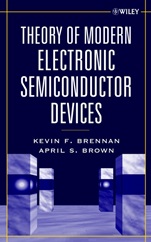
Theory of Modern Electronic Semiconductor Devices
ISBN 9780471415411
Autor: Kevin F. Brennan, April S. Brown
Wydawca: Wiley
Dostępność: 3-6 tygodni
Cena: 811,65 zł
Przed złożeniem zamówienia prosimy o kontakt mailowy celem potwierdzenia ceny.
ISBN13: |
9780471415411 |
ISBN10: |
0471415413 |
Autor: |
Kevin F. Brennan, April S. Brown |
Oprawa: |
Hardback |
Rok Wydania: |
2002-03-14 |
Ilość stron: |
448 |
Wymiary: |
240x157 |
Tematy: |
PH |
A thorough examination of the present and future of semiconductor device technology
Engineers continue to develop new electronic semiconductor devices that are almost exponentially smaller, faster, and more efficient than their immediate predecessors. Theory of Modern Electronic Semiconductor Devices endeavors to provide an up–to–date, extended discussion of the most important emerging devices and trends in semiconductor technology, setting the pace for the next generation of the discipline′s literature.
Kevin Brennan and April Brown focus on three increasingly important areas: telecommunications, quantum structures, and challenges and alternatives to CMOS technology. Specifically, the text examines the behavior of heterostructure devices for communications systems, quantum phenomena that appear in miniaturized structures and new nanoelectronic device types that exploit these effects, the challenges faced by continued miniaturization of CMOS devices, and futuristic alternatives. Device structures on the commercial and research levels analyzed in detail include:
∗ Heterostructure field effect transistors
∗ Bipolar and CMOS transistors
∗ Resonant tunneling diodes
∗ Real space transfer transistors
∗ Quantum dot cellular automata
∗ Single electron transistors
The book contains many homework exercises at the end of each chapter, and a solution manual can be obtained for instructors. Emphasizing the development of new technology, Theory of Modern Electronic Semiconductor Devices is an ideal companion to electrical and computer engineering graduate level courses and an essential reference for semiconductor device engineers.
Spis treści:
PREFACE.
1 OVERVIEW OF SEMICONDUCTOR DEVICE TRENDS.
1.1 Moore′s Law and Its Implications.
1.2 Semiconductor Devices for Telecommunications.
1.3 Digital Communications.
2 SEMICONDUCTOR HETEROSTRUCTURES.
2.1 Formatio
n of Heterostructures.
2.2 Modulation Doping.
2.3 Two–Dimensional Subband Transport at Heterointerfaces.
2.4 Strain and Stress at Heterointerfaces.
2.5 Perpendicular Transport in Heterostructures and Superlattices.
2.6 Heterojunction Materials Systems: Intrinsic and Extrinsic Properties.
Problems.
3 HETEROSTRUCTURE FIELD–EFFECT TRANSISTORS.
3.1 Motivation.
3.2 Basics of Heterostructure Field–Effect Transistors.
3.3 Simplified Long–Channel Model of a MODFET.
3.4 Physical Features of Advanced State–of–the–Art MODFETs.
3.5 High–Frequency Performance of MODFETs.
3.6 Materials Properties and Structure Optimization for HFETs.
Problems.
4 HETEROSTRUCTURE BIPOLAR TRANSISTORS.
4.1 Review of Bipolar Junction Transistors.
4.2 Emitter–Base Heterojunction Bipolar Transistors.
4.3 Base Transport Dynamics.
4.4 Nonstationary Transport Effects and Breakdown.
4.5 High–Frequency Performance of HBTs.
4.6 Materials Properties and Structure Optimization for HBTs .
Problems.
5 TRANSFERRED ELECTRON EFFECTS, NEGATIVE DIFFERENTIAL RESISTANCE, AND DEVICES.
5.1 Introduction.
5.2 k–Space Transfer.
5.3 Real–Space Transfer.
5.4 Consequences of NDR in a Semiconductor.
5.5 Transferred Electron–Effect Oscillators: Gunn Diodes.
5.6 Negative Differential Resistance Transistors.
5.7 IMPATT Diodes.
Problems.
6 RESONANT TUNNELING AND DEVICES.
6.1 Physics of Resonant Tunneling: Qualitative Approach.
6.2 Physics of Resonant Tunneling: Envelope Approximation.
6.3 Inelastic Phonon Scattering Assisted Tunneling: Hopping Conduction.
6.4 Resonant Tunneling Diodes: High–Frequency Applications.
6.5 Resonant Tunneling Diodes: Digital Applications.
6.6 Resonant Tunneling Transistors.
Problems.
7 CMOS: DEVICES AND FUTURE CHALLENGES.
7.1 Why CMOS?
7.2 Basics of Long–Channel MOSFET Operation.
7.3 Short
–Channel Effects.
7.4 Scaling Theory.
7.5 Processing Limitations to Continued Miniaturization.
Problems.
8 BEYOND CMOS: FUTURE APPROACHES TO COMPUTING HARDWARE.
8.1 Alternative MOS Device Structures: SOI, Dual–Gate FETs, and SiGe.
8.2 Quantum–Dot Devices and Cellular Automata.
8.3 Molecular Computing.
8.4 Field–Programmable Gate Arrays and Defect–Tolerant Computing.
8.5 Coulomb Blockade and Single–Electron Transistors.
8.6 Quantum Computing.
Problems.
9 MAGNETIC FIELD EFFECTS IN SEMICONDUCTORS.
9.1 Landau Levels.
9.2 Classical Hall Effect.
9.3 Integer Quantum Hall Effect.
9.4 Fractional Quantum Hall Effect.
9.5 Shubnikov–de Haas Oscillations.
Problems.
REFERENCES.
APPENDIX A: PHYSICAL CONSTANTS.
APPENDIX B: BULK MATERIAL PARAMETERS.
Table I: Silicon.
Table II: Ge.
Table III: GaAs.
Table IV: InP.
Table V: InAs.
Table VI: InN.
Table VII: GaN.
Table VIII: SiC.
Table IX: ZnS.
Table X: ZnSe.
Table XI : Al x Ga 1 fx As.
Table XI I : Ga 0:47 In 0:53 As.
Table XIII: Al 0:48 In 0:52 As.
Table XI V: Ga 0:5 In 0:5 P.
Table XV: Hg 0:70 Cd 0:30 Te.
APPENDIX C: HETEROJUNCTION PROPERTIES.
INDEX.
Nota biograficzna:
KEVIN F. BRENNAN, PhD, is Byer′s Professor of Electrical and Computer Engineering and APRIL S. BROWN, PhD, is Professor of Electrical and Computer Engineering in the School of Electrical and Computer Engineering at the Georgia Institute of Technology in Atlanta, Georgia.
Okładka tylna:
A thorough examination of the present and future of semiconductor device technology
Engineers continue to develop new electronic semiconductor devices that are almost exponentially smaller, faster, and more efficient than their immediate predecessors. Theory of Modern Electronic Semiconductor Devices endeavors to provide an up–to–date, extended discussion of the most important
emerging devices and trends in semiconductor technology, setting the pace for the next generation of the discipline′s literature.
Kevin Brennan and April Brown focus on three increasingly important areas: telecommunications, quantum structures, and challenges and alternatives to CMOS technology. Specifically, the text examines the behavior of heterostructure devices for communications systems, quantum phenomena that appear in miniaturized structures and new nanoelectronic device types that exploit these effects, the challenges faced by continued miniaturization of CMOS devices, and futuristic alternatives. Device structures on the commercial and research levels analyzed in detail include:
∗ Heterostructure field effect transistors
∗ Bipolar and CMOS transistors
∗ Resonant tunneling diodes
∗ Real space transfer transistors
∗ Quantum dot cellular automata
∗ Single electron transistors
The book contains many homework exercises at the end of each chapter, and a solution manual can be obtained for instructors. Emphasizing the development of new technology, Theory of Modern Electronic Semiconductor Devices is an ideal companion to electrical and computer engineering graduate level courses and an essential reference for semiconductor device engineers.
Koszyk
Książek w koszyku: 0 szt.
Wartość zakupów: 0,00 zł
Informacje


Kontakt
Gambit
Centrum Oprogramowania
i Szkoleń Sp. z o.o.
Al. Pokoju 29b/22-24
31-564 Kraków
Siedziba Księgarni
ul. Kordylewskiego 1
31-542 Kraków
+48 12 410 5991
+48 12 410 5987
+48 12 410 5989
Subskrypcje
Administratorem danych osobowych jest firma Gambit COiS Sp. z o.o. Na podany adres będzie wysyłany wyłącznie biuletyn informacyjny.
Autoryzacja płatności

Informacje na temat autoryzacji płatności poprzez PayU.

© Copyright 2012: GAMBIT COiS Sp. z o.o. Wszelkie prawa zastrzeżone.
Projekt i wykonanie: Alchemia Studio Reklamy