


Wydawcy
Katalog tematyczny
- Archeologia (109)
- Ekonomia, finanse, business (13704)
- Filozofia (1445)
- Historia (3040)
- Języki i językoznawstwo (2356)
- Lifestyle, hobby i rozrywka (475)
- Medycyna (9704)
- Chirurgia (272)
- Inne gałęzie medycyny (1871)
- Medycyna kliniczna (4187)
- Choroby wewnętrzne (514)
- Dermatologia (51)
- Diagnostyka medyczna (3)
- Endokrynologia (144)
- Gastroenterologia (27)
- Geriatria (50)
- Ginekologia i położnictwo (134)
- Hematologia (46)
- Hepatologia (10)
- Kardiologia (71)
- Laryngologia (12)
- Nefrologia (10)
- Neurologia (500)
- Oftalmologia (50)
- Pediatria (33)
- Pulmunologia (32)
- Reumatologia (14)
- Terapia genowa (1)
- Układ mięśniowo-szkieletowy (1)
- Urologia (14)
- Medycyna niekonwencjonalna (14)
- Medycyna przedkliniczna (269)
- Medycyna, ogólnie (1740)
- Medyczne służby pomocnicze (745)
- Studia medyczne (16)
- Weterynaria (548)
- Nauki humanistyczne (4)
- Nauki o Ziemi i środowisku (2638)
- Nauki ścisłe (20412)
- Nauki społeczne (8486)
- Nauki techniczne (13450)
- Prawo (1696)
- Publikacje informacyjne i interdyscyplinarne (1288)
- Religia i wierzenia (917)
- Technika komputerowa (4067)
- Zdrowie, relacje międzyludzkie i rozwój osobisty (657)





Informacje szczegółowe o książce
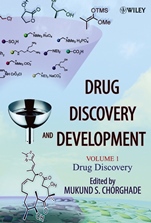
Drug Discovery and Development, Volume 1: Drug Discovery
ISBN 9780471398486
Autor: Mukund S. Chorghade
Wydawca: Wiley
Dostępność: 3-6 tygodni
Cena: 740,25 zł
Przed złożeniem zamówienia prosimy o kontakt mailowy celem potwierdzenia ceny.
ISBN13: |
9780471398486 |
ISBN10: |
0471398489 |
Autor: |
Mukund S. Chorghade |
Oprawa: |
Hardback |
Rok Wydania: |
2006-07-28 |
Ilość stron: |
476 |
Wymiary: |
255x185 |
Tematy: |
MJ |
From first principles to real–world applications — here is the first comprehensive guide to drug discovery and development
Modern drug discovery and development require the collaborative efforts of specialists in a broadarray of scientific, technical, and business disciplines—from biochemistry to molecular biology, organic chemistry to medicinal chemistry, pharmacology to marketing. Yet surprisingly, until now, there were no authoritative references offering a complete, fully integrated picture of the process.
The only comprehensive guide of its kind, this groundbreaking two–volume resource provides an overview of the entire sequence of operations involved in drug discovery and development—from initial conceptualization to commercialization to clinicians and medical practitioners. Volume 1: Drug Discovery describes all the steps in the discovery process, including conceptualizing a drug, creating a library of candidates for testing, screening candidates for in vitro and in vivo activity, conducting and analyzing the results of clinical trials, and modifying a drug as necessary. Volume 2: Drug Development delves into the nitty–gritty details of optimizing the synthetic route, drug manufacturing, outsourcing, and marketing—including drug coloring and delivery methods.
Featuring contributions from a world–class team of experts, Drug Discovery and Development:Features fascinating case studies, including the discovery and development of erythromycin analogs, Tagamet, and Ultiva (remifentanil)Discusses the discovery of medications for bacterial infections, Parkinson′s disease, psoriasis, peptic ulcers, atopic dermatitis, asthma, and cancerIncludes chapters on combinatorial chemistry, molecular biology–based drug discovery, genomics, and chemogenomics
Drug Discovery and Development is an indispensable working resource for industrialchemists, biologists, bioche
mists, and executives who work in the pharmaceutical industry.
Spis treści:
Contributors.
Preface.
1. From Patent to Prescription: Paving the Perilous Path to Profit (Richard J. Pariza).
1.1 Introduction.
1.2 A Simple Solution to a Complex Problem.
1.3 An Intriguing Patent Problem.
1.4 Another Structural Insight.
References.
2. Medicinal Chemistry in the New Millennium: A Glance into the Future (Paul W. Erhardt).
2.1 Introduction.
2.2 Practice of Medicinal Chemistry.
2.2.1 Emergence as a Formalized Discipline.
2.2.2 Early Developments.
2.2.3 Present Status.
2.2.4 Examples Involving Site–Directed Mutagenesis.
2.2.5 Latest Trends.
2.3 Evolving Drug Discovery and Development Process.
2.3.1 Working Defi nition for Medicinal Chemistry.
2.3.2 Immediate– and Long–Term Roles for Medicinal Chemistry.
2.4 Pursuing Efficacy.
2.4.1 Gathering Positive, Neutral, and Negative SARs During HTS.
2.4.2 Example Involving Multidrug Resistance of Anticancer Agents.
2.4.3 Compound Libraries: Example of Working with Nature to Enhance Molecular Diversity.
2.5 Assessing and Handling Molecular Conformation.
2.5.1 Chemoinformatics.
2.5.2 Obtaining Chemically Correct 3D Structures.
2.5.3 Infl uence of Biological Environments: Example Involving Drug Metabolism.
2.5.4 Dynamic Energy Relationships: Example Involving a Small Ring System.
2.5.5 Druglike Properties and Privileged Structures.
2.5.6 Tiered Structural Information and Searching Paradigms.
2.6 ADMET Considerations.
2.6.1 Assuring Absorption.
2.6.2 Directing Distribution.
2.6.3 Herbal Remedies: Example of Working with Nature to Discover
ADMET–Related Synergies, 59
2.6.4 Brute Force HTS to Uncover Multicomponent Synergies.
2.6.5 Controlling Metabolism: Example Involving a Soft Drug Strategy.
2.6.6 Optimizing Excretion.
2.6.7 Avoiding Toxicit
y.
2.6.8 Weighting Decision Criteria from Effi cacy and ADMET SAR.
2.7 Process Chemistry Considerations.
2.7.1 Cost and Green Chemistry.
2.7.2 Defi ning Stereochemistry: Example Involving Benzylamine Chiral Auxiliary Synthetic Reagents.
2.8 Analytical Chemistry/X–ray Diffraction.
2.8.1 Latest Trends.
2.8.2 Examples Involving Dopamine Receptors, c–AMP Phosphodiesterase Enzymes, and the Dynamics of Protein Folding.
2.9 Summary.
2.9.1 General Points.
2.9.2 Attributes of Drug Discovery Libraries, Compound Hits, and Lead Compounds.
2.9.3 Formalized Instruction of Medicinal Chemistry.
2.9.4 Intellectual Property Considerations.
2.9.5 Knowledge Versus Diversity Paradox.
Acknowledgments.
References and Notes.
3. Contemporary Drug Discovery (Lester A. Mitscher and Apurba Dutta).
3.1 Introduction.
3.1.1 Getting Started.
3.2 Characteristics of a Suitable Lead Substance.
3.2.1 Potency and Selectivity.
3.2.2 Structure–Activity Relationships.
3.2.3 Toxicity.
3.2.4 Changing Appellation of the Best in Series: Analog Attrition.
3.3 Some Criteria That a Hit Must Satisfy to Become a Drug.
3.3.1 Level of Potency.
3.3.2 Comparison of Potency and Efficacy.
3.3.3 Druglike Character.
3.3.4 Effi cacy Following Oral Administration.
3.3.5 Lipinski Rules for Oral Absorption.
3.3.6 Injectable Medications.
3.3.7 Distribution.
3.3.8 Serum Protein Binding.
3.3.9 Metabolism.
3.3.10 Distribution.
3.3.11 Excretion.
3.3.12 Patenting.
3.3.13 Pharmaceutical Properties.
3.3.14 Idiosyncratic Problems.
3.3.15 Summary.
3.4 Example of Drug Development That Illustrates Many of the Aforementioned Considerations.
3.4.1 Control of Blood Pressure with Drugs.
3.4.2 Historical Background.
3.4.3 Finding a Starting Point: A Clue from Nature.
3.4.4 Renin–Angiotensin–Aldosterone System.
3.4.5 Attempts to Inhibit Renin.
3.4.6 Attempts to In
hibit Angiotensin–Converting Enzyme.
3.4.7 Peptides Make Poor Orally Active Drugs.
3.4.8 Analoging Studies of Pit Viper–Inspired Peptides.
3.4.9 Peptidomimetics.
3.4.10 Adaptation to Inhibition of ACE.
3.4.11 Success Inspires Competition.
3.4.12 Taking a Different Approach.
3.4.13 Analoging to Enhance Absorption.
3.4.14 Clinical SAR.
3.4.15 More Recent Work.
3.4.16 Résumé.
3.5 Conclusions.
Additional Reading.
4. Combinatorial Chemistry in the Drug Discovery Process (Ian Hughes).
4.1 Introduction.
4.1.1 The Birth of Combinatorial Chemistry.
4.1.2 Development of Screening Strategies for Libraries.
4.1.3 From Peptides to Small Molecule Synthesis.
4.1.4 Beyond Solid–Phase Chemistry.
4.2 The Role of Combinatorial Chemistry in Drug Discovery.
4.3 Designing Combinatorial Libraries.
4.3.1 Describing and Measuring Diversity.
4.3.2 A More Focused Approach.
4.4 Tools for Synthesis of Combinatorial Libraries.
4.4.1 Nonautomated Tools.
4.4.2 Mix–and–Sort Systems.
4.4.3 Automated Synthesizers.
4.4.4 Postsynthesis Processing.
4.5 Managing the Combinatorial Process.
4.5.1 Specifi cation of Combinatorial Libraries.
4.5.2 Controlling the Automated Workfl ow.
4.6 From Specialist Discipline to Standard Tool.
4.7 Application of Combinatorial Chemistry in Drug Discovery.
4.7.1 Case History 1.
4.7.2 Case History 2.
4.7.3 Case History 3.
4.7.4 Case History 4.
4.8 The Future of Combinatorial Chemistry.
4.8.1 Dynamic Combinatorial Libraries.
4.8.2 Miniaturization.
4.9 Conclusions.
References.
5. Parallel Solution–Phase Synthesis (Norton P. Peet and Hwa–Ok Kim).
5.1 Introduction.
5.2 Ahead of Our Time.
5.3 Recent Reports of Parallel Solution–Phase Synthesis.
5.4 Solid Supported Reagents, Scavengers, and Catalysts.
5.5 The Future.
References.
6. Timing of Analo
Koszyk
Książek w koszyku: 0 szt.
Wartość zakupów: 0,00 zł
Informacje


Kontakt
Gambit
Centrum Oprogramowania
i Szkoleń Sp. z o.o.
Al. Pokoju 29b/22-24
31-564 Kraków
Siedziba Księgarni
ul. Kordylewskiego 1
31-542 Kraków
+48 12 410 5991
+48 12 410 5987
+48 12 410 5989
Subskrypcje
Administratorem danych osobowych jest firma Gambit COiS Sp. z o.o. Na podany adres będzie wysyłany wyłącznie biuletyn informacyjny.
Autoryzacja płatności

Informacje na temat autoryzacji płatności poprzez PayU.

© Copyright 2012: GAMBIT COiS Sp. z o.o. Wszelkie prawa zastrzeżone.
Projekt i wykonanie: Alchemia Studio Reklamy