


Wydawcy
Katalog tematyczny
- Archeologia (109)
- Ekonomia, finanse, business (13704)
- Filozofia (1445)
- Historia (3040)
- Języki i językoznawstwo (2356)
- Lifestyle, hobby i rozrywka (475)
- Medycyna (9704)
- Nauki humanistyczne (4)
- Nauki o Ziemi i środowisku (2638)
- Nauki ścisłe (20412)
- Nauki społeczne (8486)
- Nauki techniczne (13450)
- Prawo (1696)
- Publikacje informacyjne i interdyscyplinarne (1288)
- Religia i wierzenia (917)
- Technika komputerowa (4067)
- Zdrowie, relacje międzyludzkie i rozwój osobisty (657)





Informacje szczegółowe o książce
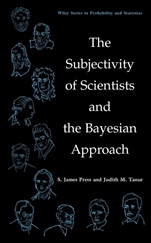
The Subjectivity of Scientists and the Bayesian Approach
ISBN 9780471396857
Autor: S. James Press, Judith M. Tanur
Wydawca: Wiley
Dostępność: 3-6 tygodni
Cena: 729,75 zł
Przed złożeniem zamówienia prosimy o kontakt mailowy celem potwierdzenia ceny.
ISBN13: |
9780471396857 |
ISBN10: |
0471396850 |
Autor: |
S. James Press, Judith M. Tanur |
Oprawa: |
Hardback |
Rok Wydania: |
2001-04-24 |
Ilość stron: |
296 |
Wymiary: |
243x164 |
Tematy: |
HB |
Comparing and contrasting the reality of subjectivity in the work of history′s great scientists and the modern Bayesian approach to statistical analysis
Scientists and researchers are taught to analyze their data from an objective point of view, allowing the data to speak for themselves rather than assigning them meaning based on expectations or opinions. But scientists have never behaved fully objectively. Throughout history, some of our greatest scientific minds have relied on intuition, hunches, and personal beliefs to make sense of empirical data–and these subjective influences have often aided in humanity′s greatest scientific achievements. The authors argue that subjectivity has not only played a significant role in the advancement of science, but that science will advance more rapidly if the modern methods of Bayesian statistical analysis replace some of the classical twentieth–century methods that have traditionally been taught.
To accomplish this goal, the authors examine the lives and work of history′s great scientists and show that even the most successful have sometimes misrepresented findings or been influenced by their own preconceived notions of religion, metaphysics, and the occult, or the personal beliefs of their mentors. Contrary to popular belief, our greatest scientific thinkers approached their data with a combination of subjectivity and empiricism, and thus informally achieved what is more formally accomplished by the modern Bayesian approach to data analysis.
Yet we are still taught that science is purely objective. This innovative book dispels that myth using historical accounts and biographical sketches of more than a dozen great scientists, including Aristotle, Galileo Galilei, Johannes Kepler, William Harvey, Sir Isaac Newton, Antoine Levoisier, Alexander von Humboldt, Michael Faraday, Charles Darwin, Louis Pasteur, Gregor Mendel, Sigmund Freud, Marie Curie, Robert Millikan, Albert Einstein, Sir Cyril Burt, and Margaret Mead. Also included is a detailed treatment of the modern Bayesian approach to data analysis. Up–to–date references to the Bayesian theoretical and applied literature, as well as reference lists of the primary sources of the principal works of all the scientists discussed, round out this comprehensive treatment of the subject.
Readers will benefit from this cogent and enlightening view of the history of subjectivity in science and the authors′ alternative vision of how the Bayesian approach should be used to further the cause of science and learning well into the twenty–first century.
Preface.
Introduction.
Selecting the Scientists.
Some Well–Known Stories of Extreme Subjectivity.
Stories of Famous Scientists.
Subjectivity in Science in Modern Times: The Bayesian Approach.
Appendix: References by Field of Application for Bayesian Statistical Science.
Bibliography.
Subject Index.
Name Index.
S. JAMES PRESS is Distinguished Professor in the Department of Statistics at the University of California at Riverside. He is also the author of Bayesian Statistics: Principles, Models, and Applications (Wiley) and Applied Multivariate Analysis: Including Bayesian and Frequentist Methods of Inference.
JUDITH M. TANUR is Distinguished Teaching Professor in the Department of Sociology at the State University of New York at Stony Brook. She is also the editor of Statistics: A Guide to the Unknown and Questions About Questions: Inquiries into the Cognitive Bases of Surveys.
"Press and Tanur argue that subjectivity has not only played a significant role in the advancement of science, but that science will advance more rapidly if the modern methods of Bayesian statistical analysis replace some of the more classical twentieth–century methods." (SciTech Book News, Vol. 25, No. 3, September 2001)
"An insightful work." (Choice, Vol. 39, No. 4, December 2001)
"compilation of interesting and popular problems" (Short Book Reviews – Publication of the Int. Statistical Institute, December 2001)
"...this book is fascinating." (Short Book Reviews, Vol. 21, No. 3, December 2001)
"...highlight the role of subjectivity in science by describing the life and works of 17 scientists." (Zentralblatt MATH, Vol. 973, 2001/23)
Koszyk
Książek w koszyku: 0 szt.
Wartość zakupów: 0,00 zł
Informacje


Kontakt
Gambit
Centrum Oprogramowania
i Szkoleń Sp. z o.o.
Al. Pokoju 29b/22-24
31-564 Kraków
Siedziba Księgarni
ul. Kordylewskiego 1
31-542 Kraków
+48 12 410 5991
+48 12 410 5987
+48 12 410 5989
Subskrypcje
Administratorem danych osobowych jest firma Gambit COiS Sp. z o.o. Na podany adres będzie wysyłany wyłącznie biuletyn informacyjny.
Autoryzacja płatności

Informacje na temat autoryzacji płatności poprzez PayU.

© Copyright 2012: GAMBIT COiS Sp. z o.o. Wszelkie prawa zastrzeżone.
Projekt i wykonanie: Alchemia Studio Reklamy