


Wydawcy
Katalog tematyczny
- Archeologia (109)
- Ekonomia, finanse, business (13704)
- Filozofia (1445)
- Historia (3040)
- Języki i językoznawstwo (2356)
- Lifestyle, hobby i rozrywka (475)
- Medycyna (9704)
- Chirurgia (272)
- Inne gałęzie medycyny (1871)
- Medycyna kliniczna (4187)
- Medycyna niekonwencjonalna (14)
- Medycyna przedkliniczna (269)
- Medycyna, ogólnie (1740)
- Historia medycyny (3)
- Lekarze, sprawy zawodowe (8)
- Medycyna, aspekty prawne (10)
- Służba zdrowia (36)
- Wyposażenie medyczne (157)
- Zdrowie publiczne (460)
- Medyczne służby pomocnicze (745)
- Studia medyczne (16)
- Weterynaria (548)
- Nauki humanistyczne (4)
- Nauki o Ziemi i środowisku (2638)
- Nauki ścisłe (20412)
- Nauki społeczne (8486)
- Nauki techniczne (13450)
- Prawo (1696)
- Publikacje informacyjne i interdyscyplinarne (1288)
- Religia i wierzenia (917)
- Technika komputerowa (4067)
- Zdrowie, relacje międzyludzkie i rozwój osobisty (657)





Informacje szczegółowe o książce
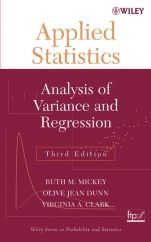
Applied Statistics: Analysis of Variance and Regression
ISBN 9780471370383
Autor: Ruth M. Mickey, Olive Jean Dunn, Virginia A. Clark
Wydawca: Wiley
Dostępność: 3-6 tygodni
Cena: 789,60 zł
Przed złożeniem zamówienia prosimy o kontakt mailowy celem potwierdzenia ceny.
ISBN13: |
9780471370383 |
ISBN10: |
047137038X |
Autor: |
Ruth M. Mickey, Olive Jean Dunn, Virginia A. Clark |
Oprawa: |
Hardback |
Rok Wydania: |
2004-03-05 |
Numer Wydania: |
3rd Edition |
Ilość stron: |
448 |
Wymiary: |
243x162 |
Tematy: |
MB |
A valuable new edition of a standard in the field ofstatistics
For the ever–increasing number of practitioners who must perform sophisticatedstatistical analyses on computers, Applied Statistics: Analysis of Variance andRegression has long been a standard reference and text. This new Third Editionhas been thoroughly revised to provide a comprehensive and up–to–datecombination of sound statistical methodology, practical advice on theapplication of this methodology, and interpretation of output from statisticalprograms.
Special features of this edition include:A highly readable text, with mathematical background kept at a low levelComprehensive treatment of each topic, from summarization of data to presentation of resultsCareful explanation of assumptions, how to check if the data meet them, and what to do if they don′t A greater emphasis on regression, data screening, and confidence intervalsIn–depth discussion of design–related topics such as mixed models and random effectsGraded and challenging exercises at the end of each chapter and on the Wiley ftp siteOverviews of more advanced topicsAn extensively revised chapter on repeated measures designs
Eminently suitable for students and researchers who may nothave a calculus background as well as for more advanced practitioners, thisself–contained, comprehensive treatment of variance and regression analysisreadies a new generation of researchers for the demands of this growing field.
Spis treści:
Preface.
1. Data Screening.
1.1 Variables and Their Classification.
1.2 Describing the Data.
1.2.1 Errors in the Data.
1.2.2 Descriptive Statistics.
1.2.3 Graphical Summarization.
1.3 Departures from Assumptions.
1.3.1 The Normal Distribution.
1.3.2 The Normality Assumption.
1.3.3 Transformations.
1.3.4 Independence.
1.4 Summary.
Problem
s.
References.
2. One–Way Analysis of Variance Design.
2.1 One–Way Analysis of Variance with Fixed Effects.
2.1.1 Example.
2.1.2 The One–Way Analysis of Variance Model with Fixed Effects.
2.1.3 Null Hypothesis: Test for Equality of Population Means.
2.1.4 Estimation of Model Terms.
2.1.5 Breakdown of the Basic Sum of Squares.
2.1.6 Analysis of Variance Table.
2.1.7 The F Test.
2.1.8 Analysis of Variance with Unequal Sample Sizes.
2.2 One–Way Analysis of Variance with Random Effects.
2.2.1 Data Example.
2..2.2 The One–Way Analysis of Variance Model with Random Effects.
2.2.3 Null Hypothesis: Test for Zero Variance of Population Means.
2.2.4 Estimation of Model Terms.
2.2.5 The F Test.
2.3 Designing an Observational Study or Experiment.
2.3.1 Randomization for Experimental Studies.
2.3.2 Sample Size and Power.
2.4 Checking if the Data Fit the One–Way ANOVA Model.
2.4.1 Normality.
2.4.2 Equality of Population Variances.
2.4.3 Independence.
2.4.4 Robustness.
2.4.5 Missing Data.
2.5 What to Do if the Data Do Not Fit the Model.
2.5.1 Making Transformations.
2.5.2 Using Nonparametric Methods.
2.5.3 Using Alternative ANOVAs.
2.6 Presentation and Interpretation of Results.
2.7 Summary.
Problems.
References.
3. Estimation and Simultaneous Inference.
3.1 Estimation for Single Population Means.
3.1.1 Parameter Estimation.
3.1.2 Confidence Intervals.
3.2 Estimation for Linear Combinations of Population Means.
3.2.1 Differences of Two Population Means.
3.2.2 General Contrasts for Two or More Means.
3.2.3 General Contrasts for Trends.
3.3 Simultaneous Statistical Inference.
3.1.1 Straightforward Approach to Inference.
3.3.2 Motivation for Multiple Comparison Procedures and Terminology.
3.3.3 The Bonferroni Multiple Comparison Method.
3.3.4 The Tukey Multiple Comparison Method.
3.3.5 The Scheffé Mul
tiple Comparison Method.
3.4 Inference for Variance Components.
3.5 Presentation and Interpretation of Results.
3.6 Summary.
Problems.
References.
4. Hierarchical or Nested Design.
4.1 Example.
4.2 The Model.
4.3 Analysis of Variance Table and F Tests.
4.3.1 Analysis of Variance Table.
4.3.2 F Tests.
4.3.3 Pooling.
4.4 Estimation of Parameters.
4.4.1 Comparison with the One–Way ANOVA Model of Chapter 2.
4.5 Inferences with Unequal Sample Sizes.
4.5.1 Hypothesis Testing.
4.5.2 Estimation.
4.6 Checking If the Data Fit the Model.
4.7 What to Do If the Data Don′t Fit the Model.
4.8 Designing a Study.
4.8.1 Relative Efficiency.
4.9 Summary.
Problems.
References.
5. Two Crossed Factors: Fixed Effects and Equal Sample Sizes.
5.1 Example.
5.2 The Model.
5.3 Interpretation of Models and Interaction.
5.4 Analysis of Variance and F Tests.
5.5 Estimates of Parameters and Confidence Intervals.
5.6 Designing a Study.
5.7 Presentation and Interpretation of Results.
5.8 Summary.
Problems.
References.
6 Randomized Complete Block Design.
6.1 Example.
6.2 The Randomized Complete Block Design.
6.3 The Model.
6.4 Analysis of Variance Table and F Tests.
6.5 Estimation of Parameters and Confidence Intervals.
6.6 Checking If the Data Fit the Model.
6.7 What to Do if the Data Don′t Fit the Model.
6.7.1 Friedman′s Rank Sum Test.
6.7.2 Missing Data.
6.8 Designing a Randomized Complete Block Study.
6.8.1 Experimental Studies.
6.8.2 Observational Studies.
6.9 Model Extensions.
6.10 Summary.
Problems.
References.
7. Two Crossed Factors: Fixed Effects and Unequal Sample Sizes.
7.1 Example.
7.2 The Model.
7.3 Analysis of Variance and F Tests.
7.4 Estimation of Parameters and Confidence Intervals.
7.4.1 Means and Adjusted Means.
7.4.2 Standard Errors and Confidence Intervals.
7.5 Checking If the D
ata Fit the Two–Way Model.
7.6 What To Do If the Data Don′t Fit the Model.
7.7 Summary.
Problems.
References.
8. Crossed Factors: Mixed Models.
8.1 Example.
8.2 The Mixed Model.
8.3 Estimation of Fixed Effects.
8.4 Analysis of Variance.
8.5 Estimation of Variance Components.
8.6 Hypothesis Testing.
8.7 Confidence Intervals for Means and Variance Components.
8.7.1 Confidence Intervals for Population Means.
8.7.2 Confidence Intervals for Variance Components.
8.8 Comments on Available Software.
8.9 Extensions of the Mixed Model.
8.9.1 Unequal Sample Sizes.
8.9.2 Fixed, Random, or Mixed Effects.
8.9.3 Crossed versus Nested Factors.
8.9.4 Dependence of Random Effects.
8.10 Summary.
Problems.
References.
9. Repeated Measures Designs.
9.1 Repeated Measures for a Single Population.
9.1.1 Example.
9.1.2 The Model.
9.1.3 Hypothesis Testing: No Time Effect.
9.1.4 Simultaneous Inference.
9.1.5 Orthogonal Contrasts.
9.1.6 F Tests for Trends over Time.
9.2 Repeated Measures with Several Populations.
9.2.1 Example.
9.2.2 Model.
9.2.3 Analysis of Variance Table and F Tests.
9.3 Checking if the Data Fit the Repeated Measures Model.
9.4 What to Do if the Data Don′t Fit the Model.
9.5 General Comments on Repeated Measures Analyses.
9.6 Summary.
Problems.
References.
10. Linear Regression: Fixed X Model.
10.1 Example.
10.2 Fitting a Straight Line.
10.3 The Fixed X Model.
10.4 Estimation of Model Parameters and Standard Errors.
10.4.1 Point Estimates.
10.4.2 Estimates of Standard Errors.
10.5 Inferences for Model Parameters: Confidence Intervals.
10.6 Inference for Model Parameters: Hypothesis Testing.
10.6.1 t Tests for Intercept and Slope.
10.6.2 Division of the Basic Sum of Squares.
10.6.3 Analysis of Variance Table and F Test.
10.7 Checking if the Data Fit the Regression Model.
10.7.1 Outliers.
10.7
Koszyk
Książek w koszyku: 0 szt.
Wartość zakupów: 0,00 zł
Informacje


Kontakt
Gambit
Centrum Oprogramowania
i Szkoleń Sp. z o.o.
Al. Pokoju 29b/22-24
31-564 Kraków
Siedziba Księgarni
ul. Kordylewskiego 1
31-542 Kraków
+48 12 410 5991
+48 12 410 5987
+48 12 410 5989
Subskrypcje
Administratorem danych osobowych jest firma Gambit COiS Sp. z o.o. Na podany adres będzie wysyłany wyłącznie biuletyn informacyjny.
Autoryzacja płatności

Informacje na temat autoryzacji płatności poprzez PayU.

© Copyright 2012: GAMBIT COiS Sp. z o.o. Wszelkie prawa zastrzeżone.
Projekt i wykonanie: Alchemia Studio Reklamy