


Wydawcy
Katalog tematyczny
- Archeologia (109)
- Ekonomia, finanse, business (13704)
- Filozofia (1445)
- Historia (3040)
- Języki i językoznawstwo (2356)
- Lifestyle, hobby i rozrywka (475)
- Medycyna (9704)
- Nauki humanistyczne (4)
- Nauki o Ziemi i środowisku (2638)
- Nauki ścisłe (20412)
- Nauki społeczne (8486)
- Nauki techniczne (13450)
- Prawo (1696)
- Publikacje informacyjne i interdyscyplinarne (1288)
- Religia i wierzenia (917)
- Technika komputerowa (4067)
- Zdrowie, relacje międzyludzkie i rozwój osobisty (657)





Informacje szczegółowe o książce
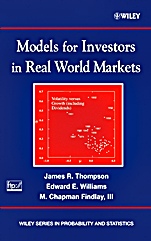
Models for Investors in Real World Markets
ISBN 9780471356288
Autor: James R. Thompson, Edward E. Williams, M. Chapman Findlay III
Wydawca: Wiley
Dostępność: 3-6 tygodni
Cena: 736,05 zł
Przed złożeniem zamówienia prosimy o kontakt mailowy celem potwierdzenia ceny.
ISBN13: |
9780471356288 |
ISBN10: |
047135628X |
Autor: |
James R. Thompson, Edward E. Williams, M. Chapman Findlay III |
Oprawa: |
Hardback |
Rok Wydania: |
2002-11-29 |
Ilość stron: |
408 |
Wymiary: |
242x159 |
Tematy: |
KF |
A uniquely timely look at where modern financial economic theory has failed–and where we should go from here
The collapse of the Scholes–Merton based Long Term Capital Management (LTCM) hedge fund should have sounded alarms or, at least, raised questions about investment strategies based on risk–neutral probabilities. More recently, the fallout of Enron, WorldCom, and similar fiascos must now give pause to those who take the efficient market–based formula for "fair prices" (especially in options and derivatives) as rigid laws.
This provocative volume provides a new, antiefficient markets approach to investment theory and management. Questioning the assumption that markets clear neatly and quickly, Models for Investors in Real World Markets considers neoclassical models in light of what can go wrong with them, outlines basic institutional factors associated with how stock markets operate, and then offers ways to bring about better (though never correct) models. Providing a stinging critique of modern financial economic theory, this timely book:
∗ Introduces basic concepts of utility theory, the cornerstone of portfolio theory
∗ Illustrates why diversification is an important fundamental requirement of rational investment choice
∗ Provides a detailed procedure for analyzing securities, borrowing the concepts of Benjamin Graham and David Dodd, and building a quantitative framework for them
∗ Examines the importance of compound interest and observes that stock growth may be viewed as noisy compound interest
∗ Demonstrates that options are themselves stochastic, risky entities and not magical devices for the elimination of risk
∗ Develops a conceptualization of risk profiling based on their development of the simugram. As opposed to the Markowitz approach of maximizing growth subject to acceptable levels of volatility, the authors use the simugram, their computer intensive forecast of th
e time–indexed density function of portfolio value. Percentiles, rather than expectations, form the major bases for the criterion functions and constraints utilized for portfolio management.
For anyone who has ever questioned–or should have questioned–the efficient market orthodoxy, this book will be a valuable reference on market analysis and investment strategy.
Spis treści:
Preface.
Introduction and the Institutional Environment.
Some Conventional Building Blocks (With Various Reservations).
Diversification and Portfolio Selection.
Capital Market Equilibrium Theories.
Equilibrium Implying Efficiency: The Neoclassical Fantasy.
More Realistic Paradigms for Investment.
Security Analysis.
Empirical Financial Forecasting.
Stock Price Growth as Noisy Compound Interest.
Investing in Real World Markets: Returns and Risk Profiles.
Common Stock Options.
Summary, Some Unsettled (Unsettling) Questions, and Conclusions.
Appendix A: A Brief Introduction to Probability and Statistics.
Appendix B: Statistical Tables.
Index.
Nota biograficzna:
JAMES R. THOMPSON, PhD, is the Noah Harding Professor of Statistics at Rice University.
EDWARD E. WILLIAMS, PhD, is Henry Gardiner Symonds Professor at the Jesse H. Jones Graduate School of Business Administration at Rice University.
M. CHAPMAN FINDLAY, III, PhD, is President and Director of Fin Fin Inc., and Director of First Texas Venture Capital, LLC, and a principal at Findlay, Phillips and Associates in Los Angeles, California.
Okładka tylna:
A uniquely timely look at where modern financial economic theory has failed–and where we should go from here
The collapse of the Scholes–Merton based Long Term Capital Management (LTCM) hedge fund should have sounded alarms or, at least, raised questions about investment strategies based on risk–neutral probabilities. More recently, the fallout
of Enron, WorldCom, and similar fiascos must now give pause to those who take the efficient market–based formula for "fair prices" (especially in options and derivatives) as rigid laws.
This provocative volume provides a new, antiefficient markets approach to investment theory and management. Questioning the assumption that markets clear neatly and quickly, Models for Investors in Real World Markets considers neoclassical models in light of what can go wrong with them, outlines basic institutional factors associated with how stock markets operate, and then offers ways to bring about better (though never correct) models. Providing a stinging critique of modern financial economic theory, this timely book:
∗ Introduces basic concepts of utility theory, the cornerstone of portfolio theory
∗ Illustrates why diversification is an important fundamental requirement of rational investment choice
∗ Provides a detailed procedure for analyzing securities, borrowing the concepts of Benjamin Graham and David Dodd, and building a quantitative framework for them
∗ Examines the importance of compound interest and observes that stock growth may be viewed as noisy compound interest
∗ Demonstrates that options are themselves stochastic, risky entities and not magical devices for the elimination of risk
∗ Develops a conceptualization of risk profiling based on their development of the simugram. As opposed to the Markowitz approach of maximizing growth subject to acceptable levels of volatility, the authors use the simugram, their computer intensive forecast of the time–indexed density function of portfolio value. Percentiles, rather than expectations, form the major bases for the criterion functions and constraints utilized for portfolio management.
For anyone who has ever questioned–or should have questioned–the efficient market orthodoxy, this book will be a valuable reference on market analysis and i
nvestment strategy.
Koszyk
Książek w koszyku: 0 szt.
Wartość zakupów: 0,00 zł
Informacje


Kontakt
Gambit
Centrum Oprogramowania
i Szkoleń Sp. z o.o.
Al. Pokoju 29b/22-24
31-564 Kraków
Siedziba Księgarni
ul. Kordylewskiego 1
31-542 Kraków
+48 12 410 5991
+48 12 410 5987
+48 12 410 5989
Subskrypcje
Administratorem danych osobowych jest firma Gambit COiS Sp. z o.o. Na podany adres będzie wysyłany wyłącznie biuletyn informacyjny.
Autoryzacja płatności

Informacje na temat autoryzacji płatności poprzez PayU.

© Copyright 2012: GAMBIT COiS Sp. z o.o. Wszelkie prawa zastrzeżone.
Projekt i wykonanie: Alchemia Studio Reklamy