


Wydawcy
Katalog tematyczny
- Archeologia (109)
- Ekonomia, finanse, business (13704)
- Filozofia (1445)
- Historia (3040)
- Języki i językoznawstwo (2356)
- Lifestyle, hobby i rozrywka (475)
- Medycyna (9704)
- Nauki humanistyczne (4)
- Nauki o Ziemi i środowisku (2638)
- Nauki ścisłe (20412)
- Nauki społeczne (8486)
- Nauki techniczne (13450)
- Prawo (1696)
- Publikacje informacyjne i interdyscyplinarne (1288)
- Religia i wierzenia (917)
- Technika komputerowa (4067)
- Zdrowie, relacje międzyludzkie i rozwój osobisty (657)





Informacje szczegółowe o książce
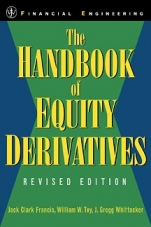
The Handbook of Equity Derivatives
ISBN 9780471326038
Autor: Jack Clark Francis, William W. Toy, J. Gregg Whittaker
Wydawca: Wiley
Dostępność: 3-6 tygodni
Cena: 638,40 zł
Przed złożeniem zamówienia prosimy o kontakt mailowy celem potwierdzenia ceny.
ISBN13: |
9780471326038 |
ISBN10: |
0471326038 |
Autor: |
Jack Clark Francis, William W. Toy, J. Gregg Whittaker |
Oprawa: |
Hardback |
Rok Wydania: |
2000-01-27 |
Ilość stron: |
720 |
Wymiary: |
235x164 |
Tematy: |
KF |
"There are so many ways to use derivatives that I′m almost surprised when someone doesn′t use them. Producers and consumers, investors and issuers, hedgers and speculators, governments and financial institutions: almost everyone can use them." – From the Foreword by Fischer Black, Cocreator of the Black–Scholes Model
Never before has there been so much interest in equity derivatives–or so much innovation in structuring these products. As new forms of instruments proliferate, their complexity has grown as well. Even equity derivatives professionals are unlikely to know all the details about every existing structure. With equity derivatives comprising one of the most important components of the capital markets, it′s more crucial than ever for every financial professional, specialist and nonspecialist alike, to understand how derivative instruments behave, how they′re structured, and how to use them profitably.
Edited by leading thinkers in the field, The Handbook of Equity Derivatives, Revised Edition, assembles dozens of experts from universities and Wall Street to help the reader gain a practical grasp of the growing variety of financial instruments and how they work. Contributions from such respected authorities as Gary Gastineau, Mark Rubinstein,
J. Gregg Whittaker, and Fischer Black outline the full range of the equity derivatives market, from classic warrants, options, and futures to the new and innovative PERCs, equity swaps, and equity–linked bonds.
In nonmathematical language, the book provides a clear introduction to equity derivatives, including the fundamentals and history of options, basic equity structures, and pricing determinants, along with a historical perspective on their evolution. You′ll find thorough surveys of:
∗ The burgeoning field of synthetic structures–OTC options and exotics, equity swaps, SPINs, SIGNs, PENs, MITTs, and SuperShares
∗ U.S. and foreign
derivatives traded on organized exchanges
∗ Issuer derivative structures, such as warrants, convertibles, PERCs, and unbundled stock units
∗ The unique tax, legal, accounting, and regulatory features of derivatives
∗ How to make the most profitable use of the many equity derivative products
∗ Why some financial instruments succeed–and others fail
∗ The future of the equity derivative market– place
Whether you′re a finance student becoming familiar with the field or a practicing professional seeking better ways to exploit the tremendous potential of equity derivatives for profit, The Handbook of Equity Derivatives, Revised Edition belongs on your bookshelf.
"I heartily endorse The Handbook of Equity Derivatives . . . while the market is continuously inventing new instruments and discarding older ones, the clarity and straightforward nature of the handbook hints at a longevity that will make it useful for many years to come." – Stephen A. Ross Sterling Professor of Economics and Finance, MIT (on the first edition)
The most relied–upon resource on equity derivative instruments, their structure, and diverse global markets– now extensively revised and updated
Once, equity derivatives were exotic instruments relegated to the hands of specialists. Today, they are among the institutional investor′s most popular tools for managing risk and uncovering new profit opportunities. Recognized for its authoritative contributors and its accessible, comprehensive coverage of the entire field, The Handbook of Equity Derivatives has become the standard reference on the subject for specialist and nonspecialist alike. Now, this essential resource has been carefully updated and revised to cover the most current innovations in these continually evolving investment vehicles, including:
∗ Comprehensive coverage of the all–important OTC market
∗ Basic equity structures
and how they work
∗ Pricing determinants
∗ PERCs, SPIDERs, and WEBs
∗ The Black–Scholes model
∗ The best uses for and profit potential of new derivative products
∗ Key accounting, tax, and regulatory issues
Spis treści:
Options Fundamentals (T. Weithers).
A Historical Perspective on Equity Derivatives (J. Hill & B. Dunn).
PRODUCTS TRADED ON ORGANIZED EXCHANGES IN THE UNITED STATES.
U.S. Options Exchanges (J. Junkus).
U.S. Stock Index Futures Markets (T. Petzel).
Index Participation Units (E. Kirzner).
Exchange–Traded Equity Funds–Genesis, Growth, and Outlook (G. Gastineau & C. Weber).
International Equity Derivatives (J. Junkus).
ISSUER DERIVATIVE STRUCTURES.
Warrants (E. Harty).
Japanese Warrants (B. Sucher & J. Knight).
Convertibles (A. Aithal).
Buy–Write Securities (T. McManus).
The Enigma of Tax–Driven Security Design: The Unbundled Stock Units and Other Experiences (R. Sah & N. Vasavada).
SYNTHETIC STRUCTURES.
Applications of OTC Options and Other Structured Products (M. Zurack).
Americus Trust′s Primes and Scores: Precursors to Leaps, Percs, Elks, Yeelds and Chips, and Supertrust (E. Harty).
Public Equity–Linked Debt (W. Toy & M. Ryan).
Equity Swaps: Structures, Uses, and Pricing (J. Marshall & R. Yuyuenyongwatana).
Nikkei 225 Put Warrants (M. Ryan & R. Granovsky).
Synthetic Warrants (T. Lindberg).
Supershares (M. Rubinstein).
Structured Equity Derivative Products (J. Whittaker).
A Practitioner′s Guide To Structuring Listed Equity Derivative Securities (J. Braddock & B. Krause).
ACCOUNTING, TAX, AND REGULATORY ISSUES.
Accounting Considerations for Equity Derivatives (M. Joseph).
Legal Issues Concerning Equity Derivative Instruments (P. Gottlieb & J. Gatsos).
The U.S. Taxation of Equity Derivative Instruments (E. Kleinbard).
Deve
lopments in U.S. Derivatives Regulation (T. Russo & M. Vinciguerra).
SEARCHING FOR MEANINGFUL PATTERNS.
Why Financial Instruments Fail or Succeed (J. Francis).
What Lies Ahead? (G. Gastineau & L. Margolis).
The Theory of Security Design (A. Boot, et al.).
Index.
Nota biograficzna:
JACK CLARK FRANCIS is Professor of Economics and Finance at Bernard M. Baruch College in New York City and author of several well–known college textbooks. He previously served as a Federal Reserve economist and on the finance faculty of the University of Pennsylvania′s Wharton School.
WILLIAM W. TOY is a Vice President in the Equity Derivatives Department at Goldman, Sachs & Co. and a codeveloper of the Black–Derman–Toy interest rate options model. He holds a PhD in physics from MIT.
J. GREGG WHITTAKER is a Managing Director and the global head of Credit Derivatives for Chase Securities in New York City and a former senior vice president of S. G. Warburg, where he headed the Equity–Structured Products Division. He earned a PhD in economics from the University of Wisconsin.
Okładka tylna:
"There are so many ways to use derivatives that I′m almost surprised when someone doesn′t use them. Producers and consumers, investors and issuers, hedgers and speculators, governments and financial institutions: almost everyone can use them." – From the Foreword by Fischer Black, Cocreator of the Black–Scholes Model
Never before has there been so much interest in equity derivatives–or so much innovation in structuring these products. As new forms of instruments proliferate, their complexity has grown as well. Even equity derivatives professionals are unlikely to know all the details about every existing structure. With equity derivatives comprising one of the most important components of the capital markets, it′s more crucial than ever for every financial profession
al, specialist and nonspecialist alike, to understand how derivative instruments behave, how they′re structured, and how to use them profitably.
Edited by leading thinkers in the field, The Handbook of Equity Derivatives, Revised Edition, assembles dozens of experts from universities and Wall Street to help the reader gain a practical grasp of the growing variety of financial instruments and how they work. Contributions from such respected authorities as Gary Gastineau, Mark Rubinstein,
J. Gregg Whittaker, and Fischer Black outline the full range of the equity derivatives market, from classic warrants, options, and futures to the new and innovative PERCs, equity swaps, and equity–linked bonds.
In nonmathematical language, the book provides a clear introduction to equity derivatives, including the fundamentals and history of options, basic equity structures, and pricing determinants, along with a historical perspective on their evolution. You′ll find thorough surveys of:
∗ The burgeoning field of synthetic structures–OTC options and exotics, equity swaps, SPINs, SIGNs, PENs, MITTs, and SuperShares
∗ U.S. and foreign derivatives traded on organized exchanges
∗ Issuer derivative structures, such as warrants, convertibles, PERCs, and unbundled stock units
∗ The unique tax, legal, accounting, and regulatory features of derivatives
∗ How to make the most profitable use of the many equity derivative products
∗ Why some financial instruments succeed–and others fail
∗ The future of the equity derivative market– place
Whether you′re a finance student becoming familiar with the field or a practicing professional seeking better ways to exploit the tremendous potential of equity derivatives for profit, The Handbook of Equity Derivatives, Revised Edition belongs on your bookshelf.
"I heartily endorse The Handbook of Equity Derivatives . . . while the market is
continuously inventing new instruments and discarding older ones, the clarity and straightforward nature of the handbook hints at a longevity that will make it useful for many years to come." – Stephen A. Ross Sterling Professor of Economics and Finance, MIT (on the first edition)
The most relied–upon resource on equity derivative instruments, their structure, and diverse global markets– now extensively revised and updated
Once, equity derivatives were exotic instruments relegated to the hands of specialists. Today, they are among the institutional investor′s most popular tools for managing risk and uncovering new profit opportunities. Recognized for its authoritative contributors and its accessible, comprehensive coverage of the entire field, The Handbook of Equity Derivatives has become the standard reference on the subject for specialist and nonspecialist alike. Now, this essential resource has been carefully updated and revised to cover the most current innovations in these continually evolving investment vehicles, including:
∗ Comprehensive coverage of the all–important OTC market
∗ Basic equity structures and how they work
∗ Pricing determinants
∗ PERCs, SPIDERs, and WEBs
∗ The Black–Scholes model
∗ The best uses for and profit potential of new derivative products
∗ Key accounting, tax, and regulatory issues
Koszyk
Książek w koszyku: 0 szt.
Wartość zakupów: 0,00 zł
Informacje


Kontakt
Gambit
Centrum Oprogramowania
i Szkoleń Sp. z o.o.
Al. Pokoju 29b/22-24
31-564 Kraków
Siedziba Księgarni
ul. Kordylewskiego 1
31-542 Kraków
+48 12 410 5991
+48 12 410 5987
+48 12 410 5989
Subskrypcje
Administratorem danych osobowych jest firma Gambit COiS Sp. z o.o. Na podany adres będzie wysyłany wyłącznie biuletyn informacyjny.
Autoryzacja płatności

Informacje na temat autoryzacji płatności poprzez PayU.

© Copyright 2012: GAMBIT COiS Sp. z o.o. Wszelkie prawa zastrzeżone.
Projekt i wykonanie: Alchemia Studio Reklamy