


Wydawcy
Katalog tematyczny
- Archeologia (1)
- Ekonomia, finanse, business (698)
- Filozofia (20)
- Historia (57)
- Języki i językoznawstwo (4)
- Lifestyle, hobby i rozrywka (32)
- Medycyna (1025)
- Nauki humanistyczne (2)
- Nauki o Ziemi i środowisku (430)
- Nauki ścisłe (1681)
- Nauki społeczne (1297)
- Nauki techniczne (530)
- Budownictwo lądowe (6)
- Chemia przemysłowa (27)
- Elektronika i telekomunikacja (163)
- Energetyka (25)
- Inne nauki stosowane (16)
- Inżynieria biochemiczna (11)
- Inżynieria transportu (17)
- Mechanika i materiały (176)
- Nauka o środowisku (27)
- Rolnictwo (8)
- Technika, ogólnie (46)
- Prawo (1437)
- Publikacje informacyjne i interdyscyplinarne (32)
- Religia i wierzenia (15)
- Technika komputerowa (237)
- Zdrowie, relacje międzyludzkie i rozwój osobisty (4)





Informacje szczegółowe o książce
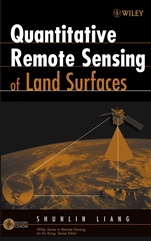
Quantitative Remote Sensing of Land Surfaces
ISBN 9780471281665
Autor: Shunlin Liang, Jin Au Kong
Wydawca: Wiley
Dostępność: 3-6 tygodni
Cena: 1 071,00 zł
Przed złożeniem zamówienia prosimy o kontakt mailowy celem potwierdzenia ceny.
ISBN13: |
9780471281665 |
ISBN10: |
0471281662 |
Autor: |
Shunlin Liang, Jin Au Kong |
Oprawa: |
Hardback |
Rok Wydania: |
2004-01-27 |
Ilość stron: |
560 |
Wymiary: |
242x166 |
Tematy: |
TJ |
A comprehensive resource of basic principles and practical algorithms
Remote sensing of land surfaces has entered a new era. A series of operating satellites from the NASA Earth Observing System (EOS) program, other international programs, and commercial programs are producing tremendous volumes of data at significantly higher levels of measurement precision. In order to effectively interpret the data and estimate Earth surface variables, scientists require ever more sophisticated and targeted quantitative algorithms. Quantitative Remote Sensing of Land Surfaces fills this reference need, connecting theoretical, physically based modeling to specific applications.
Shunlin Liang divides his much–needed resource into two parts. The first presents the current understanding of optical remote sensing with an emphasis on radiative transfer modeling of the atmosphere, canopy, soil, and snow. The second, greater part of the text, discusses a variety of practical algorithms for estimating land surface variables quantitatively. It includes state–of–the–art quantitative algorithms for:Sensor calibrationAtmospheric and topographic correctionEstimation of a variety of biophysical and geophysical variablesFour–dimensional data assimilation
The book cites more than 1,300 references, and the companion CD–ROM includes useful computer program codes and valuable data sets. The author assumes no special mathematical background beyond a good working knowledge of statistics, calculus, and linear algebra on an undergraduate level.
Graduate students as well as practitioners of interdisciplinary research on the Earth’s land surface environment will find Quantitative Remote Sensing of Land Surfaces to be a peerless addition to the professional literature.
Spis treści:
Preface.
Acronyms.
Chapter 1. Introduction.
1.1 Quantitative Models in Optical remote Sensing.<
br>1.2 Basic Concepts.
1.3 Remote Sensing Modeling System.
1.4 Summary.
1.5 References.
Chapter 2. Atmospheric Shortwave Radiative Transfer Modeling.
2.1 Radiative Transfer Equation.
2.2 Surface Statistical BRDF Models.
2.3 Atmospheric Optical Properties.
2.4 Solving Radiative Transfer Equations.
2.5 Approximate Representation for Incorporating Surface BRDF.
2.6 Summary.
2.7 References.
Chapter 3. Canopy Reflectance Modeling.
3.1 Canopy Radiative Transfer Formulation.
3.2 Leaf Optical Models.
3.3 Solving Radiative Transfer Equations.
3.4 Geometric Optical Models.
3.5 Computer Simulation Models.
3.6 Summary.
3.7 References.
Chapter 4. Soil and Snow Reflectance Modeling.
4.1 Single Scattering Properties of Snow and Soil.
4.2 Multiple Scattering Solutions for Angular Reflectance from Snow and Soil.
4.3 Geome tric Optical Modeling.
4.4 Inversion of Snow Parameters.
4.5 Practical Issues.
4.6 Summary.
4.7 References.
Chapter 5. Satellite Sensor Radiometric Calibration.
5.1 Background.
5.2 Post–launch Calibration Methods.
5.3 Calibration Coefficients for Landsat TM and AVHRR Reflective Bands.
5.4 Summary.
5.6 References.
Chapter 6. Atmospheric Correction.
6.1 Introduction.
6.2 Methods for Correcting Single Viewing–angle Imagery.
6.3 Methods for Correcting Multiangular Observations.
6.4 Methods for Estimating Total Column Water Vapor Content.
6.5 Summary.
6.6 References.
Chapter 7. Topographic Correction Methods.
7.1 Introduction.
7.2 Cosine Correction Algorithms.
7.3 IPW Method.
7.4 Shadowing Function Algorithms.
7.5 DEM Data and Generation.
7.6 Summary.
7.7 References.
Chapter 8. Estimation of Land Surface Biophysical variables.
8.1 Statistical Methods.
8.2 Optimization Inversion Method.
8.3 Generic Algorithm (GA).
8.4 Table Look–up Methods.
8.5 Hybrid Inversion Methods.
8.6 Comparisons of D
ifferent Inversion Methods.
8.7 Summary.
8.8 References.
Chapter 9. Estimation of Surface Radiation Budget: I. Broadband Albedo.
9.1 Introduction.
9.2 Broadband Albedo Characteristics.
9.3 Narrowband to Broadband Conversion.
9.4 Direct Estimation of Surface Broadband Albedos.
9.5 Diurnal Cycle Modeling.
9.6 Summary.
9.7 References.
Chapter 10. Estimation of Surface Radiation Budget (II): Longwave.
10.1 Introduction.
10.2 Monochromatic Radiative Transfer Formulation and Solutions.
10.3 Line–by–line Methods.
10.4 Band Models.
10.5 Correlated k–Distribution Methods.
10.6 Atmospheric Correction Methods.
10.7 Split–window Algorithm for Estimating LST.
10.8 Multispectral Algorithms for Separating Temperature and Emissivity.
10.9 Computing Broadband Emissivity.
10.10 Surface Energy Balance Modeling.
10.11 Summary.
10.12 References.
Chapter 11. Four–Dimensional (4D) Data Assimilation.
11.1 Introduction.
11.2 Assimilation Algorithms.
11.3 Minimization Algorithms.
11.4 Data Assimilation in Hydrology.
11.5 Data Assimilationdata with Crop Growth Models.
11.6 Summary.
11.7 References.
Chapter 12. Validation and Spatial Scaling.
12.1 Rationale of Validation.
12.2 Validation Methodology.
12.3 Spatial Scaling Techniques.
12.4 Summary.
12.5 References.
Chapter 13. Applications.
13.1 Methodologies for Integrating Remote Sensing with Ecological Process Models.
13.2 Agricultural Applications.
13.3 "Urban Heat Island" Effects.
13.4 Carbon Cycle Studies.
13.5 Land–atmospheric Interaction.
13.6 Summary.
References.
Appendix.
CD–ROM Content.
Data Directory
Software Directory.
Index.
Nota biograficzna:
SHUNLIN LIANG, PhD, is an associate professor in the Department of Geography at the University of Maryland, where he teaches courses in remote sensing, quantitative spatial analy
sis, and computer cartography. He is the Associate Editor for IEEE Transactions on Geoscience and Remote Sensing and the coeditor of Geographic Information Science.
Okładka tylna:
A comprehensive resource of basic principles and practical algorithms
Remote sensing of land surfaces has entered a new era. A series of operating satellites from the NASA Earth Observing System (EOS) program, other international programs, and commercial programs are producing tremendous volumes of data at significantly higher levels of measurement precision. In order to effectively interpret the data and estimate Earth surface variables, scientists require ever more sophisticated and targeted quantitative algorithms. Quantitative Remote Sensing of Land Surfaces fills this reference need, connecting theoretical, physically based modeling to specific applications.
Shunlin Liang divides his much–needed resource into two parts. The first presents the current understanding of optical remote sensing with an emphasis on radiative transfer modeling of the atmosphere, canopy, soil, and snow. The second, greater part of the text, discusses a variety of practical algorithms for estimating land surface variables quantitatively. It includes state–of–the–art quantitative algorithms for:Sensor calibrationAtmospheric and topographic correctionEstimation of a variety of biophysical and geophysical variablesFour–dimensional data assimilation
The book cites more than 1,300 references, and the companion CD–ROM includes useful computer program codes and valuable data sets. The author assumes no special mathematical background beyond a good working knowledge of statistics, calculus, and linear algebra on an undergraduate level.
Graduate students as well as practitioners of interdisciplinary research on the Earth’s land surface environment will find Quantitative Remote Sensing of Land Surf
Koszyk
Książek w koszyku: 0 szt.
Wartość zakupów: 0,00 zł
Informacje


Kontakt
Gambit
Centrum Oprogramowania
i Szkoleń Sp. z o.o.
Al. Pokoju 29b/22-24
31-564 Kraków
Siedziba Księgarni
ul. Kordylewskiego 1
31-542 Kraków
+48 12 410 5991
+48 12 410 5987
+48 12 410 5989
Subskrypcje
Administratorem danych osobowych jest firma Gambit COiS Sp. z o.o. Na podany adres będzie wysyłany wyłącznie biuletyn informacyjny.
Autoryzacja płatności

Informacje na temat autoryzacji płatności poprzez PayU.

© Copyright 2012: GAMBIT COiS Sp. z o.o. Wszelkie prawa zastrzeżone.
Projekt i wykonanie: Alchemia Studio Reklamy