


Wydawcy
Katalog tematyczny
- Archeologia (109)
- Ekonomia, finanse, business (13704)
- Filozofia (1445)
- Historia (3040)
- Języki i językoznawstwo (2356)
- Lifestyle, hobby i rozrywka (475)
- Medycyna (9704)
- Nauki humanistyczne (4)
- Nauki o Ziemi i środowisku (2638)
- Nauki ścisłe (20412)
- Nauki społeczne (8486)
- Nauki techniczne (13450)
- Prawo (1696)
- Publikacje informacyjne i interdyscyplinarne (1288)
- Religia i wierzenia (917)
- Technika komputerowa (4067)
- Zdrowie, relacje międzyludzkie i rozwój osobisty (657)





Informacje szczegółowe o książce
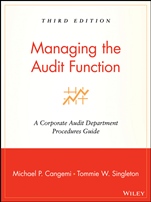
Managing the Audit Function: A Corporate Audit Department Procedures Guide
ISBN 9780471281191
Autor: Michael P. Cangemi, Tommie W. Singleton
Wydawca: Wiley
Dostępność: 3-6 tygodni
Cena: 502,95 zł
Przed złożeniem zamówienia prosimy o kontakt mailowy celem potwierdzenia ceny.
ISBN13: |
9780471281191 |
ISBN10: |
0471281190 |
Autor: |
Michael P. Cangemi, Tommie W. Singleton |
Oprawa: |
Paperback |
Rok Wydania: |
2003-04-25 |
Numer Wydania: |
3rd Edition |
Ilość stron: |
384 |
Wymiary: |
277x215 |
Tematy: |
KF |
As auditing shifts from an outsourced function to a cornerstone of internal control, audit directors need an updated manual that reflects the radical changes the internal audit profession recently experienced in order to establish efficient processes for conducting successful audits. Managing the Audit Function, Third Edition, provides a blueprint for the creation of an effective procedures manual for an internal audit department.
A new chapter defines internal control, risk assessment, control strategies, and malicious activities. This subject should be studied and understood not only by internal auditors but by all managers and board members as well. The recent developments with accounting irregularities demonstrated a clear need for an education on the complex subject of internal control.
By implementing the methods recommended in Cangemi and Singleton’s authoritative guide, auditors can play an integral role in improving overall corporate performance. Among other services, the Third Edition:Provides a discussion of what world–class audit departments are doing with Baldridge criteria, balanced scorecard, and other continuous improvement techniques</ LI>Contains unique matrices that describe each component of the audit function in detail, from administration to performance to reportingIncludes standards for information systems auditingOffers a discussion of quality assurance and marketingDelivers a new section on the internal control system, which includes models, tools, and techniques, that should be read by all senior management and board members
By following the manual, auditors can ensure that they are following the guidelines for internal control that both the Foreign Corrupt Services Act and the Committee of Sponsoring Organizations (COSO) require. The authors also present a sample procedures manual on an available Web site:
www.wiley.com/go/audit manual.
Each page of the manual has a hea
ding consisting of a generic company name, title of the manual (Corporate Audit Department Procedures Manual, if appropriate), section number, revision number, and the date of the revision. The authors have written much of the text this way as a boilerplate that can be used to easily create a unique, modifiable, dynamic manual. In this shifting accounting landscape, effective auditing procedures are absolutely essential to appropriate internal control. Managing the Audit Function, Third Edition provides internal auditors the reliable resource they need.
Praise for Managing the Audit Function
"The corporate governance issues, accounting irregularities, and legislative actions that have taken place over the past two years have elevated the role and importance of the internal audit function. Managing the Audit Function provides a valuable guide and reference tool for those charged with either executing or overseeing this function."
–– Daniel S. Kaplan, Business Risk Services Partner
Ernst & Young LLP
"It was refreshing to read Internal Audit literature with the appropriate focus on information systems and information systems auditing, since computer systems play such a key role in the processing of accounting transactions and the performance of business operations in today’s business environment."
–– William J. Powers, Partner, National Director
Information Systems Assurance Services
BDO Seidman, LLP
"Cangemi and Singleton have created a knowledge management tool for the creation of quality audit manuals and functions. Managing the Audit Function is an important book for all audit managers, and with the addition of new and updated material, including information on the implications and requirements of the Sarbanes–Oxley Act, it provides the information to keep pace with changing conditions affecting the audit function."
–– Robert S. Roussey, Professor of Accounting
Leventhal Schoo
l of Accounting, University of Southern California
International President, Information Systems Audit and Control Association
" This is basically a procedures manual for an internal auditing department that has been prepared by two of the world’s most knowledgeable IT auditors. The book is a handy tool because examples are given throughout of relevant audit documents, such as audit reports, responses to reports, responses to delinquent responses, matrices, checklists, and flowcharts. Every audit department should have this book as a reference manual."
–– Dale L. Flesher, PhD, CPA, CMA, CIA, CFE, CGFM
Professor of Accountancy and Associate Dean
University of Mississippi
Spis treści:
Foreword.
Preface.
PART ONE: FUNDAMENTALS OF THE INTERNAL AUDITING FUNCTION.
Chapter 1. Background.
1.1 Introduction.
1.2 History of Auditing.
1.3 History of Internal Auditing.
1.4 Auditing Government Agencies.
1.5 History of Information Systems Auditing.
1.6 History of Federal Regulations Related to Auditing.
1.7 Professional Organizations Related to Internal Auditing.
Chapter 2. Auditing Standards and Responsibilities.
2.1 Introduction.
2.2 Ethics.
2.3 Professional Auditing Standards.
2.4 Systems Development Life Cycle Standards.
2.5 Professional Development.
2.6 Responsibilities of a Corporate Auditor.
Chapter 3. Internal Control System.
3.1 Definition.
3.2 Fundamental Assumptions in Establishing an Internal Control System.
3.3 Effective Internal Control Models.
3.4 Regulations.
3.5 Policies.
3.6 Risk Assessment.
3.7 Control Strategies.
3.8 Malicious Activities.
3.9 Specific Controls/CAATTs.
PART TWO: MANAGEMENT AND ADMINISTRATION.
Chapter 4. Department Organization.
4.1 Introduction.
4.2 Corporate Audit Charter.
4.3 Company Organization.
4.4 Audit Department Policies.
Chapter 5. Personnel, Administration, and Recruiting.
5.1 I
ntroduction.
5.2 Personal Development.
5.3 Personnel Files.
5.4 Periodic Performance Evaluation Review.
5.5 Annual Staff Meeting/Conference.
5.6 New Staff Orientation.
PART THREE: TECHNICAL PROCEDURES.
Chapter 6. Audit Planning.
6.1 Corporate Audit Planning, Scheduling, and Staffing.
6.2 Internal Controls.
6.3 Materiality.
6.4 Types of Audits.
6.5 Time Reporting.
6.6 Expense Reporting.
Chapter 7. Audit Performance.
7.1 Corporate Audit Performance Process Matrix.
7.2 Workpapers.
7.3 Audit Objectives.
Chapter 8. Audit Reporting.
8.1 Corporate Audit Report Process.
8.2 Report to Management.
8.3 Report to Audit Committee.
PART FOUR: LONG–TERM EFFECTIVENESS.
Chapter 9. Managing the Effectiveness of the Audit Department.
9.1 Introduction.
9.2 Corporate Governance.
9.3 Quality Assurance.
9.4 Continuous Improvement Systems for Internal Auditors.
9.5 Marketing the Audit Function.
Index.
Nota biograficzna:
MICHAEL P. CANGEMI, CPA, CISA, is President and Chief Executive Officer of Aigner Group, a leading wholesale/retail firm that designs and produces quality branded leather goods. Prior to joining Aigner Group, he was partner and national director of EDP auditing for BDO Seidman, where he founded and directed a service area for internal audit services and was general auditor of Phelps Dodge Corporation.
TOMMIE SINGLETON, CPA, CMA, CISA, CITP, is Professor and Director of the Development of Computer Accounting Information Systems and of the Forensic Accounting Program at the University of North Alabama.
Okładka tylna:
As auditing shifts from an outsourced function to a cornerstone of internal control, audit directors need an updated manual that reflects the radical changes the internal audit profession recently experienced in order to establish efficient processes for conducting successful audits. Managing the Audit Function, Third Edition, pr
Koszyk
Książek w koszyku: 0 szt.
Wartość zakupów: 0,00 zł
Informacje


Kontakt
Gambit
Centrum Oprogramowania
i Szkoleń Sp. z o.o.
Al. Pokoju 29b/22-24
31-564 Kraków
Siedziba Księgarni
ul. Kordylewskiego 1
31-542 Kraków
+48 12 410 5991
+48 12 410 5987
+48 12 410 5989
Subskrypcje
Administratorem danych osobowych jest firma Gambit COiS Sp. z o.o. Na podany adres będzie wysyłany wyłącznie biuletyn informacyjny.
Autoryzacja płatności

Informacje na temat autoryzacji płatności poprzez PayU.

© Copyright 2012: GAMBIT COiS Sp. z o.o. Wszelkie prawa zastrzeżone.
Projekt i wykonanie: Alchemia Studio Reklamy