


Wydawcy
Katalog tematyczny
- Archeologia (109)
- Ekonomia, finanse, business (13704)
- Filozofia (1445)
- Historia (3040)
- Języki i językoznawstwo (2356)
- Lifestyle, hobby i rozrywka (475)
- Medycyna (9704)
- Nauki humanistyczne (4)
- Nauki o Ziemi i środowisku (2638)
- Nauki ścisłe (20412)
- Nauki społeczne (8486)
- Nauki techniczne (13450)
- Budownictwo lądowe (1045)
- Chemia przemysłowa (2258)
- Elektronika i telekomunikacja (3287)
- Energetyka (1122)
- Inne nauki stosowane (363)
- Inżynieria biochemiczna (507)
- Inżynieria transportu (232)
- Mechanika i materiały (3316)
- Nauka o środowisku (321)
- Rolnictwo (507)
- Technika, ogólnie (475)
- Prawo (1696)
- Publikacje informacyjne i interdyscyplinarne (1288)
- Religia i wierzenia (917)
- Technika komputerowa (4067)
- Zdrowie, relacje międzyludzkie i rozwój osobisty (657)





Informacje szczegółowe o książce
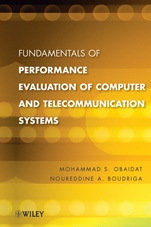
Fundamentals of Performance Evaluation of Computer and Telecommunication Systems
ISBN 9780471269830
Autor: Mohammed S. Obaidat, Noureddine A. Boudriga
Wydawca: Wiley
Dostępność: 3-6 tygodni
Cena: 643,65 zł
Przed złożeniem zamówienia prosimy o kontakt mailowy celem potwierdzenia ceny.
ISBN13: |
9780471269830 |
ISBN10: |
0471269832 |
Autor: |
Mohammed S. Obaidat, Noureddine A. Boudriga |
Oprawa: |
Hardback |
Rok Wydania: |
2010-02-09 |
Ilość stron: |
480 |
Wymiary: |
239x155 |
Tematy: |
TJ |
The only singular, all–encompassing textbook on state–of–the–art technical performance evaluation
Fundamentals of Performance Evaluation of Computer and Telecommunication Systems uniquely presents all techniques of performance evaluation of computers systems, communication networks, and telecommunications in a balanced manner. Written by the renowned Professor Mohammad S. Obaidat and his coauthor Professor Noureddine Boudriga, it is also the only resource to treat computer and telecommunication systems as inseparable issues. The authors explain the basic concepts of performance evaluation, applications, performance evaluation metrics, workload types, benchmarking, and characterization of workload. This is followed by a review of the basics of probability theory, and then, the main techniques for performance evaluation—namely measurement, simulation, and analytic modeling—with case studies and examples.
Contains the practical and applicable knowledge necessary for a successful performance evaluation in a balanced approach
Reviews measurement tools, benchmark programs, design of experiments, traffic models, basics of queueing theory, and operational and mean value analysis
Covers the techniques for validation and verification of simulation as well as random number generation, random variate generation, and testing with examples
Features numerous examples and case studies, as well as exercises and problems for use as homework or programming assignments
Fundamentals of Performance Evaluation of Computer and Telecommunication Systems is an ideal textbook for graduate students in computer science, electrical engineering, computer engineering, and information sciences, technology, and systems. It is also an excellent reference for practicing engineers and scientists.
Spis treści:
1. Introduction and Basic Concepts.
1.1. Background.
1.2. Performa
nce Evaluation Viewpoints and Concepts.
1.3. Goals of Performance Evaluation.
1.4. Applications of Performance Evaluation.
1.5. Techniques.
1.6. Metrics of Performance.
1.7. Workload characterization.
1.8. Benchmarking.
1.9. Summary.
Exercises.
2. Probability Theory Review.
2.1 Basic Concepts on Probability Theory.
2.2 Sample Space and Events.
2.3 Conditional Probability and Independence.
2.2 Mean and Median use.
2.3 Geometric, and Harmonic Mean.
2.4 Variance, and Standard Deviation.
2.5 Random Variables.
2.6 Expectation and Variance.
2.7 Density and Distribution Functions.
2.8 Comparing Systems Using Sample Data.
2.9 Regression Models.
2.10 Summary.
Exercises.
3. Measurement/Testing Technique.
3.1. Event and Measurement Strategies.
3.2. Event Tracing.
3.3. Hardware Monitor.
3.4. Software Monitors.
3.5. Hybrid Monitors.
3.6. Traffic Issues and Solutions.
3.7. Accounting Logs.
3.8. Summary.
Exercises.
4. Benchmarking and Capacity Planning.
4.1 Types of Benchmark Programs.
4.2 Common Mistakes in Benchmarking.
4.3 Example Benchmark Programs.
4.4 Procedures of Capacity planning.
4.5 Problems in Capacity Planning.
4.6 Summary.
Exercises.
5. Data Representation and Game Ratio.
5.1 Guidelines for Preparing Plots.
5.2 Charts Used for Data Presentation.
5.3 Program Profiling.
5.4 Common Mistakes in Charts Construction.
5.5 Errors in Experimental Measurements.
5.6 Summary.
Exercises.
6. Basics of Queueing Theory.
6.1 Introduction.
6.2 Queueing Modeling Notations.
6.3 Rules for all Queues.
6.4 Single–Queue, Single (M/M/ 1) System.
6.5. Single–Queue, Multiple Server (M/M/c) System.
6.6 Other Queues.
6.7. Little’s Law.
6.8. Summary.
Exercises.
7. Queueing Networks.
7.1 Definitions.
7.2 Open Queueing Networks.
7.3 Closed Queueing Networks.
7.4 Product–Form Queueing Netw
orks.
7.5 Case Studies.
Exercises.
8. Operational and Mean Value Analysis.
8.1 Utilization Law.
8.2 Little’s Formula.
8.3 Forced Flow Law.
8.4 Interactive Response Time Law.
8.5 Bottleneck Analysis.
8.6 Standard Mean Value Analysis (MVA).
8.7 Scheweitzer’s Approximation of MVA.
8.8 Balanced Job Bounds.
9. Introduction to the Simulation Technique.
9.1 Simulation Types.
9.2 Terminology.
9.3 Random Number Generation Techniques.
9.3.1 Linear Congruential Generators.
9.3.2 Mixed Generators.
9.3.3 Tausworthe Generators.
9.3.5 Extended Fibonici Generators.
9.4 Survey of Commonly Used Random Number Generators.
9.5 Seed Selections.
9.6 Testing Random Number Generators.
9.7 Random Variate Generation Techniques.
9.7.1 Inverse Transformation.
9.7.2 Rejection.
9.7.3 Characterization.
9.7.4 Convolution.
9.7.5 Composition.
9.8 Examples.
Exercises.
10. Commonly Used Distributions in Simulation and Their Applications.
10.1 Exponential.
10.2 Posisson.
10.3 Uniform.
10.5 Normal.
10.6 Weibull.
10.7 Pareto.
10.8 Geometric.
10.9 Gamma.
10.10 Erlang.
10.11 Beta.
10.12 Binomial.
10.13 Bernoulli.
10.14 Chi–Square.
10.15 F Distribution.
10.16 Log Normal.
10.17 Pascal.
10.18 Student’s t Distribution.
10.19 Examples.
Exercises.
11. Analysis of Simulation Outputs.
11.1 Introduction.
11.2 Vérification Techniques.
11.3 Validation techniques.
11.4 Techniques for Transient Removal.
11.5 Techniques for Termination of Simulation and Stopping Criteria.
Exercises.
12. Simulation Software.
12.1 General Purpose Languages.
12.2 Simulation languages.
12.3 Object–Oriented languages.
12.3.1 Standard Object–Oriented Languages.
12.3.2 Objected–oriented Simulation Languages.
12.4 Simulation Packages Used for Simulation of Computer and Telecommunications Systems.
12.4 Case
Studies.
Exercises.
Okładka tylna:
The only singular, all–encompassing textbook on state–of–the–art technical performance evaluation
Fundamentals of Performance Evaluation of Computer and Telecommunication Systems uniquely presents all techniques of performance evaluation of computers systems, communication networks, and telecommunications in a balanced manner. Written by the renowned Professor Mohammad S. Obaidat and his coauthor Professor Noureddine Boudriga, it is also the only resource to treat computer and telecommunication systems as inseparable issues. The authors explain the basic concepts of performance evaluation, applications, performance evaluation metrics, workload types, benchmarking, and characterization of workload. This is followed by a review of the basics of probability theory, and then, the main techniques for performance evaluation—namely measurement, simulation, and analytic modeling—with case studies and examples.
Contains the practical and applicable knowledge necessary for a successful performance evaluation in a balanced approach
Reviews measurement tools, benchmark programs, design of experiments, traffic models, basics of queueing theory, and operational and mean value analysis
Covers the techniques for validation and verification of simulation as well as random number generation, random variate generation, and testing with examples
Features numerous examples and case studies, as well as exercises and problems for use as homework or programming assignments
Fundamentals of Performance Evaluation of Computer and Telecommunication Systems is an ideal textbook for graduate students in computer science, electrical engineering, computer engineering, and information sciences, technology, and systems. It is also an excellent reference for practicing engineers and scientists.
Koszyk
Książek w koszyku: 0 szt.
Wartość zakupów: 0,00 zł
Informacje


Kontakt
Gambit
Centrum Oprogramowania
i Szkoleń Sp. z o.o.
Al. Pokoju 29b/22-24
31-564 Kraków
Siedziba Księgarni
ul. Kordylewskiego 1
31-542 Kraków
+48 12 410 5991
+48 12 410 5987
+48 12 410 5989
Subskrypcje
Administratorem danych osobowych jest firma Gambit COiS Sp. z o.o. Na podany adres będzie wysyłany wyłącznie biuletyn informacyjny.
Autoryzacja płatności

Informacje na temat autoryzacji płatności poprzez PayU.

© Copyright 2012: GAMBIT COiS Sp. z o.o. Wszelkie prawa zastrzeżone.
Projekt i wykonanie: Alchemia Studio Reklamy