


Wydawcy
Katalog tematyczny
- Archeologia (109)
- Ekonomia, finanse, business (13704)
- Filozofia (1445)
- Historia (3040)
- Języki i językoznawstwo (2356)
- Lifestyle, hobby i rozrywka (475)
- Medycyna (9704)
- Nauki humanistyczne (4)
- Nauki o Ziemi i środowisku (2638)
- Nauki ścisłe (20412)
- Astronomia (294)
- Biologia (5119)
- Chemia (6540)
- Chemia analityczna (361)
- Chemia fizyczna (346)
- Chemia nieorganiczna (137)
- Chemia organiczna (535)
- Krystalografia (27)
- Minerologia (46)
- Fizyka (3309)
- Matematyka (4574)
- Nauki ścisłe, ogólnie (503)
- Nauki społeczne (8486)
- Nauki techniczne (13450)
- Prawo (1696)
- Publikacje informacyjne i interdyscyplinarne (1288)
- Religia i wierzenia (917)
- Technika komputerowa (4067)
- Zdrowie, relacje międzyludzkie i rozwój osobisty (657)





Informacje szczegółowe o książce
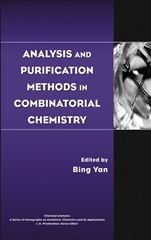
Analysis and Purification Methods in Combinatorial Chemistry
ISBN 9780471269298
Autor: Bing Yan
Wydawca: Wiley
Dostępność: 3-6 tygodni
Cena: 861,00 zł
Przed złożeniem zamówienia prosimy o kontakt mailowy celem potwierdzenia ceny.
ISBN13: |
9780471269298 |
ISBN10: |
0471269298 |
Autor: |
Bing Yan |
Oprawa: |
Hardback |
Rok Wydania: |
2004-01-09 |
Ilość stron: |
480 |
Wymiary: |
230x159 |
Tematy: |
PN |
Quality measurement, control, and improvement incombinatorial chemistry
Combinatorial chemistry has developed rapidly in the past decade, with greatadvances made by scientists working on analysis and purification of a largenumber of compounds and the analysis of polymer–bound compounds. However,formidable challenges lie ahead of today′s researcher. For example,high–throughput analysis and purification technologies must be furtherdeveloped to ensure combinatorial libraries are "purifiable," and "drugable."
To this end, Analysis and Purification Methods inCombinatorial Chemistry describes various analytical techniques and systems forthe development, validation, quality control, purification, and physicochemicaltesting of combinatorial libraries. A new volume in Wiley′s Chemical Analysisseries, this text has four parts covering:Various approaches to monitoring reactions on solid support and optimizing reactions for library synthesisHigh–throughput analytical methods used to analyze the quality of librariesHigh–throughput purification techniquesAnalytical methods applied in post–synthesis and post–purification stages
Drawing from the contributions of respected experts incombinatorial chemistry, this comprehensive book provides coverage ofapplications of Nuclear Magnetic Resonance (NMR), liquid chromatography/massspectrometry (LC/MS), Fourier Transform Infrared (FTIR), micellarelectrokinetic chromatography (MEKC) technologies, as well as other analyticaltechniques.
This eminently useful volume is an essential addition to thelibrary of students and researchers studying or working in analyticalchemistry, combinatorial chemistry, medicinal chemistry, organic chemistry,biotechnology, biochemistry, or biophysics.
Spis treści:
Preface.
Contributors.
PART I: ANALYSIS FOR FEASIBILITY AND OPTIMIZATION OF LIBRARY SYNTHESIS.
Chapter 1. Quantitati
ve Analysis in Organic Synthesis with NMR (L. Lucas & C. Larive).
Chapter 2. 19F Gel–phase NMR Spectroscopy for Reaction Monitoring and Quantification of Resin Loading (J. Salvino).
Chapter 3. The Application of Single–Bead FTIR and Color Test for Reaction Monitoring and Building Block Validation in Combinatorial Library Sysnthesis(J. Cournoyer, et al.).
Chapter 4. HR–MAS NMR Analysis of Compounds Attached to Polymer Supports (M. Guinó & Y. de Miguel).
Chapter 5. Multivariate Tools for Real–Time Monitoring and Optimization of Combinatorial Materials and Process Conditions (R. Potyrailo, et al.).
Chapter 6. Mass Spectrometry and Soluble Polymeric Supports (C. Enjalbal, et al.).
PART II: HIGH–THROUGHPUT ANALYSIS FOR LIBRARY QUALITY CONTROL.
Chapter 7. High–Throughput NMR Techniques for Combinatorial Chemical Library Analysis (T. Hou & D. Raftery).
Chapter 8. Micellar Electrokinetic Chromatography as a Tool for Combinatorial Chemistry Analysis: Theory and Applications (P. Simms).
Chapter 9. Characterization of Split–Pool Encoded Combinatorial Libraries (J. Zhang & W. Fitch).
PART III: HIGH–THROUGHPUT PURIFICATION TO IMPROVE LIBRARY QUALITY.
Cha pter 10. Strategies and Methods for Purifying Organic Compounds and Combinatorial Libraries (J. Zhao, et al.).
Chapter 11. HTP of Combinatorial Chemistry Libraries (J. Hochlowski).
Chapter 12. Practical HPLC in High Throughput Analysis and Purification (H. Gumm & R. God).
PART IV: ANALYSIS FOR COMPOUND STABILITY AND DRUGABILITY.
Chapter 13. Organic Compound Stability in Large, Diverse Phatmaceutical Screening Collection (K. Morand & X. Cheng).
Chapter 14. Quartz Crystal Microbalance in Biomolecular Recognition (M. Tseng, et al.).
Chapter 15. High–Throughput Physicochemical Profiling: Potential and Limitations (B.
Faller).
Chapter 16. Solubility in the Design of Combinatorial Libraries (C. Lipinski).
Chapter 17. High–Throughput Determination of Log D Values by LC/MS Method (J. Villena, et al.).
Index.
Nota biograficzna:
BING YAN, PhD, was born in China and received his PhD inchemistry at Columbia University in 1990. He then worked at CambridgeUniversity and the University of Texas–Houston Medical School as a postdoctoralfellow. From 1993 to 1999, he worked for Novartis in the Core Technologies areaof preclinical research in New Jersey. He is currently at the DiscoveryChemistry division of Discovery Partners International, Inc., in San Francisco.His major research interests are drug discovery, optimization of solid–phaseand solution–phase combinatorial synthesis, high–throughput quantitative andqualitative analysis, and high–throughput purification of combinatoriallibraries. He has written four books and published over seventy reviews andresearch articles.
Okładka tylna:
Quality measurement, control, and improvement incombinatorial chemistry
Combinatorial chemistry has developed rapidly in the past decade, with greatadvances made by scientists working on analysis and purification of a largenumber of compounds and the analysis of polymer–bound compounds. However,formidable challenges lie ahead of today′s researcher. For example,high–throughput analysis and purification technologies must be furtherdeveloped to ensure combinatorial libraries are "purifiable," and "drugable."
To this end, Analysis and Purification Methods inCombinatorial Chemistry describes various analytical techniques and systems forthe development, validation, quality control, purification, and physicochemicaltesting of combinatorial libraries. A new volume in Wiley′s Chemical Analysisseries, this text has four parts covering:Various approaches to monitoring reac
tions on solid support and optimizing reactions for library synthesisHigh–throughput analytical methods used to analyze the quality of librariesHigh–throughput purification techniquesAnalytical methods applied in post–synthesis and post–purification stages
Drawing from the contributions of respected experts incombinatorial chemistry, this comprehensive book provides coverage ofapplications of Nuclear Magnetic Resonance (NMR), liquid chromatography/massspectrometry (LC/MS), Fourier Transform Infrared (FTIR), micellarelectrokinetic chromatography (MEKC) technologies, as well as other analyticaltechniques.
This eminently useful volume is an essential addition to thelibrary of students and researchers studying or working in analyticalchemistry, combinatorial chemistry, medicinal chemistry, organic chemistry,biotechnology, biochemistry, or biophysics.
Koszyk
Książek w koszyku: 0 szt.
Wartość zakupów: 0,00 zł
Informacje


Kontakt
Gambit
Centrum Oprogramowania
i Szkoleń Sp. z o.o.
Al. Pokoju 29b/22-24
31-564 Kraków
Siedziba Księgarni
ul. Kordylewskiego 1
31-542 Kraków
+48 12 410 5991
+48 12 410 5987
+48 12 410 5989
Subskrypcje
Administratorem danych osobowych jest firma Gambit COiS Sp. z o.o. Na podany adres będzie wysyłany wyłącznie biuletyn informacyjny.
Autoryzacja płatności

Informacje na temat autoryzacji płatności poprzez PayU.

© Copyright 2012: GAMBIT COiS Sp. z o.o. Wszelkie prawa zastrzeżone.
Projekt i wykonanie: Alchemia Studio Reklamy