


Wydawcy
Katalog tematyczny
- Archeologia (109)
- Ekonomia, finanse, business (13704)
- Filozofia (1445)
- Historia (3040)
- Języki i językoznawstwo (2356)
- Lifestyle, hobby i rozrywka (475)
- Medycyna (9704)
- Nauki humanistyczne (4)
- Nauki o Ziemi i środowisku (2638)
- Nauki ścisłe (20412)
- Nauki społeczne (8486)
- Nauki techniczne (13450)
- Budownictwo lądowe (1045)
- Chemia przemysłowa (2258)
- Elektronika i telekomunikacja (3287)
- Energetyka (1122)
- Inne nauki stosowane (363)
- Inżynieria biochemiczna (507)
- Inżynieria transportu (232)
- Mechanika i materiały (3316)
- Nauka o środowisku (321)
- Rolnictwo (507)
- Technika, ogólnie (475)
- Prawo (1696)
- Publikacje informacyjne i interdyscyplinarne (1288)
- Religia i wierzenia (917)
- Technika komputerowa (4067)
- Zdrowie, relacje międzyludzkie i rozwój osobisty (657)





Informacje szczegółowe o książce
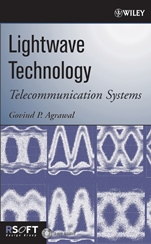
Lightwave Technology: Telecommunication Systems
ISBN 9780471215721
Autor: Govind P. Agrawal
Wydawca: Wiley
Dostępność: 3-6 tygodni
Cena: 708,75 zł
Przed złożeniem zamówienia prosimy o kontakt mailowy celem potwierdzenia ceny.
ISBN13: |
9780471215721 |
ISBN10: |
0471215724 |
Autor: |
Govind P. Agrawal |
Oprawa: |
Hardback |
Rok Wydania: |
2005-07-15 |
Ilość stron: |
480 |
Wymiary: |
243x164 |
Tematy: |
TJ |
The state of the art of modern lightwave system design
Recent advances in lightwave technology have led to an explosion of high–speed global information systems throughout the world. Responding to the growth of this exciting new technology, Lightwave Technology provides a comprehensive and up–to–date account of the underlying theory, development, operation, and management of these systems from the perspective of both physics and engineering.
The first independent volume of this two–volume set, Components and Devices, deals with the multitude of silica– and semiconductor–based optical devices. This second volume, Telecommunication Systems, helps readers understand the design of modern lightwave systems, with an emphasis on wavelength–division multiplexing (WDM) systems.Two introductory chapters cover topics such as modulation formats and multiplexing techniques used to create optical bit streamsChapters 3 to 5 consider degradation of optical signals through loss, dispersion, and nonlinear impairment during transmission and its corresponding impact on system performanceChapters 6 to 8 provide readers with strategies for managing degradation induced by amplifier noise, fiber dispersion, and various nonlinear effectsChapters 9 and 10 discuss the engineering issues involved in the design of WDM systems and optical networks
Each chapter includes problems that enable readers to engage and test their new knowledge to solve problems. A CD containing illuminating examples based on RSoft Design Group′s award–winning OptSim optical communication system simulation software is included with the book to assist readers in understanding design issues. Finally, extensive, up–to–date references at the end of each chapter enable students and researchers to gather more information about the most recent technology breakthroughs and applications.
With its extensive p
roblem sets and straightforward writing style, this is an excellent textbook for upper–level undergraduate and graduate students. Research scientists and engineers working in lightwave technology will use this text as a problem–solving resource and a reference to additional research papers in the field.
Spis treści:
Preface.
1. Introduction.
2. Optical Signal Generation.
3. Signal Propagation in Fibers.
4. Nonlinear Impairments.
5. Signal Recovery and Noise.
6. Optical Amplifier Noise.
7. Dispersion Management.
8. Nonlinearity Management.
9. WDM Systems.
10. Optical Networks.
Appendix A: System of Units.
Appendix B: Software Package.
Appendix C: Acronyms.
Index.
Nota biograficzna:
GOVIND P. AGRAWAL, PhD, is a Professor of Optics at The Institute of Optics, University of Rochester, New York, and a Fellow of the Optical Society of America and the IEEE. Internationally recognized as an expert in his field, Dr. Agrawal has authored or coauthored more than 300 research papers, books, and monographs.
Okładka tylna:
The state of the art of modern lightwave system design
Recent advances in lightwave technology have led to an explosion of high–speed global information systems throughout the world. Responding to the growth of this exciting new technology, Lightwave Technology provides a comprehensive and up–to–date account of the underlying theory, development, operation, and management of these systems from the perspective of both physics and engineering.
The first independent volume of this two–volume set, Components and Devices, deals with the multitude of silica– and semiconductor–based optical devices. This second volume, Telecommunication Systems, helps readers understand the design of modern lightwave systems, with an emphasis on wavelength–division multiplexing (WDM) systems.Two introductory chapte
rs cover topics such as modulation formats and multiplexing techniques used to create optical bit streamsChapters 3 to 5 consider degradation of optical signals through loss, dispersion, and nonlinear impairment during transmission and its corresponding impact on system performanceChapters 6 to 8 provide readers with strategies for managing degradation induced by amplifier noise, fiber dispersion, and various nonlinear effectsChapters 9 and 10 discuss the engineering issues involved in the design of WDM systems and optical networks
Each chapter includes problems that enable readers to engage and test their new knowledge to solve problems. A CD containing illuminating examples based on RSoft Design Group′s award–winning OptSim optical communication system simulation software is included with the book to assist readers in understanding design issues. Finally, extensive, up–to–date references at the end of each chapter enable students and researchers to gather more information about the most recent technology breakthroughs and applications.
With its extensive problem sets and straightforward writing style, this is an excellent textbook for upper–level undergraduate and graduate students. Research scientists and engineers working in lightwave technology will use this text as a problem–solving resource and a reference to additional research papers in the field.
Koszyk
Książek w koszyku: 0 szt.
Wartość zakupów: 0,00 zł
Informacje


Kontakt
Gambit
Centrum Oprogramowania
i Szkoleń Sp. z o.o.
Al. Pokoju 29b/22-24
31-564 Kraków
Siedziba Księgarni
ul. Kordylewskiego 1
31-542 Kraków
+48 12 410 5991
+48 12 410 5987
+48 12 410 5989
Subskrypcje
Administratorem danych osobowych jest firma Gambit COiS Sp. z o.o. Na podany adres będzie wysyłany wyłącznie biuletyn informacyjny.
Autoryzacja płatności

Informacje na temat autoryzacji płatności poprzez PayU.

© Copyright 2012: GAMBIT COiS Sp. z o.o. Wszelkie prawa zastrzeżone.
Projekt i wykonanie: Alchemia Studio Reklamy