


Wydawcy
Katalog tematyczny
- Archeologia (109)
- Ekonomia, finanse, business (13704)
- Filozofia (1445)
- Historia (3040)
- Języki i językoznawstwo (2356)
- Lifestyle, hobby i rozrywka (475)
- Medycyna (9704)
- Nauki humanistyczne (4)
- Nauki o Ziemi i środowisku (2638)
- Nauki ścisłe (20412)
- Nauki społeczne (8486)
- Nauki techniczne (13450)
- Budownictwo lądowe (1045)
- Chemia przemysłowa (2258)
- Elektronika i telekomunikacja (3287)
- Energetyka (1122)
- Inne nauki stosowane (363)
- Inżynieria biochemiczna (507)
- Inżynieria transportu (232)
- Mechanika i materiały (3316)
- Nauka o środowisku (321)
- Rolnictwo (507)
- Technika, ogólnie (475)
- Prawo (1696)
- Publikacje informacyjne i interdyscyplinarne (1288)
- Religia i wierzenia (917)
- Technika komputerowa (4067)
- Zdrowie, relacje międzyludzkie i rozwój osobisty (657)





Informacje szczegółowe o książce
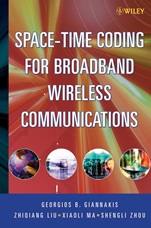
Space–Time Coding for Broadband Wireless Communications
ISBN 9780471214793
Autor: Georgios B. Giannakis, Zhiqiang Liu, Xiaoli Ma, Sheng Zhou
Wydawca: Wiley
Dostępność: 3-6 tygodni
Cena: 590,10 zł
Przed złożeniem zamówienia prosimy o kontakt mailowy celem potwierdzenia ceny.
ISBN13: |
9780471214793 |
ISBN10: |
0471214795 |
Autor: |
Georgios B. Giannakis, Zhiqiang Liu, Xiaoli Ma, Sheng Zhou |
Oprawa: |
Hardback |
Rok Wydania: |
2007-01-12 |
Ilość stron: |
488 |
Wymiary: |
238x168 |
Tematy: |
TJ |
The state of the art in space–time code design
This cutting–edge text presents the state of the art in space–time (ST) coded multi–antenna systems operating over broadband wireless mobile channels, including an analysis of the most recent research findings. Specifically, the authors focus on the algorithms and performance analysis of ST coded systems at the physical layer.
This text is a complement to previously published works covering ST coded multi–antenna systems and offers several unique features and benefits:Systematic coverage of one of the most promising techniques that will support the next generation of broadband multimedia servicesUnified and comprehensive exposition on the design of ST codes, which places all the latest research in contextThorough designs of ST codes for the gamut of frequency–selective, time–selective, and doubly–selective MIMO channels that are encountered with broadband wireless mobile links, in addition to ST codes for flat fading MIMO channelsRecent advances in complex field coded transmissions, sphere decoding algorithms, closed–loop ST coded systems, operation in the presence of colored interference, and multi–user, multi–antenna systemsDevelopment and analysis of novel algorithms and techniques that have arisen from recent research
Numerical and simulated examples are given for most of the algorithms presented in the text to help readers better visualize and understand how they work. In addition, the authors provide background information on wireless communications basics, diversity techniques, and capacity of MIMO channels, giving readers the necessary foundation to grasp all the key concepts and techniques presentedin the text.
This text will not only bring engineers, network designers, and graduate students in wireless communications up to date with the latest findings, it will also provide them
with the latest applications.
Spis treści:
Preface.
Acronyms.
1. Motivation and Context.
1.1 Evolution of Wireless Communication Systems.
1.2 Wireless Propagation Effects.
1.3 Parameters and Classification of Wireless Channels.
1.3.1 Delay Spread and Coherence Bandwidth.
1.3.2 Doppler Spread and Coherence Time.
1.4 Providing, Enabling and Collecting Diversity.
1.4.1 Diversity Provided by Frequency–Selective Channels.
1.4.2 Diversity Provided by Time–Selective Channels.
1.4.3 Diversity Provided by Multi–Antenna Channels.
1.5 Chapter–by–Chapter Organization.
2. Fundamentals of ST Wireless Communications.
2.1 Generic ST System Model.
2.2 ST Coding viz Channel Coding.
2.3 Capacity of ST Channels.
2.3.1 Outage Capacity.
2.3.2 Ergodic Capacity.
2.4 Error Performance of ST Coding.
2.5 Design Criteria for ST Codes.
2.6 Diversity and Rate: Finite SNR viz Asymptotics.
2.7 Classification of ST Codes.
2.8 Closing Comments.
3. Coherent ST Codes for Flat Fading Channels.
3.1 Delay Diversity ST Codes.
3.2 ST Trellis Codes.
3.2.1 Trellis Representation.
3.2.2 TSC ST Trellis Codes.
3.2.3 BBH ST Trellis Codes.
3.2.4 GFK ST Trellis Codes.
3.2.5 Viterbi Decoding of ST Trellis Codes.
3.3 Orthogonal ST Block Codes.
3.3.1 Encoding of OSTBCs.
3.3.2 Linear ML Decoding of OSTBCs.
3.3.3 BER Performance with OSTBCs.
3.3.4 Channel Capacity with OSTBCs.
3.4 Quasi–Orthogonal ST Block Codes.
3.5 ST Linear Complex Field Codes.
3.5.1 Antenna Switching and Linear Precoding.
3.5.2 Designing Linear Precoding Matrices.
3.5.3 Upper–Bound on Coding Gain.
3.5.4 Construction based on Parameterization.
3.5.5 Construction Based on Algebraic Tools.
3.5.6 Decoding ST Linear Complex Field Codes.
3.5.7 Modulus–Preserving STLCFC.
3.6 Linking OSTBC, QO–STBC and STLCFC Desig
ns.
3.6.1 Embedding MP–STLCFC into the Alamouti Code.
3.6.2 Embedding 2 x 2 MP–STLCFCs into OSTBC.
3.6.3 Decoding QO–MP–STLCFC.
3.7 Closing Comments.
4. Layered ST Codes.
4.1 BLAST Designs.
4.1.1 D–BLAST.
4.1.2 V–BLAST.
4.1.3 Rate Performance with BLAST Codes.
4.2 ST Codes Trading Diversity for Rate.
4.2.1 Layered ST Codes with Antenna–Grouping.
4.2.2 Layered High–Rate Codes.
4.3 Full–Diversity Full–Rate ST Codes.
4.3.1 The FDFR Transceiver.
4.3.2 Algebraic FDFR Code Design.
4.3.3 Mutual Information Analysis.
4.3.4 Diversity–Rate–Performance Trade–offs.
4.4 Numerical Examples.
4.5 Closing Comments.
5. Sphere Decoding and (Near–) Optimal MIMO Demodulation.
5.1 Sphere Decoding Algorithm.
5.1.1 Selecting a Finite Search Radius.
5.1.2 Initializing with Unconstrained LS.
5.1.3 Searching within the Fixed–Radius Sphere.
5.2 Average Complexity of SDA in Practice.
5.3 SDA Improvements.
5.3.1 SDA with Detection Ordering and Nulling–Cancelling.
5.3.2 Schnorr–Euchner Variate of SDA.
5.3.3 SDA with Increasing Radius Search.
5.3.4 Simulated Comparisons.
5.4 Reduced–Complexity IRS–SDA.
5.5 Soft Decision Sphere Decoding.
5.5.1 List Sphere Decoding (LSD).
5.5.2 Soft SDA using Hard SDAs.
5.6 Closing Comments.
6. Non–Coherent and Differential ST Codes for Flat Fading Channels.
6.1 Non–Coherent ST Codes.
6.1.1 Search–Based Designs.
6.1.2 Training–Based Designs.
6.2 Differential ST Codes.
6.2.1 Scalar Differential Codes.
6.2.2 Differential Unitary ST Codes.
6.2.3 Differential Alamouti Codes.
6.2.4 Differential OSTBCs.
6.2.5 Cayley Differential Unitary ST Codes.
6.3 Closing Comments.
7. ST Codes for Frequency–Selective Fading Channels: Single–Carrier Systems.
7
.1 System Model and Performance Limits.
7.1.1 Flat–Fading Equivalence and Diversity.
7.1.2 Rate Outage Probability.
7.2 ST Trellis Codes.
7.2.1 Generalized Delay Diversity.
7.2.2 Search–Based STTC Construction.
7.2.3 Numerical Examples.
7.3 ST Block Codes.
7.3.1 Block Coding with Two Transmit–Antennas.
7.3.2 Receiver Processing.
7.3.3 ML Decoding based on the Viterbi Algorithm.
7.3.4 Turbo Equalization.
7.3.5 Multi–Antenna Extensions.
7.3.6 OSTBC Properties.
7.3.7 Numerical Examples.
7.4 Closing Comments.
8. ST Codes for Frequency–Selective Fading Channels: Multi–Carrier Systems.
8.1 The General MIMO OFDM Framework.
8.1.1 OFDM Basics.
8.1.2 MIMO OFDM.
8.1.3 STF Framework.
8.2 ST and SF Coded MIMO OFDM.
8.3 STF Coded OFDM.
8.3.1 Subcarrier Grouping.
8.3.2 GSTF Block Codes.
8.3.3 GSTF Trellis Codes.
8.3.4 Numerical Examples.
8.4 Digital Phase Sweeping and Block Circular Delay.
8.5 Full–Diversity Full–Rate MIMO OFDM.
8.5.1 Encoders and Decoders.
8.5.2 Diversity and Rate Analysis.
8.5.3 Numerical Examples.
8.6 Closing Comments.
9. ST Codes for Time–Varying Channels.
9.1 Time–Varying Channels.
9.1.1 Channel Models.
9.1.2 Time–Frequency Duality.
9.1.3 Doppler Diversity.
9.2 Space–Time–Doppler Block Codes.
9.2.1 Duality–Based STDO Codes.
9.2.2 Phase Sweeping Design.
9.3 Space–Time–Doppler FDFR Codes.
9.4 Space–Time–Doppler Trellis Codes.
9.4.1 Design Criterion.
9.4.2 Smart–Greedy Codes.
9.5 Numerical Examples.
9.6 Space–Time–Doppler Differential Codes.
9.6.1 Inner Codec.
9.6.2 Outer Differential Codec.
9.7 ST Codes for Doubly–Selective Channels.
9.7.1 Numerical Examples.
9.8 Closing Comments.
10. Joint Galois–Field and Linear Complex–Field ST Codes.
Koszyk
Książek w koszyku: 0 szt.
Wartość zakupów: 0,00 zł
Informacje


Kontakt
Gambit
Centrum Oprogramowania
i Szkoleń Sp. z o.o.
Al. Pokoju 29b/22-24
31-564 Kraków
Siedziba Księgarni
ul. Kordylewskiego 1
31-542 Kraków
+48 12 410 5991
+48 12 410 5987
+48 12 410 5989
Subskrypcje
Administratorem danych osobowych jest firma Gambit COiS Sp. z o.o. Na podany adres będzie wysyłany wyłącznie biuletyn informacyjny.
Autoryzacja płatności

Informacje na temat autoryzacji płatności poprzez PayU.

© Copyright 2012: GAMBIT COiS Sp. z o.o. Wszelkie prawa zastrzeżone.
Projekt i wykonanie: Alchemia Studio Reklamy