


Wydawcy
Katalog tematyczny
- Archeologia (109)
- Ekonomia, finanse, business (13704)
- Filozofia (1445)
- Historia (3040)
- Języki i językoznawstwo (2356)
- Lifestyle, hobby i rozrywka (475)
- Medycyna (9704)
- Nauki humanistyczne (4)
- Nauki o Ziemi i środowisku (2638)
- Nauki ścisłe (20412)
- Nauki społeczne (8486)
- Nauki techniczne (13450)
- Budownictwo lądowe (1045)
- Chemia przemysłowa (2258)
- Elektronika i telekomunikacja (3287)
- Energetyka (1122)
- Inne nauki stosowane (363)
- Inżynieria biochemiczna (507)
- Inżynieria transportu (232)
- Mechanika i materiały (3316)
- Nauka o środowisku (321)
- Rolnictwo (507)
- Technika, ogólnie (475)
- Prawo (1696)
- Publikacje informacyjne i interdyscyplinarne (1288)
- Religia i wierzenia (917)
- Technika komputerowa (4067)
- Zdrowie, relacje międzyludzkie i rozwój osobisty (657)





Informacje szczegółowe o książce
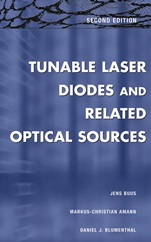
Tunable Laser Diodes and Related Optical Sources
ISBN 9780471208167
Autor: Jens Buus, Markus–Christian Amann, Daniel J. Blumenthal
Wydawca: Wiley
Dostępność: 3-6 tygodni
Cena: 595,35 zł
Przed złożeniem zamówienia prosimy o kontakt mailowy celem potwierdzenia ceny.
ISBN13: |
9780471208167 |
ISBN10: |
0471208167 |
Autor: |
Jens Buus, Markus–Christian Amann, Daniel J. Blumenthal |
Oprawa: |
Hardback |
Rok Wydania: |
2005-03-04 |
Numer Wydania: |
2nd Edition |
Ilość stron: |
408 |
Wymiary: |
244x163 |
Tematy: |
TJ |
An essential introduction to the powerful new developments in optoelectronics
Tunable laser diodes, characterized by their unique ability to "tune in"to different wavelengths, thus significantly improving the efficiency of the switch, are rapidly becoming key components for advanced optical communication. Tunable Laser Diodes and Related Optical Sources, Second Edition is a much–needed single reference covering the range of optical networks and the components they require, with emphasis on tunable lasers. Written by respected experts in this groundbreaking technology, this resource covers fundamentals not only of tunable laser diodes, but also modern laser diodes in general, from theory to applications.
Highlights include: Basic properties of semiconductor lasersEssential properties for single–mode laser diodes Principles, design and practice of tunable laser diodesOptical components related to tunable lasers and non–semiconductor tunable lasersApplication areas like optical communication, radar, environmental sensing, reflectometry, and circuit analysis
Designed for engineers developing tunable lasers for optical networks, as well as graduate students enrolled in the optical engineering curriculum, Tunable Laser Diodes and Related Optical Sources, Second Edition promises to be the definitive resource on this groundbreaking optoelectronics technology.
Spis treści:
Foreword.
Preface.
1 Introduction.
2 Fundamental Laser Diode Characteristics.
2.1 Optical Gain in Semiconductors.
2.2 Semiconductor Heterostructures.
2.2.1 Carrier Confinement.
2.2.2 Optical Confinement.
2.2.3 Material Systems.
2.3 Waveguiding and Transverse Laser Modes.
2.3.1 The Slab Waveguide.
2.3.2 Lateral Waveguiding.
2.4 Laser Structures.
2.5 The Fabry–Perot Laser.
2.6 The Rate Equations.
2.6.1 Stationary Solution of the Rate Equati
ons.
2.6.2 Laser Spectrum and Side–Mode Suppression.
2.6.3 Small–Signal Modulation Behavior.
2.7 Quantum Well Laser Diodes.
3 Single–Mode Laser Diodes.
3.1 Mode Selectivity Requirements.
3.2 Wave Propagation in Periodic Structures.
3.2.1 Alternative Derivation of the Coupled–Mode Equations.
3.2.2 Solution of the Coupled–Mode Equations.
3.3 Distributed Bragg–Reflector Lasers.
3.3.1 Magnitude and Phase of Reflection.
3.3.2 Grating Shapes.
3.3.3 DBR Laser Structures.
3.4 Distributed–Feedback Lasers.
3.4.1 DFB Laser With Nonreflecting Facets.
3.4.2 DFB Lasers With Reflecting Facets.
3.4.3 Phase–Shifted and Gain–Coupled DFB Lasers.
3.5 Laser Fabrication and Tolerances.
3.5.1 Wavelength Dependence on Structural Parameters.
3.5.2 Thermal Properties under CW Operation.
3.6 Spectral Linewidth.
4 Basic Concepts of Tunable Laser Diodes.
4.1 Continuous, Discontinuous, and Quasicontinuous Tuning Schemes.
4.2 Tuning of Cavity Gain Characteristic.
4.3 Tuning of Comb–Mode Spectrum.
4.4 Simultaneous Tuning of Cavity Gain and Comb–Mode Spectrum.
4.5 Electronic Wavelength Control.
4.5.1 The Free–Carrier Plasma Effect.
4.5.2 The Quantum–Confined Stark Effect.
4.5.3 Thermal Tuning.
4.6 Integration Techniques.
4.7 Dynamic Behavior.
5 Wavelength–Tunable Single–Mode Laser Diodes.
5.1 Longitudinally Integrated Structures.
5.1.1 Two–Section DBR Laser.
5.1.2 Three–Section DBR Laser.
5.1.3 Multisection DFB Laser.
5.2 Transversely Integrated Structures.
5.2.1 Tunable Twin–Guide DFB Laser.
5.2.2 Striped Heater DFB Laser.
5.3 Integration Technology.
5.4 Physical Limitations on the Continuous Tuning Range.
5.5 Tuning Dynamics and Modulation.
6 Linewidth Broadening.
6.1 Injection–Recombination Shot Noise in the Tuning Region.
6.2 Impedance and Thermal Noise of Bias Source.
6.3 Spatial Correlation.
6.4 1/f Noise.
6.5 Fluctuations of Bias Source.
7 Widely Tunable Monolithic Laser Diodes.
7.1 The Vernier Effect.
7.2 DBR–type Laser Structures.
7.2.1 Sampled–Grating DBR Lasers.
7.2.2 Superstructure–Grating DBR Lasers.
7.2.3 Digital Supermode DBR Lasers.
7.2.4 Superimposed and Binary Gratings.
7.3 Interferometric Structures.
7.3.1 Lateral Integration: The Y–Laser.
7.3.2 Transverse Integration: The VMZ Laser.
7.4 Codirectionally Coupled Laser Diodes.
7.4.1 Theory for Codirectional Coupling.
7.4.2 Tuning and Mode Spacing.
7.4.3 Longitudinally Integrated Structures.
7.4.4 Transversely Integrated Structures.
7.5 Combination of Techniques.
7.5.1 The Grating–Coupled Sampled–Reflector Laser.
7.5.2 The Modulated–Grating Y–structure Laser.
7.6 Comparison of Widely Tunable Monolithic Laser Structures.
8 Practical Issues Related to Monolithic Tunable Laser Diodes.
8.1 Characterization and Control.
8.1.1 DFB and DBR Lasers.
8.1.2 Widely Tunable Lasers.
8.2 Wavelength Stability and Aging.
8.3 Modulation and Wavelength–Switching Dynamics.
8.3.1 Modulation and Transmission.
8.3.2 Wavelength Switching.
8.4 Monolithic Integration.
9 Related DWDM Sources.
9.1 External–Cavity Lasers.
9.1.1 External Grating and External Filter Cavities.
9.1.2 MEMS External Cavities.
9.1.3 Hybrid Structures.
9.2 Vertical–Cavity Lasers.
9.2.1 VCSEL Basics.
9.2.2 Tunable VCSELs.
9.3 Laser Arrays.
9.3.1 Multistripe Arrays.
9.3.2 Selectable Arrays.
9.3.3 DBR Arrays.
9.3.4 Phased Arrays.
9.4 Technology Summary.
9.5 Fiber and Waveguide Lasers.
9.6 Tunable Pulse Sources and Comb Generators.
10 Communications Applications and Requirements.
10.1 Wavelength Tunability.
10.1.1 Tuning Speed and Latenc
y.
10.1.2 Tuning Continuity.
10.1.3 Tuning Uniformity.
10.1.4 Tuning Stability and Accuracy.
10.1.5 Other Design Considerations.
10.2 Functions and Components.
10.2.1 Tunable Transmitters and Transponders.
10.2.2 Tunable Wavelength Converters with Regeneration Capability.
10.2.3 Optical Wavelength Switches.
10.3 Communications Applications.
10.3.1 Point–to–Point Links and Networks.
10.3.2 Fixed–Wavelength Networks.
10.3.3 Reconfigurable Networks.
10.3.4 Optical–Protection Switching.
10.3.5 Optical–Burst Switching.
10.3.6 Photonic–Packet Switching.
11 Other Applications.
11.1 Optical Frequency–Modulated Continuous–Wave Radar.
11.2 Optical Components Characterization.
11.3 Trace–Gas Sensing, Environmental Analysis, and Spectroscopy.
11.4 Heterodyne Techniques.
11.5 Optical Spectrum and Network Analysis.
11.6 Anemometry.
Appendix A: Refractive Index of InGaAsP.
Appendix B: The Slab Waveguide.
Appendix C: Transfer Matrices.
Appendix D: Thermal Response of a Laser Diode.
D.1 Pulse Response in the Time Domain.
D.2 Response in the Frequency Domain.
Appendix E: Theory for General Reflectors.
Appendix F: Codirectional Coupling.
List of Symbols.
List of Acronyms.
Index.
About the Authors.
Nota biograficzna:
JENS BUUS, PhD, is a fellow of the IEEE whose research has made numerous contributions to the understanding of the properties of semiconductor lasers and optical waveguides. He holds five patents and has written two earlier books. A popular speaker, Dr. Buus has presented tutorials and short courses at major conferences, including: ECOC, OFC, EFOC, and the IEEE International Semiconductor Laser Conference.
MARKUS–CHRISTIAN AMANN, PhD, is Professor of Electrical Engineering at the Walter Schottky Institute of the Techn
Koszyk
Książek w koszyku: 0 szt.
Wartość zakupów: 0,00 zł
Informacje


Kontakt
Gambit
Centrum Oprogramowania
i Szkoleń Sp. z o.o.
Al. Pokoju 29b/22-24
31-564 Kraków
Siedziba Księgarni
ul. Kordylewskiego 1
31-542 Kraków
+48 12 410 5991
+48 12 410 5987
+48 12 410 5989
Subskrypcje
Administratorem danych osobowych jest firma Gambit COiS Sp. z o.o. Na podany adres będzie wysyłany wyłącznie biuletyn informacyjny.
Autoryzacja płatności

Informacje na temat autoryzacji płatności poprzez PayU.

© Copyright 2012: GAMBIT COiS Sp. z o.o. Wszelkie prawa zastrzeżone.
Projekt i wykonanie: Alchemia Studio Reklamy