


Wydawcy
Katalog tematyczny
- Archeologia (109)
- Ekonomia, finanse, business (13704)
- Filozofia (1445)
- Historia (3040)
- Języki i językoznawstwo (2356)
- Lifestyle, hobby i rozrywka (475)
- Medycyna (9704)
- Nauki humanistyczne (4)
- Nauki o Ziemi i środowisku (2638)
- Nauki ścisłe (20412)
- Nauki społeczne (8486)
- Nauki techniczne (13450)
- Prawo (1696)
- Publikacje informacyjne i interdyscyplinarne (1288)
- Religia i wierzenia (917)
- Technika komputerowa (4067)
- Zdrowie, relacje międzyludzkie i rozwój osobisty (657)





Informacje szczegółowe o książce
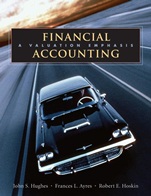
Financial Accounting: A Valuation Emphasis
ISBN 9780471203599
Autor: John S. Hughes, Frances L. Ayres, Robert E. Hoskin
Wydawca: Wiley
Dostępność: 3-6 tygodni
Cena: 1 146,60 zł
Przed złożeniem zamówienia prosimy o kontakt mailowy celem potwierdzenia ceny.
ISBN13: |
9780471203599 |
ISBN10: |
0471203599 |
Autor: |
John S. Hughes, Frances L. Ayres, Robert E. Hoskin |
Oprawa: |
Hardback |
Rok Wydania: |
2005-03-18 |
Ilość stron: |
592 |
Wymiary: |
260x205 |
Tematy: |
KF |
A company is worth only as much as its accounting information.
The Financial Accounting Standards Board recently issued an exposure draft providing guidance on how to measure fair value. Some observers anticipate future pronouncements requiring more extensive use of fair value in accounting disclosures. In the absence of market prices, determining fair values requires the application of various valuation concepts.
Financial Accounting: A Valuation Emphasis integrates an understanding of valuation concepts with accounting principles. The authors place considerable emphasis on the economic consequences of accounting practices. You’ll develop a solid background in basic accounting processes and disclosures, and the critical role of accounting in valuation.
FeaturesHighlights the valuation and economic consequences of core accounting concepts.Emphasizes the construction of accounting information and how that information affects the value of the firm.Offers an inviting and accessible presentation, with real–world examples and transactions.Provides an early treatment of statement of cash flows and financial statement analysis.Illustrates key concepts, including valuation models through an integrated example of a hypothetical company.Helps you appreciate the significance of accounting information to managers, investors, regulators, and others with an interest in the firm′s affairs.
Spis treści:
CHAPTER 1. Financial Reporting: The Institutional Setting.
LEARNING OBJECTIVES.
REAL WORLD VIGNETTE.
Reporting of the Activities of the Firm.
Regulation of Financial Reporting.
Determining Generally Accepted Accounting Principles.
Independent Audits of Financial Statements.
Economic Consequences of Accounting Practices.
Financial Reporting and Valuation.
Summary and Transition.
CHAPTER 2. Financial Statements: An Overview.
LEARNING OBJECTIVES.
R
EAL WORLD VIGNETTE.
Forms of Business Organization.
Financial Accounting Reports.
Statement of Financial Position.
ASSETS.
LIABILITIES.
STOCKHOLDERSâ EQUITY.
THE ACCOUNTING EQUATION.
STATEMENT OF FINANCIAL POSITION: ROSS STORES.
Flow Statements: Changes in Financial Position.
Statement of Earnings.
Statement of Cash Flows.
Articulation of the Financial Statements.
Statement of Changes in Stockholdersâ Equity.
Other Statement Disclosures.
The Influence of Financial Statements.
Summary and Transition.
CHAPTER 3. The Accounting Process.
LEARNING OBJECTIVES.
REAL WORLD VIGNETTE.
Balance Sheet Accounts.
ASSETS.
LIABILITIES.
STOCKHOLDERSâ EQUITY.
NOMINAL ACCOUNTS.
Accounting for Transactions.
Double–Entry Accounting Systems.
T–ACCOUNTS.
JOURNAL ENTRIES.
COMPUTERIZED ACCOUNTING.
An Illustration of Transaction Analysis.
ANALYSIS OF FINANCING AND INVESTING ACTIVITIES.
Issuing Stock.
Purchasing Fixtures.
Borrowing Funds.
Using Journal Entries and T–Accounts to Record Transactions.
CONSTRUCTION THE FINANCIAL STATEMENTS.
ANALYSIS OF OPERATING ACTIVITIES.
Revenues and Expenses.
Using the Accounting Equation to Analyze Operating Activities.
Purchasing Inventory on Account (Transaction 4).
Selling Inventory on Account (Transaction 5).
Recognizing Cost of Goods Sold (Transaction 6).
Collecting Receivables (Transaction 7).
Paying Accounts Payable (Transaction 8).
Paying Selling and Administrative Costs (Transaction 9).
Depreciating Fixtures (Transaction 10).
Paying Interest (Transaction 11).
Dividends (Transaction 12).
Nominal Accounts Revisited.
Using Journal Entries and T–Accounts to Record Transactions.
CONSTRUCTING THE FINANCIAL STATEMENTS.
CLOSING ENTRIES.
The Accounting Cycle.
Analyzing Financial Statements.
Summary and Transition.
CHAPTER 4. In
come Measurement and Reporting.
LEARNING OBJECTIVES.
REAL WORLD VIGNETTE.
Accrual Accounting.
Revenue Recognition.
REVENUE RECOGNITION CRITERIA.
At Point of Delivery.
As Service Is Provided or Cost Incurred.
Based on Contractual Agreements.
At Time of Production.
As Cash Is Collected.
During Construction.
Expense Recognition.
Recording Accrual Entries.
REVENUES THAT ARE RECEIVED IN CASH BEFORE THEY ARE EARNED.
REVENUES THAT ARE EARNED BEFORE THEY ARE RECEIVED IN CASH.
EXPENSES THAT ARE PAID IN CASH BEFORE THEY ARE INCURRED.
EXPENSES THAT ARE INCURRED BEFORE THEY ARE PAID IN CASH.
Valuation Implications of Income Recognition.
Income Statement Format.
LINE ITEM DEFINITIONS.
INCOME STATEMENT LABELS.
Income from Continuing Operations.
Nonrecurring Items.
Discontinued Operations.
Extraordinary Items.
Accounting Changes and Errors.
Pro Forma Earnings.
Earnings per Share.
Comprehensive Income.
Summary and Transition.
CHAPTER 5. Financial Statements: Measuring Cash Flow.
Cash Flow Statement Components.
CASH FLOW FROM OPERATING ACTIVITIES.
CASH FLOW FROM INVESTING ACTIVITIES.
CASH FLOW FROM FINANCING ACTIVITIES.
Preparation of the Statement of Cash Flows.
WORKSHEET ENTRIES FOR CASH FROM OPERATIONS.
Adjusting Net Income.
Revenue Adjustments to Net Income.
Cost of Goods Sold Adjustment to Net Income.
Depreciation Adjustment to Net Income.
Prepaid Expense Adjustment to Net Income.
WORKSHEET ENTRIES FOR CASH FROM INVESTING.
WORKSHEET ENTRIES FOR CASH FROM FINANCING.
SUMMARY OF CASH FLOW STATEMENT PREPARATIONâINDIRECT METHOD.
Articulation of the Cash Flow Statement.
Supplemental Disclosures to the Cash Flow Statement.
Interpreting the Cash Flow Statement.
Valuation Implications of the Cash Flow Statement.
Summary and Transition.
CHAPTER 6. Financial Statement Analysis.
LEARNING OBJECTIVES.
REAL WOR
LD VIGNETTE.
Overview of Financial Statement Analysis.
CHAPTER 8. Valuing Inventories.
Learning Objectives.
REAL WORLD VIGNETTE.
Merchandise and Manufacturing Inventories.
INVENTORY COSTS.
INVENTORY–LEVEL MANAGEMENT.
VALUING INVENTORY.
ACCOUNTING FOR INVENTORY.
Inventory Recording Procedures.
PERIODIC METHOD.
PERPETUAL METHOD.
Inventory Cost Flow Assumptions.
FIRST–IN, FIRST–OUT.
LAST–IN, FIRST–OUT.
WEIGHTED AVERAGE.
SPECIFIC IDENTIFICATION.
Illustration of Cost Flow Assumptions.
PERIODIC INVENTORY COMPUTATIONS.
Periodic FIFO.
Periodic LIFO.
Periodic Weighted Average.
PERPETUAL INVENTORY COMPUTATIONS.
Perpetual FIFO.
Perpetual LIFO.
Perpetual Weighted Average.
COMPARISON OF INVENTORY METHODS.
Inventory Method Choices and Firm Value.
LIFOâs Effect on Financial Statements.
LATE PURCHASES.
LIFO LIQUIDATIONS.
Financial Analysis and Inventory: Converting from LIFO to FIFO.
RATIO ANALYSIS IMPLICATIONS.
Transition and Summary.
CHAPTER 9. Valuing Long–Lived Assets.
LEARNING OBJECTIVES.
REAL WORLD VIGNETTE.
Capitalization Criteria.
INTEREST CAPITALIZATION.
BASKET PURCHASES.
Creating Comparable Data for Financial Statement Analysis.
âAS IFâ RESTATEMENTS.
MANDATED ACCOUNTING CHANGES.
DISCRETIONARY ACCOUNTING CHANGES.
Using Financial Ratios to Assess Past Performance.
ASSESSING PROFITABILITY.
ASSESSING TURNOVER RATIOS.
ASSESSING DEBT REPAYMENT ABILITY.
SHORT–TERM DEBT.
LONG–TERM DEBT.
Using Financial Ratios to Assess Comparative Performance.
INTER–TEMPORAL COMPARISONS.
CROSS–SECTIONAL COMPARISONS.
Forecasting.
TIME SERIES ANALYSIS.
PRO FORMA STATEMENTS.
Time Value of Money.
FUTURE VALUE.
PRESENT VALUE.
ADJUSTING FOR UNCERTAINTY.
Model for Valuing Equity.
DCF APPROACH.
RI APPROACH.
Summar
Koszyk
Książek w koszyku: 0 szt.
Wartość zakupów: 0,00 zł
Informacje


Kontakt
Gambit
Centrum Oprogramowania
i Szkoleń Sp. z o.o.
Al. Pokoju 29b/22-24
31-564 Kraków
Siedziba Księgarni
ul. Kordylewskiego 1
31-542 Kraków
+48 12 410 5991
+48 12 410 5987
+48 12 410 5989
Subskrypcje
Administratorem danych osobowych jest firma Gambit COiS Sp. z o.o. Na podany adres będzie wysyłany wyłącznie biuletyn informacyjny.
Autoryzacja płatności

Informacje na temat autoryzacji płatności poprzez PayU.

© Copyright 2012: GAMBIT COiS Sp. z o.o. Wszelkie prawa zastrzeżone.
Projekt i wykonanie: Alchemia Studio Reklamy