


Wydawcy
Katalog tematyczny
- Archeologia (109)
- Ekonomia, finanse, business (13704)
- Filozofia (1445)
- Historia (3040)
- Języki i językoznawstwo (2356)
- Lifestyle, hobby i rozrywka (475)
- Medycyna (9704)
- Nauki humanistyczne (4)
- Nauki o Ziemi i środowisku (2638)
- Nauki ścisłe (20412)
- Nauki społeczne (8486)
- Nauki techniczne (13450)
- Budownictwo lądowe (1045)
- Chemia przemysłowa (2258)
- Elektronika i telekomunikacja (3287)
- Energetyka (1122)
- Inne nauki stosowane (363)
- Inżynieria biochemiczna (507)
- Inżynieria transportu (232)
- Mechanika i materiały (3316)
- Nauka o środowisku (321)
- Rolnictwo (507)
- Technika, ogólnie (475)
- Prawo (1696)
- Publikacje informacyjne i interdyscyplinarne (1288)
- Religia i wierzenia (917)
- Technika komputerowa (4067)
- Zdrowie, relacje międzyludzkie i rozwój osobisty (657)





Informacje szczegółowe o książce
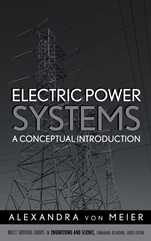
Electric Power Systems: A Conceptual Introduction
ISBN 9780471178590
Autor: Alexandra von Meier
Wydawca: Wiley
Dostępność: 3-6 tygodni
Cena: 597,45 zł
Przed złożeniem zamówienia prosimy o kontakt mailowy celem potwierdzenia ceny.
ISBN13: |
9780471178590 |
ISBN10: |
0471178594 |
Autor: |
Alexandra von Meier |
Oprawa: |
Hardback |
Rok Wydania: |
2006-08-04 |
Ilość stron: |
328 |
Wymiary: |
234x156 |
Tematy: |
TJ |
A clear explanation of the technology for producing and delivering electricity
Electric Power Systems explains and illustrates how the electric grid works in a clear, straightforward style that makes highly technical material accessible. It begins with a thorough discussion of the underlying physical concepts of electricity, circuits, and complex power that serves as a foundation for more advanced material. Readers are then introduced to the main components of electric power systems, including generators, motors and other appliances, and transmission and distribution equipment such as power lines, transformers, and circuit breakers. The author explains how a whole power system is managed and coordinated, analyzed mathematically, and kept stable and reliable.
Recognizing the economic and environmental implications of electric energy production and public concern over disruptions of service, this book exposes the challenges of producing and delivering electricity to help inform public policy decisions. Its discussions of complex concepts such as reactive power balance, load flow, and stability analysis, for example, offer deep insight into the complexity of electric grid operation and demonstrate how and why physics constrains economics and politics.
Although this survival guide includes mathematical equations and formulas, it discusses their meaning in plain English and does not assume any prior familiarity with particular notations or technical jargon. Additional features include:A glossary of symbols, units, abbreviations, and acronymsIllustrations that help readers visualize processes and better understand complex conceptsDetailed analysis of a case study, including a Web reference to the case, enabling readers to test the consequences of manipulating various parameters
With its clear discussion of how electric grids work, Electric Power Systems is appropriate for a broad readership of professionals, undergrad
uate and graduate students, government agency managers, environmental advocates, and consumers.
Spis treści:
Preface.
1. The Physics of Electricity.
1.1 Basic Quantities.
1.1.1 Introduction.
1.1.2 Charge.
1.1.3 Potential or Voltage.
1.1.4 Ground.
1.1.5 Conductivity.
1.1.6 Current.
1.2 Ohm’s law.
1.2.1 Resistance.
1.2.2 Conductance.
1.2.3 Insulation.
1.3 Circuit Fundamentals.
1.3.1 Static Charge.
1.3.2 Electric Circuits.
1.3.3 Voltage Drop.
1.3.4 Electric Shock.
1.4 Resistive Heating.
1.4.1 Calculating Resistive Heating.
1.4.2 Transmission Voltage and Resistive Losses.
1.5 Electric and Magnetic Fields.
1.5.1 The Field as a Concept.
1.5.2 Electric Fields.
1.5.3 Magnetic Fields.
1.5.4 Electromagnetic Induction.
1.5.5 Electromagnetic Fields and Health Effects.
1.5.6 Electromagnetic Radiation.
2. Basic Circuit Analysis.
2.1 Modeling Circuits.
2.2 Series and Parallel Circuits.
2.2.1 Resistance in Series.
2.2.2 Resistance in Parallel.
2.2.3 Network Reduction.
2.2.4 Practical Aspects.
2.3 Kirchhoff’s Laws.
2.3.1 Kirchhoff’s Voltage Law.
2.3.2 Kirchhoff’s Current Law.
2.3.3 Application to Simple Circuits.
2.3.4 The Superposition Principle.
2.4 Magnetic Circuits.
3. AC Power.
3.1 Alternating Current and Voltage.
3.1.1 Historical Notes.
3.1.2 Mathematical Description.
3.1.3 The rms Value.
3.2 Reactance.
3.2.1 Inductance.
3.2.2 Capacitance.
3.2.3 Impedance.
3.2.4 Admittance.
3.3 Power.
3.3.1 Definition of Electric Power.
3.3.2 Complex Power.
3.3.3 The Significance of Reactive Power.
3.4 Phasor Notation.
3.4.1 Phasors as Graphics.
3.4.2 Phasors as Exponentials.
3.4.3 Operations with Phasors.
4. Generators.
4.1 The Simple Generator.
4.2 The Synchronous Generator.
4.2.1 Basic Components and Functioning.
4.2.2 Other Design
Aspects.
4.3 Operational Control of Synchronous Generators.
4.3.1 Single Generator: Real Power.
4.3.2 Single Generator: Reactive Power.
4.3.3 Multiple Generators: Real Power.
4.3.4 Multiple Generators: Reactive Power.
4.4 Operating Limits.
4.5 The Induction Generator.
4.5.1 General Characteristics.
4.5.2 Electromagnetic Characteristics.
4.6 Inverters.
5. Loads.
5.1 Resistive Loads.
5.2 Motors.
5.3 Electronic Devices.
5.4 Load from the System Perspective.
5.4.1 Coincident and Noncoincident Demand.
5.4.2 Load Profiles and Load Duration Curve.
5.5 Single– and Multiphase Connections.
6. Transmission and Distribution.
6.1 System Structure.
6.1.1 Historical Notes.
6.1.2 Structural Features.
6.1.3 Sample Diagram.
6.1.4 Topology.
6.1.5 Loop Flow.
6.1.6 Stations and Substations.
6.1.7 Reconfiguring the System.
6.2 Three–Phase Transmission.
6.2.1 Rationale for Three Phases.
6.2.2 Balancing Loads.
6.2.3 Delta and Wye Connections.
6.2.4 Per–Phase Analysis.
6.2.5 Three–Phase Power.
6.2.6 D.C. Transmission.
6.3 Transformers.
6.3.1 General Properties.
6.3.2 Transformer Heating.
6.3.3 Delta and Wye Transformers.
6.4 Characteristics of Power Lines.
6.4.1 Conductors.
6.4.2 Towers, Insulators, and Other Components.
6.5 Loading.
6.5.1 Thermal Limits.
6.5.2 Stability Limit.
6.6 Voltage Control.
6.7 Protection.
6.7.1 Basics of Protection and Protective Devices.
6.7.2 Protection Coordination.
7. Power Flow Analysis.
7.1 Introduction.
7.2 The Power Flow Problem.
7.2.1 Network Representation.
7.2.2 Choice of Variables.
7.2.3 Types of Buses.
7.2.4 Variables for Balancing Real Power.
7.2.5 Variables for Balancing Reactive Power.
7.2.6 The Slack Bus.
7.2.7 Summary of Variables.
7.3 Example with Interpretation of Results.
7.3.1 Six–Bus Example.
7.3.2 Tweaking the
Case.
7.3.3 Conceptualizing Power Flow.
7.4 Power Flow Equations and Solution Methods.
7.4.1 Derivation of Power Flow Equations.
7.4.2 Solution Methods.
7.4.3 Decoupled Power Flow.
7.5 Applications and Optimal Power Flow.
8. System Performance.
8.1 Reliability.
8.1.1 Measures of Reliability.
8.1.2 Valuation of Reliability.
8.2 Security.
8.3 Stability.
8.3.1 The Concept of Stability.
8.3.2 Steady–State Stability.
8.3.3 Dynamic Stability.
8.3.4 Voltage Stability.
8.4 Power Quality.
8.4.1 Voltage.
8.4.2 Frequency.
8.4.3 Waveform.
9. System Operation, Management, and New Technology.
9.1 Operation and Control on Different Time Scales.
9.1.1 The Scale of a Cycle.
9.1.2 The Scale of Real–Time Operation.
9.1.3 The Scale of Scheduling.
9.1.4 The Planning Scale.
9.2 New Technology.
9.2.1 Storage.
9.2.2 Distributed Generation.
9.2.3 Automation.
9.2.4 FACTS.
9.3 Human Factors.
9.3.1 Operators and Engineers.
9.3.2 Cognitive Representations of Power Systems.
9.3.3 Operational Criteria.
9.3.4 Implications for Technological Innovation.
9.4 Implications for Restructuring.
Appendix: Symbols, Units, Abbreviations, and Acronyms.
Index.
Nota biograficzna:
ALEXANDRA von MEIER, PhD, is Associate Professor in the Department of Environmental Studies and Planning and Director of the Environmental Technology Center at Sonoma State University. An award–winning educator, Dr. von Meier teaches courses in energy management and design that address science, technology, policy, economics, and environmental issues, emphasizing energy efficiency and renewable resources.
Okładka tylna:
A clear explanation of the technology for producing and delivering electricity
Electric Power Systems explains and illustrates how the electric grid works in a clear, straightforward style that ma
Koszyk
Książek w koszyku: 0 szt.
Wartość zakupów: 0,00 zł
Informacje


Kontakt
Gambit
Centrum Oprogramowania
i Szkoleń Sp. z o.o.
Al. Pokoju 29b/22-24
31-564 Kraków
Siedziba Księgarni
ul. Kordylewskiego 1
31-542 Kraków
+48 12 410 5991
+48 12 410 5987
+48 12 410 5989
Subskrypcje
Administratorem danych osobowych jest firma Gambit COiS Sp. z o.o. Na podany adres będzie wysyłany wyłącznie biuletyn informacyjny.
Autoryzacja płatności

Informacje na temat autoryzacji płatności poprzez PayU.

© Copyright 2012: GAMBIT COiS Sp. z o.o. Wszelkie prawa zastrzeżone.
Projekt i wykonanie: Alchemia Studio Reklamy