


Wydawcy
Katalog tematyczny
- Archeologia (109)
- Ekonomia, finanse, business (13704)
- Filozofia (1445)
- Historia (3040)
- Języki i językoznawstwo (2356)
- Lifestyle, hobby i rozrywka (475)
- Medycyna (9704)
- Nauki humanistyczne (4)
- Nauki o Ziemi i środowisku (2638)
- Nauki ścisłe (20412)
- Nauki społeczne (8486)
- Nauki techniczne (13450)
- Budownictwo lądowe (1045)
- Chemia przemysłowa (2258)
- Elektronika i telekomunikacja (3287)
- Energetyka (1122)
- Inne nauki stosowane (363)
- Inżynieria biochemiczna (507)
- Inżynieria transportu (232)
- Mechanika i materiały (3316)
- Nauka o środowisku (321)
- Rolnictwo (507)
- Technika, ogólnie (475)
- Prawo (1696)
- Publikacje informacyjne i interdyscyplinarne (1288)
- Religia i wierzenia (917)
- Technika komputerowa (4067)
- Zdrowie, relacje międzyludzkie i rozwój osobisty (657)





Informacje szczegółowe o książce
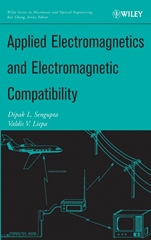
Applied Electromagnetics and Electromagnetic Compatibility
ISBN 9780471165491
Autor: Dipak L. Sengupta, Valdis V. Liepa
Wydawca: Wiley
Dostępność: 3-6 tygodni
Cena: 597,45 zł
Przed złożeniem zamówienia prosimy o kontakt mailowy celem potwierdzenia ceny.
ISBN13: |
9780471165491 |
ISBN10: |
0471165492 |
Autor: |
Dipak L. Sengupta, Valdis V. Liepa |
Oprawa: |
Hardback |
Rok Wydania: |
2005-12-02 |
Ilość stron: |
510 |
Wymiary: |
240x158 |
Tematy: |
TJ |
Tools for understanding and design for EMC
With tighter regulation of electromagnetic emissions, the electronics industry is increasingly looking for professionals with a solid understanding of electromagnetic compatibility (EMC).
The IEEE also encourages engineering schools to include EMC as a course topic. In response to this rising need and demand, the authors have developed a textbook based on their extensive experience in teaching and measurements for EMC compliance.
This textbook skillfully integrates the fundamentals of fields and waves, transmission lines and antennas, and examples in applied electromagnetics, along with a variety of other topics essential to the understanding of EMC. Presentations of electromagnetics are given in the context of EMC; discussions of EMC itself are tailored to assist in analysis and design, as well as planning of measurements for EMC compliance.
Chapter 1 introduces readers to electromagnetic interference and describes the evolution of EMC in the digital electronics era. Following, the authors build on basic concepts and demonstrate their application to the design of electronic devices that perform compatibly in given electromagnetic environments. Topics covered provide a mix of theory and practical problem solving:The Electromagnetic EnvironmentFundamentals of Fields and WavesSignal Waveform and Spectral AnalysisTransmission LinesAntennas and RadiationBehavior of Circuit ComponentsRadiated Emissions and SusceptibilityElectromagnetic ShieldingCoupling Between DevicesElectrostatic DischargeEMC StandardsMeasurement of Emissions
Most chapters conclude with problem sets that test readers′ knowledge and ensure that they have mastered the key concepts. References provided with each chapter enable readers to explore specific topics in greater depth.
This textbook is recommended for senior under
graduate and graduate courses. Additionally, it is an excellent reference for basic electromagnetics and EMC.
Spis treści:
Preface.
Acknowledgments.
1 General Considerations.
1.1 Introduction.
1.2 Definitions.
1.3 Interference mechanisms.
1.4 Examples.
1.5 Discussion.
References.
2 The Electromagnetic Environment.
2.1 Introduction.
2.2 Natural Noise.
2.3 Man–Made Noise.
2.4 CW and Transient Sources.
2.5 Characteristic Parameters of Authorized Radiators.
2.6 Noise Emission Intensity.
2.7 Home Environment.
2.8 Discussion of Noise Sources.
2.9 Subject Matter of the Book.
References.
3 Fundamentals of Fields and Waves.
3.1 Introduction.
3.2 Basic Parameters.
3.3 Time Dependent Relations.
3.3.1 Continuity of Current and Conservation of Charge.
3.3.2 Faraday′s Law.
3.3.3 Ampere′s Circuital Law.
3.3.4 Lorentz Force Law.
3.3.5 Maxwell′s Equations.
3.3.6 Historical Commt:nts on Maxwell′s Equations.
3.3.7 Media Considerations.
3.3.8 Boundary Conditions.
3.3.9 Energy Flow and Poynting′s Theorem.
3.3.10 Uniqueness Theorem.
3.4 Harmonically Oscillating Fields.
3.4.1 Introduction.
3.4.2 Phasors.
3.4.3 Time Harmonic Relations.
3.4.4 Complex Permittivity.
3.4.5 Boundary Conditions Again.
3.4.6 Notes on the Solution.
3.4.7 The Complex Poynting Theorem.
3.5 The Wave Equation.
3.5.1 Time Dependent Case.
3.5.2 Time Hannonic Case.
3.6 Uniform Plane Waves.
3.6.1 General Considerations.
3.6.2 Energy Considerations.
3.6.3 Group Velocity.
3.6.4 Summary.
3.6.5 General Representation of TEM Waves.
3.6.6 Plane Waves in Lossy Media.
3.6.7 Skin Effect.
3.6.8 Polarization of Plane Waves.
3.7 Reflection and Refraction (Transmission) of Plane Waves.
3.7.1 Normal Incidence on a Plane Interface.
3.7.2 Oblique Incidence.
References.
Problems.
4 Signal Waveform and Spectral Analysis.
4.1 Introduction.
4.2 Classification of Signals.
4.3 Energy Signals.
4.3.1 Definitions.
4.3.2 A Rectangular Pulse.
4.4 Power Signals.
4.4.1 Periodic Signals.
4.4.2 Trapezoidal Waveform.
4.5 Examples of Some Signals.
References.
Problems.
5 Transmission Lines.
5.1 Introduction.
5.2 Basic Discussion.
5.3 Transverse Electromagnetic (TEM) Transmission Lines.
5.4 Telegrapher′s Equations: Quasi–Lumped Circuit Model.
5.5 Wave Equations.
5.6 Frequency Domain Analysis.
5.6.1 General Solution.
5.6.2 Further Discussion of Propagation Constant and Characteristic Impedance.
5.6.3 Voltage, Current, and Impedance Relations.
5.7 Line Parameters.
5.7.1 Coaxial Line.
5.7.2 Parallel Wire Line.
5.7.3 Parallel Plate Line.
5.7.4 Circular Wire above a Ground Plane..
5.7.5 Microstrip Line.
5.7.6 Stripline.
5.7.7 Comments.
5.8 Transients on Transmission Lines.
5.8.1 Initial and Final (Steady State) Values.
5.8.2 Transient Values.
5.9 Measurements.
5.9.1 Slotted Line Measurements.
5.9.2 Network Analyzer Measurement.
References.
Problems.
6 Antennas and Radiation.
6.1 Introduction.
6.2 Potential Functions.
6.3 Radiation from a Short Current Element.
6.3.1 Complete Fields.
6.3.2 Near Zone and Far Zone Considerations.
6.3.3 Near Zone and Far Zone Fields.
6.3.4 Radiated Power and Radiation Pattern.
6.3.5 Wave Impedance.
6.4 Radiation from a Small Loop of Current.
6.4.1 Complete Fields.
6.4.2 Far Zone Fields.
6.4.3 Radiated Power.
6.4.4 Wave Impedance.
6.5 Fundamental Antenna Pal–ameters.
6.5.1 Radiation Intensity.
6.5.2 Directivity and Gain.
6.6 Far Fields of Arbitrary Current Distributions.
6.6.1 The Radiation Vector and the Far Fields.
6.6.2 Vector Effective Length of an Antenna.
6.6.3 Summary.
6.7 Linear Antennas.
6.7.1 Center&#
8211;Fed Linear Antenna.
6.7.2 Far Fields of a Dipole of Length.
6.7.3 Radiated Power and Directivity.
6.7.4 Cosine, Sine, and Modified Cosine Integrals.
6.7.5 The Half–Wave Dipole.
6.8 Near Field and Far Field Regions.
6.8.1 Basic Assumptions.
6.8.2 Point or Small Sources.
6.8.3 Extended Sources.
6.8.4 Definitions of Various Regions.
6.8.5 Specific Values of the Region Boundaries.
6.9 Equivalent Circuits of Antennas.
6.9.1 Transmitting Antenna.
6.9.2 Receiving Antennas.
6.9.3 Equivalent Area.
6.10 Antenna Arrays.
6.10.1 General Considerations.
6.10.2 A Two–Element Array.
6.1 1 Antennas Above Ground.
6.1 1.1 Ground and Ground Plane.
6.1 1.2 Image Theory.
6.11.3 Images of Electric Current Elements above Perfect Ground.
6.1 1.4 Dipoles above Ground.
6.1 1.5 Monopole Antennas.
6.12 Biconical Antenna.
6.12.1 Biconical Transmission Line.
6.12.2 Finite Biconical Antenna.
References.
Problems.
7 Behavior of Circuit Components.
7.1 Introduction.
7.2 The Series RLC Circuit.
7.3 Definitions of Lumped Circuit Paranleters R, L, and C.
7.3.1 Circuit Theory Description.
7.3.2 Field Theory Description.
7.4 Round Wires.
7.4.1 Resistance.
7.4.2 Internal Inductance.
7.5 External Inductance of Round Wire Configurations.
7.5.1 General Relations.
7.5.2 Circular Loops.
7.6 Inductance of Straight Wires.
7.6.1 Partial Inductance.
7.6.2 Inductance of a Closed Rectangular Loop.
7.7 Other Configurations.
7.7.1 Printed Circuit Board (PCB) Lines.
7.7.2 Microstrip, Strip, and Coplanar Lines.
7.8 Behavior of Circuit Elements.
7.8.1 Bode Plots.
7.8.2 Resistors.
7.8.3 Capacitors.
7.8.4 Inductors.
References.
Problems.
8 Radiated Emissions and Susceptibility.
8.1 Introduction.
8.2 Main Requirements.
8.3 Emissions from Linear Elements.
8.4 Two Parallel Currents.
8.4.1 Introductio
Koszyk
Książek w koszyku: 0 szt.
Wartość zakupów: 0,00 zł
Informacje


Kontakt
Gambit
Centrum Oprogramowania
i Szkoleń Sp. z o.o.
Al. Pokoju 29b/22-24
31-564 Kraków
Siedziba Księgarni
ul. Kordylewskiego 1
31-542 Kraków
+48 12 410 5991
+48 12 410 5987
+48 12 410 5989
Subskrypcje
Administratorem danych osobowych jest firma Gambit COiS Sp. z o.o. Na podany adres będzie wysyłany wyłącznie biuletyn informacyjny.
Autoryzacja płatności

Informacje na temat autoryzacji płatności poprzez PayU.

© Copyright 2012: GAMBIT COiS Sp. z o.o. Wszelkie prawa zastrzeżone.
Projekt i wykonanie: Alchemia Studio Reklamy