


Wydawcy
Katalog tematyczny
- Archeologia (109)
- Ekonomia, finanse, business (13704)
- Filozofia (1445)
- Historia (3040)
- Języki i językoznawstwo (2356)
- Lifestyle, hobby i rozrywka (475)
- Medycyna (9704)
- Nauki humanistyczne (4)
- Nauki o Ziemi i środowisku (2638)
- Nauki ścisłe (20412)
- Astronomia (294)
- Biologia (5119)
- Chemia (6540)
- Fizyka (3309)
- Elektryczność i magnetyzm (90)
- Fizyka atomowa i molekularna (110)
- Fizyka cząstek elementarnych (36)
- Fizyka jądra atomowego (36)
- Fizyka kwantowa (210)
- Fizyka matematyczna (121)
- Fizyka relatywistyczna (36)
- Fizyka statystyczna (51)
- Fizyka stosowana (498)
- Mechanika klasyczna (186)
- Optyka i światło (133)
- Stany materii (202)
- Matematyka (4574)
- Nauki ścisłe, ogólnie (503)
- Nauki społeczne (8486)
- Nauki techniczne (13450)
- Prawo (1696)
- Publikacje informacyjne i interdyscyplinarne (1288)
- Religia i wierzenia (917)
- Technika komputerowa (4067)
- Zdrowie, relacje międzyludzkie i rozwój osobisty (657)





Informacje szczegółowe o książce
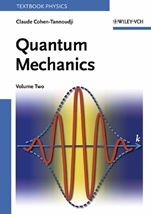
Quantum Mechanics, Volume 2
ISBN 9780471164357
Autor: Claude Cohen–Tannoudji, Bernard Diu, Franck Laloë
Wydawca: Wiley
Dostępność: 3-6 tygodni
Cena: 638,40 zł
Przed złożeniem zamówienia prosimy o kontakt mailowy celem potwierdzenia ceny.
ISBN13: |
9780471164357 |
ISBN10: |
0471164356 |
Autor: |
Claude Cohen–Tannoudji, Bernard Diu, Franck Laloë |
Oprawa: |
Paperback |
Rok Wydania: |
1977-06-23 |
Ilość stron: |
640 |
Wymiary: |
238x173 |
Tematy: |
PH |
Beginning students of quantum mechanics frequently have difficulty separating essential underlying principles from the specific examples to which these principles have historically been applied. This book is especially designed to eliminate that difficulty. Fourteen chapters, augmented by 14 "complementary sections," provide a clarity of organization, careful attention to pedagogical details, and a wealth of topics and examples that allow physics professors to tailor courses to meet students’ specific needs. Each chapter starts with a clear exposition of the problem to be treated and then logically develops the physical and mathematical concept. These chapters emphasize the underlying principles of the material, undiluted by extensive references to applications and practical examples. (Such applications and practical examples are contained in the complementary sections.) The book begins with a qualitative introduction to quantum mechanical ideas using simple optical analogies and continues with a systematic presentation of the mathematical tools and postulates of quantum mechanics as well as a discussion of their physical content. Applications follow, starting with the simplest ones (two–level systems, the harmonic oscillator, etc.), and becoming gradually more complicated (the hydrogen atom, approximation methods, etc.). The complementary sections each expand this basic knowledge, supplying a wide range of applications and related topics which make use of the essential skills. Here the authors include carefully written, detailed expositions of a large number of special problems and more advanced topics—integrated as an essential portion of the text. These topics, however, are not interdependent; this allows professors to direct their quantum mechanics courses toward both physics and chemistry students.
Spis treści:
An Elementary Approach to the Quantum Theory of Scattering by a Potential Electron Spin.
Addition of
Angular Momenta.
Stationary Perturbation Theory.
An Application of Perturbation Theory.
The Fine and Hyperfine Structure of the Hydrogen Atom.
Approximation Methods for Time–Dependent Problems.
Systems of Identical Particles.
APPENDIXES: Fourier Series and the Fourier Transform.
The Dirac δ `` Function′′.
The Lagrangian and Hamiltonian in Classical Mechanics.
INDEX.
Nota biograficzna:
Claude Cohen–Tannoudji, born in Constantine (Algeria) in 1933, studied at the École Normale Supérieure in Paris, where he received a postdoctoral lecture qualification in 1962. In 1973 he was accepted at the Collège de France, and in 1981 became a member of the Academy of Sciences. In 1997, Claude Cohen–Tannoudji was awarded the Nobel Prize in Physics for his research on laser cooling of neutral atoms (together with Steven Chu and William D. Phillips). The method is relevant for the development of precise atomic clocks, which are used for positioning and navigation. His is currently affiliated to the Laboratoire de Physique at the École Normale Supérieure (Paris).
His textbook on quantum mechanics, written together with Bernard Diu und Franck Laloë, is one of the best–known timeless standard references in this field and is recommended on a regular basis by lecturers of undergraduate courses.
Okładka tylna:
Beginning students of quantum mechanics frequently have difficulty separating essential underlying principles from the specific examples to which these principles have historically been applied. This book is especially designed to eliminate that difficulty. Fourteen chapters, augmented by 14 "complementary sections," provide a clarity of organization, careful attention to pedagogical details, and a wealth of topics and examples that allow physics professors to tailor courses to meet students’ specific needs. Each chapte
r starts with a clear exposition of the problem to be treated and then logically develops the physical and mathematical concept. These chapters emphasize the underlying principles of the material, undiluted by extensive references to applications and practical examples. (Such applications and practical examples are contained in the complementary sections.) The book begins with a qualitative introduction to quantum mechanical ideas using simple optical analogies and continues with a systematic presentation of the mathematical tools and postulates of quantum mechanics as well as a discussion of their physical content. Applications follow, starting with the simplest ones (two–level systems, the harmonic oscillator, etc.), and becoming gradually more complicated (the hydrogen atom, approximation methods, etc.). The complementary sections each expand this basic knowledge, supplying a wide range of applications and related topics which make use of the essential skills. Here the authors include carefully written, detailed expositions of a large number of special problems and more advanced topics—integrated as an essential portion of the text. These topics, however, are not interdependent; this allows professors to direct their quantum mechanics courses toward both physics and chemistry students.
Koszyk
Książek w koszyku: 0 szt.
Wartość zakupów: 0,00 zł
Informacje


Kontakt
Gambit
Centrum Oprogramowania
i Szkoleń Sp. z o.o.
Al. Pokoju 29b/22-24
31-564 Kraków
Siedziba Księgarni
ul. Kordylewskiego 1
31-542 Kraków
+48 12 410 5991
+48 12 410 5987
+48 12 410 5989
Subskrypcje
Administratorem danych osobowych jest firma Gambit COiS Sp. z o.o. Na podany adres będzie wysyłany wyłącznie biuletyn informacyjny.
Autoryzacja płatności

Informacje na temat autoryzacji płatności poprzez PayU.

© Copyright 2012: GAMBIT COiS Sp. z o.o. Wszelkie prawa zastrzeżone.
Projekt i wykonanie: Alchemia Studio Reklamy