


Wydawcy
Katalog tematyczny
- Archeologia (109)
- Ekonomia, finanse, business (13704)
- Filozofia (1445)
- Historia (3040)
- Języki i językoznawstwo (2356)
- Lifestyle, hobby i rozrywka (475)
- Medycyna (9704)
- Nauki humanistyczne (4)
- Nauki o Ziemi i środowisku (2638)
- Nauki ścisłe (20412)
- Nauki społeczne (8486)
- Nauki techniczne (13450)
- Budownictwo lądowe (1045)
- Chemia przemysłowa (2258)
- Elektronika i telekomunikacja (3287)
- Energetyka (1122)
- Inne nauki stosowane (363)
- Inżynieria biochemiczna (507)
- Inżynieria transportu (232)
- Mechanika i materiały (3316)
- Nauka o środowisku (321)
- Rolnictwo (507)
- Technika, ogólnie (475)
- Prawo (1696)
- Publikacje informacyjne i interdyscyplinarne (1288)
- Religia i wierzenia (917)
- Technika komputerowa (4067)
- Zdrowie, relacje międzyludzkie i rozwój osobisty (657)





Informacje szczegółowe o książce
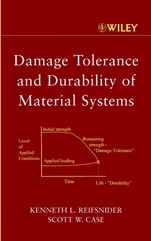
Damage Tolerance and Durability of Material Systems
ISBN 9780471152996
Autor: Kenneth L. Reifsnider, Scott W. Case
Wydawca: Wiley
Dostępność: 3-6 tygodni
Cena: 861,00 zł
Przed złożeniem zamówienia prosimy o kontakt mailowy celem potwierdzenia ceny.
ISBN13: |
9780471152996 |
ISBN10: |
0471152994 |
Autor: |
Kenneth L. Reifsnider, Scott W. Case |
Oprawa: |
Hardback |
Rok Wydania: |
2002-05-16 |
Ilość stron: |
436 |
Wymiary: |
238x159 |
Tematy: |
TG |
A daring, original approach to understanding and predicting the mechanical behavior of materials
"Damage is an abstraction . . . Strength is an observable, an independent variable that can be measured, with clear and familiar engineering definitions."
–from the Preface to Damage Tolerance and Durability of Material Systems
Long–term behavior is one of the most challenging and important aspects of material engineering. There is a great need for a useful conceptual or operational framework for measuring long–term behavior. As much a revolution in philosophy as an engineering text, Damage Tolerance and Durability of Material Systems postulates a new mechanistic philosophy and methodology for predicting the remaining strength and life of engineering material. This philosophy associates the local physical changes in material states and stress states caused by time–variable applied environments with global properties and performance.
There are three fundamental issues associated with the mechanical behavior of engineering materials and structures: their stiffness, strength, and life. Treating these issues from the standpoint of technical difficulty, time, and cost for characterization, and relationship to safety, reliability, liability, and economy, the authors explore such topics as:
∗ Damage tolerance and failure modes
∗ Factors that determine composite strength
∗ Micromechanical models of composite stiffness and strength
∗ Stiffness evolution
∗ Strength evolution during damage accumulation
∗ Non–uniform stress states
∗ Lifetime prediction
With a robust selection of example applications and case studies, this book takes a step toward the fulfillment of a vision of a future in which the prediction of physical properties from first principles will make possible the creation and application of new materials and material systems at a remarkable cost savings.
<
b>Spis treści:
Preface.
Introduction: Basic Thesis.
I.1 Elements of the Approach.
I.2 Basic Concepts.
I.3 Nonuniform Stress States: Characteristic Material Dimensions.
I.4 Strength Evolution.
I.5 Outline of the Methodology.
I.6 Virtual Design.
References.
1 Physical Behavior.
1.1 Continuous–Fiber Composite Materials.
1.2 Damage Tolerance and Durability.
1.3 Damage Modes and Failure Modes.
1.4 Summary of Concepts.
References.
2 Engineering Concepts of Strength.
2.1 Factors That Determine Composite Material Strength.
2.2 Strength under Multiaxial Loading.
2.3 Failure Functions for Damage Accumulation.
References.
Exercises.
3 Strength Evolution.
3.1 Nature of the Problem.
3.2 Progressive Failure.
3.3 Failure Modes.
3.4 Remaining Strength under Long–Term Loading.
3.5 Features of Strength Evolution Integral.
3.6 Summary of Approach.
References.
Exercises.
4 Micromechanical Models of Composite Stiffness and Strength.
4.1 Axial Tensile Strength of Unidirectional Composites.
4.2 Compression Strength.
4.3 Transverse Strength and Shear Strength.
References.
Exercises.
5 Stiffness Evolution.
5.1 Problem Definition.
5.2 Stiffness Change Due to Matrix Cracking.
5.3 Time–Dependent Stiffness Change.
5.4 Temperature–Dependent Stiffness Change.
5.5 Summary.
References.
Exercises.
6 Strength Evolution During Damage Accumulation.
6.1 Problem Definition.
6.2 Factors That Influence Strength.
6.3 Models of Strength Evolution.
6.4 Application Example.
References.
Exercises.
7 Nonuniform Stress States.
7.1 Problem Definition.
7.2 Laminate Edge–Related Stresses.
7.3 Undamaged Notched Strength.
7.4 Notched Strength After Damage.
7.5 Fracture Mechanics and Energy Methods.
References.
Exercises.
8 Example Applications and Case Studies.
8.1 Example: Unnotched Failure of Poly
mer Composite.
8.2 Case Study 1: Fatigue Behavior of APC–2 Laminates.
8.3 Case Study 2: Elevated–Temperature Fatigue Behavior of Graphite Fiber–PPS Laminates.
8.4 Case Study 3: Elevated–Temperature Fatigue Behavior of Nextel 610.... Alumina–Yttria Composites.
8.5 Case Study 4: Elevated–Temperature Fatigue Behavior of Nicalon–Enhanced SiC Composites.
8.6 Case Study 5: Fatigue Failure of a Structural Composite Shape.
8.7 Summary.
References.
Appendix to Chapter 1.
Index.
Nota biograficzna:
KENNETH L. REIFSNIDER and SCOTT W. CASE are members of the engineering faculty at the Virginia Polytechnic Institute and State University, Blacksburg, Virginia.
Okładka tylna:
A daring, original approach to understanding and predicting the mechanical behavior of materials
"Damage is an abstraction . . . Strength is an observable, an independent variable that can be measured, with clear and familiar engineering definitions."
–from the Preface to Damage Tolerance and Durability of Material Systems
Long–term behavior is one of the most challenging and important aspects of material engineering. There is a great need for a useful conceptual or operational framework for measuring long–term behavior. As much a revolution in philosophy as an engineering text, Damage Tolerance and Durability of Material Systems postulates a new mechanistic philosophy and methodology for predicting the remaining strength and life of engineering material. This philosophy associates the local physical changes in material states and stress states caused by time–variable applied environments with global properties and performance.
There are three fundamental issues associated with the mechanical behavior of engineering materials and structures: their stiffness, strength, and life. Treating these issues from the standpoint of technical difficulty, time, and cost for chara
cterization, and relationship to safety, reliability, liability, and economy, the authors explore such topics as:
∗ Damage tolerance and failure modes
∗ Factors that determine composite strength
∗ Micromechanical models of composite stiffness and strength
∗ Stiffness evolution
∗ Strength evolution during damage accumulation
∗ Non–uniform stress states
∗ Lifetime prediction
With a robust selection of example applications and case studies, this book takes a step toward the fulfillment of a vision of a future in which the prediction of physical properties from first principles will make possible the creation and application of new materials and material systems at a remarkable cost savings.
Koszyk
Książek w koszyku: 0 szt.
Wartość zakupów: 0,00 zł
Informacje


Kontakt
Gambit
Centrum Oprogramowania
i Szkoleń Sp. z o.o.
Al. Pokoju 29b/22-24
31-564 Kraków
Siedziba Księgarni
ul. Kordylewskiego 1
31-542 Kraków
+48 12 410 5991
+48 12 410 5987
+48 12 410 5989
Subskrypcje
Administratorem danych osobowych jest firma Gambit COiS Sp. z o.o. Na podany adres będzie wysyłany wyłącznie biuletyn informacyjny.
Autoryzacja płatności

Informacje na temat autoryzacji płatności poprzez PayU.

© Copyright 2012: GAMBIT COiS Sp. z o.o. Wszelkie prawa zastrzeżone.
Projekt i wykonanie: Alchemia Studio Reklamy