


Wydawcy
Katalog tematyczny
- Archeologia (109)
- Ekonomia, finanse, business (13704)
- Filozofia (1445)
- Historia (3040)
- Języki i językoznawstwo (2356)
- Lifestyle, hobby i rozrywka (475)
- Medycyna (9704)
- Nauki humanistyczne (4)
- Nauki o Ziemi i środowisku (2638)
- Nauki ścisłe (20412)
- Nauki społeczne (8486)
- Nauki techniczne (13450)
- Budownictwo lądowe (1045)
- Chemia przemysłowa (2258)
- Elektronika i telekomunikacja (3287)
- Energetyka (1122)
- Inne nauki stosowane (363)
- Inżynieria biochemiczna (507)
- Inżynieria transportu (232)
- Mechanika i materiały (3316)
- Nauka o środowisku (321)
- Rolnictwo (507)
- Technika, ogólnie (475)
- Prawo (1696)
- Publikacje informacyjne i interdyscyplinarne (1288)
- Religia i wierzenia (917)
- Technika komputerowa (4067)
- Zdrowie, relacje międzyludzkie i rozwój osobisty (657)





Informacje szczegółowe o książce
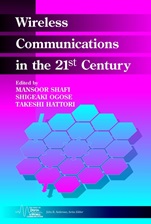
Wireless Communications in the 21st Century
ISBN 9780471150411
Autor: Mansoor Shafi, Shigeaki Ogose, Takeshi Hattori
Wydawca: Wiley
Dostępność: 3-6 tygodni
Cena: 899,85 zł
Przed złożeniem zamówienia prosimy o kontakt mailowy celem potwierdzenia ceny.
ISBN13: |
9780471150411 |
ISBN10: |
047115041X |
Autor: |
Mansoor Shafi, Shigeaki Ogose, Takeshi Hattori |
Oprawa: |
Hardback |
Rok Wydania: |
2002-03-22 |
Ilość stron: |
456 |
Wymiary: |
261x187 |
Tematy: |
TJ |
The promise of communications in the future–
A quick overview of next–generation mobile communications
Communications technology is moving toward a major milestone. Rapid innovation, the growth of the wireless industry, the move to optical networks, and the new areas opened up by the Internet are spurring us toward explosive developments in communications technology. Drawing together the best articles from IEEE publications, Wireless Communications in the 21st Century presents the state of the art of research in the field and offers a picture of things to come in an area that is likely to transform people′s lives in significant and even radical ways.
What are the key visions of wireless communications that are driving the technology innovations to come? How are the standards evolving? What kind of constituent technologies are likely to be adopted by future systems? What are the key features of the new systems currently being introduced? In this volume, more than twenty world–renowned experts answer these and other critical questions. They provide:
∗ An overview of wireless standards
∗ A comprehensive survey of radio channel propagation
∗ An overview of IMT 2000 radio systems
∗ An overview of wireless ATM
In addition, the chapters discuss such matters as modulation and coding issues pertinent to the physical layer, spatial and temporal signal processing, and the characteristics of new packet radio systems. Providing a comprehensive review of the technological breakthroughs under way and upcoming, Wireless Communications in the 21st Century opens a window on the next generation of mobile communications.
Spis treści:
Preface.
1 Introduction (Mansoor Shaft, Shigeaki Ogose, and Keith Buttenvorth).
1.1 History of Mobile Radio Communications.
1.2 Telecommunication Needs for the 21st Century.
1.3 Data Rate Road Map to 3G.
1.4 Mobile Networks of Tomorro
w.
1.5 4G Mobile Systems.
1.6 Handsets.
1.7 Mobility Management in an IP World.
1.8 Mobile IP.
1.9 Spectrum for Mobile Systems.
1.10 Organization of this Book.
1.11 Summary.
Acronyms.
References.
PART 1: Visions of Wireless Communications Applications in the 21st Century.
2 Vision of Wireless Communications in the 21st Century (Raymond Steele).
2.1 Introduction.
2.2 Current Scene in Wireless Communications.
2.3 3G Scene for the Beginning of the 21st Century.
2.4 Post–3G Systems.
2.5 Global Family of Ad Hoc Networks.
2.6 Peering Through the Future Haze.
References.
3 Wireless Migration to Packet Network: U.S. Viewpoint (Chung Liu and Wayne Strom).
3.1 Future Wireless Network Vision.
3.2 Future Wireless Network Architecture.
3.3 Wireless Packet Network Evolution.
3.4 Migration of Wireless Radio Access to Packet Data Network (Including M–IP and GPRS).
3.5 Wireless Packet Network.
3.6 Summary.
References.
4 Vision of Wireless Communications Applications in the 21st Century: A View from Japan (Mitsutoshi Hatori).
4.1 Introduction 57
4.2 Current Wireless Communications Systems.
4.3 Third–Generation Systems.
4.4 Fourth–Generation Systems.
4.5 Other Future Systems.
4.6 Summary.
References.
PART 2: Developments in International Standards.
5 Developments in International Standards (Jane Brownley, Fran O ′Brien, Maria Palamara, Derek Richards, and Lynne Sinclair).
5.1 Overview.
5.2 ITU′s IMT–2000 Standardization Efforts.
5.3 3G Standardization Consortia.
5.4 Evolving Radio Standards.
5.5 Evolving Network Standards.
5.6 Related Standardization Efforts.
5.7 Summary.
References.
6 Standardization on Broadband Wireless Access: Wireless ATM and IP (Masahiro Umehira).
6.1 Introduction.
6.2 Standardization Efforts
Related to Broadband Wireless Access.
6.3 Standardization on Radio Access Layer.
6.4 Standardization on Mobile ATM.
6.5 Conclusions.
References.
PART 3: Propagation Issues.
7 Multipath Effects Observed for the Radio Channel (Hemy L. Bertoni).
7.1 Introduction.
7.2 Measurement of Multipath Arrivals.
7.3 Multipath Phenomena for Narrowband Excitation.
7.4 Multipath Phenomena for Broadband Excitation.
7.5 Angular Spread for Space–Time Signal Processing.
7.6 Summary.
References.
8 Indoor Propagation Modeling (Homayoun Hashemi).
8.1 Introduction.
8.2 Types of Variations in the Channel.
8.3 Wideband Channel.
8.4 Large–Scale Path Losses.
8.5 rms Delay Spread.
8.6 Spatial Variations of the Channel.
8.7 Temporal Variations of the Channel.
8.8 Comparison Between Indoor and Outdoor Radio Channels.
8.9 Indoor Infrared Channel.
8.10 Conclusions.
References.
9 Propagation Loss Prediction Models (Masaharu Hata).
9.1 Introduction.
9.2 Empirical Models.
9.3 Analytical Models.
9.4 Deterministic Methods.
9.5 Summary.
References.
10 Path–Loss Measurements for Wireless Mobile Systems (Dongsoo Ear and Howard H. Xia).
10.1 Overview.
10.2 Macrocellular Measurements.
10.3 Microcellular Measurements.
10.4 Indoor Measurements.
10.5 Summary.
References.
Part 4: Technologies.
11 Coding and Modulation for Power–Constrained Wireless Channels (Ezio Biglieri, Giuseppe Caire, and Giorgio Taricco).
11.1 Introduction.
11.2 Designing a C/M Scheme: The Gaussian Channel Perspective.
11.3 Wireless Channel: A New Perspective.
11.4 Flat Independent Fading Channel.
11.5 Block–Fading Channel.
11.6 Interference–Limited Channel.
11.7 Conclusions.
References.
12 Modulation and Demodulation Techniques for Wireless Communication Systems (Seiichi Sampei).
12.1 Introduction.
12.2 Outline of Modulation and Demodulation Techniques.
12.3 GMSK.
12.4 QPSK.
12.5 Π/4–QPSK.
12.6 M–ary QAM.
12.7 Pilot Signal–Aided Fading Compensation Techniques.
12.8 Orthogonal Frequency Division Multiplexing.
12.9 Adaptive Modulation.
12.10 Summary.
References.
13 Fundamentals of Multiple Access Techniques (Fumiyuki Adachi).
13.1 Introduction.
13.2 Multiple Access Techniques.
13.3 Demand–Assign–Based Multiple Access.
13.4 Random Multiple Access.
13.5 Summary.
References.
14 Spatial–Temporal Signal Processing for Broadband Wireless Systems (David Falconer).
14.1 Introduction: Motivation and Configurations for Space–Time Processing.
14.2 Channel Models for Multielement Arrays.
14.3 Receiver Space–Time Processing.
14.4 Recent Space–Time Wireless Communication Architectures.
14.5 Adaptation Issues.
14.6 Transmitter Space–Time Processing.
14.7 Conclusions and Future Applications.
References.
15 Interference Cancellation and Multiuser Detection (Ryuji Kohno).
15.1 Introduction.
15.2 CDMA System Model.
15.3 Multiuser Detection for CDMA.
15.4 Co–Channel Interference Cancellation for DS/CDMA.
15.5 Co–Channel Interference Cancellation for FH/CDMA.
15.6 Concluding Remarks.
References.
PART 5: Wireless Systems and Applications.
16 EDGE: Enhanced Data Rates for GSM and TDMA/136 Evolution (Stefan Jäverbring).
16.1 Introduction.
16.2 Background.
16.3 Physical Layer.
16.4 Link Layer.
16.5 EGPRS Performance.
16.6 Conclusions.
References
17 Continuing Evolution of CDMA into New and Improved Services (Andrew J. Viterbi).
17.1 Commercial CDMA: A Brief Condensed History.
17.2 System Features of Code Division Multiple Access.
17.3 Early CDMA Evolution for Data Services.
17.4 Improvement and Evolut
Koszyk
Książek w koszyku: 0 szt.
Wartość zakupów: 0,00 zł
Informacje


Kontakt
Gambit
Centrum Oprogramowania
i Szkoleń Sp. z o.o.
Al. Pokoju 29b/22-24
31-564 Kraków
Siedziba Księgarni
ul. Kordylewskiego 1
31-542 Kraków
+48 12 410 5991
+48 12 410 5987
+48 12 410 5989
Subskrypcje
Administratorem danych osobowych jest firma Gambit COiS Sp. z o.o. Na podany adres będzie wysyłany wyłącznie biuletyn informacyjny.
Autoryzacja płatności

Informacje na temat autoryzacji płatności poprzez PayU.

© Copyright 2012: GAMBIT COiS Sp. z o.o. Wszelkie prawa zastrzeżone.
Projekt i wykonanie: Alchemia Studio Reklamy