


Wydawcy
Katalog tematyczny
- Archeologia (109)
- Ekonomia, finanse, business (13704)
- Filozofia (1445)
- Historia (3040)
- Języki i językoznawstwo (2356)
- Lifestyle, hobby i rozrywka (475)
- Medycyna (9704)
- Nauki humanistyczne (4)
- Nauki o Ziemi i środowisku (2638)
- Nauki ścisłe (20412)
- Nauki społeczne (8486)
- Edukacja (229)
- Kryminologia, opieka spełeczna (284)
- Obronność (10)
- Polityka (1389)
- Psychologia (777)
- Socjologia (410)
- Społeczeństwo i kultura (187)
- Nauki techniczne (13450)
- Prawo (1696)
- Publikacje informacyjne i interdyscyplinarne (1288)
- Religia i wierzenia (917)
- Technika komputerowa (4067)
- Zdrowie, relacje międzyludzkie i rozwój osobisty (657)





Informacje szczegółowe o książce
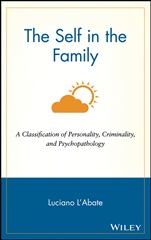
The Self in the Family: A Classification of Personality, Criminality, and Psychopathology
ISBN 9780471122470
Autor: Luciano LAbate
Wydawca: Wiley
Dostępność: 3-6 tygodni
Cena: 811,65 zł
Przed złożeniem zamówienia prosimy o kontakt mailowy celem potwierdzenia ceny.
ISBN13: |
9780471122470 |
ISBN10: |
0471122475 |
Autor: |
Luciano LAbate |
Oprawa: |
Hardback |
Rok Wydania: |
1997-01-27 |
Ilość stron: |
404 |
Wymiary: |
233x163 |
Tematy: |
JBJC |
In his acclaimed book A Theory of Personality Development, Luciano L′Abate introduced a revolutionary theory of personality development and functioning that departed radically from traditional theories. In place of hypothetical traits existing in an empirical vacuum, Dr. L′Abate offered an image of observable interpersonal competencies functioning within the basic contexts of home, work, leisure, and the marketplace. Central to his theory was a developmental model that posited the family as the primordial setting in which propensities are formed and behavior patterns set. By defining personality in terms of the growth and interplay of interpersonal competencies, the L′Abate theory provided an epistemologically and empirically sound basis for understanding personality function and dysfunction as corollaries and extensions of one another.
In The Self in the Family, Luciano L′Abate and Margaret Baggett again break new ground by expanding the L′Abate theory of personality development to encompass criminal and psychopathological behavior. Drawing upon mounting empirical evidence that the family paradigm is the major determinant of personality socialization throughout the life span, the authors develop a selfhood model with demonstrable links between the three domains of personality function, criminality, and psychopathology. With the help of the model, they show how it is now possible to arrive at a personality–based interpretation of most deviant behaviors, including criminality, psychopathology, addictions, and even psychosomatic illnesses, and they describe various preventive and psychotherapeutic applications for this expanded theory of family–based personality development.
The authors further elaborate on the theories developed in Dr. L′Abate′s previous books by introducing the core concepts of hurt—the basic feeling underlying much of personality functioning and dysfunctioning—and a co
ntinuum of likeness—the fundamental determinant of interpersonal choices and behavior in friendships, parent–child relations, and marital relations.
Offering an empirically rigorous, developmentally based, unified field theory of personality function, criminality, and psychopathology, The Self in the Family is essential reading for developmental and clinical psychologists, family therapists, personality theorists, and criminality and psychopathology researchers.
CHILD–CENTERED FAMILY THERAPY
Lucille L. Andreozzi
This book is the first complete introduction to the Child–Centered Structural Dynamic Therapy Model—a revolutionary, short–term treatment model which helps integrate child and family system development into a comprehensive framework for self–guided, family–initiated change. This guide, with its numerous case illustrations, works to build knowledge from within the family by engaging family members in structured activities that help them translate family system principles into practical, everyday reality. Child–Centered Family Therapy is an important resource for couples and family therapists, child psychologists, counselors, and social workers.
1996 (0–471–14858–X) 374 pp.
TREATING THE CHANGING FAMILY
Handling Normative and Unusual Events
Edited by Michele Harway
This inimitable book offers a broad–ranging, carefully integrated review of contemporary trends in family therapy, research, and practice. It reexamines the family and the many challenges to its function and provides practical advice for therapists who treat troubled families. It explores the impact that non–normative events such as violence and abuse, addiction, long–term and chronic illness, divorce, adoption, trauma, and many others can have on family function and provides proven intervention strategies and techniques for treating these families. With the special attention
given to the structure, dynamics, and unique problems of families that do not fit the traditional mold, such as binuclear, single–parent, and gay and lesbian families, Treating the Changing Family is a valuable resource for all mental health professionals and families.
1995 (0–471–07905–7) 374 pp.
Also in the Series:
HANDBOOK OF RELATIONAL DIAGNOSIS AND DYSFUNCTIONAL FAMILY PATTERNS
Florence W. Kaslow, Editor
1996 (0–471–08078–0) 592 pp.
Spis treści:
SUMMARY AND EXPANSION OF THE THEORY.
The Family as the Context for Personality Development and Socialization.
Corroborating the Theory: Independent and Indirect Evidence.
Corroborating the Theory: Direct Evidence.
Hurt: A Fundamental but Neglected Feeling.
The Continuum of Likeness in Intimate Relationships: Theory and Research.
Linking Individual with Family Behavior: Seven Models in Search of a Theory.
EXPANSIONS OF THE THEORY TO PERSONALITY, CRIMINALITY, AND PSYCHOPATHOLOGY.
Linking Personality with Criminality and Psychopathology.
Criminalities.
Affective Disorders.
Psychopathologies.
Addictions and Psychosomatic Illnesses.
APPLICATIONS OF THE THEORY TO PSYCHOLOGICAL INTERVENTIONS.
Prevention.
Crisis Interventions and the Psychotherapies.
CONCLUSION.
Toward a Simple Arithmetical Model for Interpersonal Relationships.
Appendix.
References.
Indexes.
Nota biograficzna:
LUCIANO L′ABATE, PhD, is Professor Emeritus of Psychology at Georgia State University. In addition to his academic career, Dr. L′Abate has maintained a private clinical practice in individual, marriage, and family therapy since 1958. On retiring from Georgia State, Dr. L′Abate was appointed Clinical Director of the International Counseling Center, a church–sponsored facility dedicated to helping minority ethnic groups in Atlanta, Georgia. Dr. L′Abate is a member of numer
ous professional societies, most notably the American Family Therapy Association, the International Academy of Family Psychology––of which he was cofounder and first president––and the American Orthopsychiatric Association. A prolific writer and editor, Dr. L′Abate has written several other books including A Theory of Personality Development, Handbook of Developmental Family Psychology and Psycho–pathology, both available from Wiley, and Handbook of Social Skills Training and Research.
MARGARET S. BAGGETT, PhD, is a licensed clinical psychologist who specializes in the assessment and treatment of children and their families. In addition to her private practice, she works as a school psychologist. She is a member of the American Psychological Association, the Georgia Psychological Association (in which she holds a board position), and the American Society of Clinical Hypnosis. She is also a charter member of the Georgia Play Therapy Association. Dr. Baggett has studied and published with Dr. L′Abate over the past twenty years.
Okładka tylna:
In his acclaimed book A Theory of Personality Development, Luciano L′Abate introduced a revolutionary theory of personality development and functioning that departed radically from traditional theories. In place of hypothetical traits existing in an empirical vacuum, Dr. L′Abate offered an image of observable interpersonal competencies functioning within the basic contexts of home, work, leisure, and the marketplace. Central to his theory was a developmental model that posited the family as the primordial setting in which propensities are formed and behavior patterns set. By defining personality in terms of the growth and interplay of interpersonal competencies, the L′Abate theory provided an epistemologically and empirically sound basis for understanding personality function and dysfunction as corollaries and extensions of one another.
In Th
Koszyk
Książek w koszyku: 0 szt.
Wartość zakupów: 0,00 zł
Informacje


Kontakt
Gambit
Centrum Oprogramowania
i Szkoleń Sp. z o.o.
Al. Pokoju 29b/22-24
31-564 Kraków
Siedziba Księgarni
ul. Kordylewskiego 1
31-542 Kraków
+48 12 410 5991
+48 12 410 5987
+48 12 410 5989
Subskrypcje
Administratorem danych osobowych jest firma Gambit COiS Sp. z o.o. Na podany adres będzie wysyłany wyłącznie biuletyn informacyjny.
Autoryzacja płatności

Informacje na temat autoryzacji płatności poprzez PayU.

© Copyright 2012: GAMBIT COiS Sp. z o.o. Wszelkie prawa zastrzeżone.
Projekt i wykonanie: Alchemia Studio Reklamy