


Wydawcy
Katalog tematyczny
- Archeologia (109)
- Ekonomia, finanse, business (13704)
- Filozofia (1445)
- Historia (3040)
- Języki i językoznawstwo (2356)
- Lifestyle, hobby i rozrywka (475)
- Medycyna (9704)
- Nauki humanistyczne (4)
- Nauki o Ziemi i środowisku (2638)
- Nauki ścisłe (20412)
- Nauki społeczne (8486)
- Nauki techniczne (13450)
- Prawo (1696)
- Publikacje informacyjne i interdyscyplinarne (1288)
- Religia i wierzenia (917)
- Technika komputerowa (4067)
- Zdrowie, relacje międzyludzkie i rozwój osobisty (657)





Informacje szczegółowe o książce
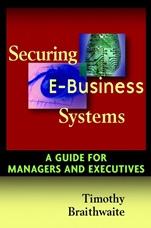
Securing E–Business Systems: A Guide for Managers and Executives
ISBN 9780471072980
Autor: Timothy Braithwaite
Wydawca: Wiley
Dostępność: 3-6 tygodni
Cena: 233,10 zł
Przed złożeniem zamówienia prosimy o kontakt mailowy celem potwierdzenia ceny.
ISBN13: |
9780471072980 |
ISBN10: |
0471072982 |
Autor: |
Timothy Braithwaite |
Oprawa: |
Hardback |
Rok Wydania: |
2002-04-24 |
Ilość stron: |
288 |
Wymiary: |
236x156 |
Tematy: |
KF |
This is a must–read for the entire CXO community if businesses are to survive in cyberspace. Attack methodologies and the cyber threat poised against our business systems are advancing rapidly. Business leaders are soon to face downstream liability issues for the damage their unprotected and exploited systems cause not only to themselves but to all of those with whom they do business in cyberspace. American businesses are now the target of choice by our nation′s enemies. We may secure the airways, ports, and borders, but only the boardrooms of America can ensure the survival of our economy." –John R. Thomas, Colonel, U.S. Army, Retired, Former Commander of the DoD, Global Operations and Security Center
Today′s e–business depends on the security of its networks and information technology infrastructure to safeguard its customers and its profits. But with rapid innovation and the emergence of new threats and new countermeasures, keeping up with security is becoming more complex than ever. Securing E–Business Systems offers a new model for developing a proactive program of security administration that works as a continuous process of identifying weaknesses and implementing solutions. This book offers a real, working design for managing an IT security program with the attention it truly warrants, treating security as a constant function that adapts to meet a company′s changing security needs.
Topics include:
∗ Security weaknesses
∗ Safeguarding technologies
∗ Countermeasure best practices
∗ Establishing an adaptable e–business security management program
∗ Essential elements of a corporate security management program
∗ Functions, structure, staffing, and contracting considerations in security management
∗ Implementing intrusion detection technology
∗ Designing tomorrow′s e–business application for secured operations
∗ Conte
mporary rationales for justifying increased spending on security programs
∗ Emerging liability issues for e–businesses
Spis treści:
Preface.
Chapter 1 Electronic Business Systems Security.
Introduction.
How Is E–Business Security Defined?
Can E–Business Security Be Explained More Simply?
Is E–Business Security Really Such a Big Deal?
Is E–Business Security More Important Than Other Information Technology Initiatives?
How Does an Organization Get Started?
Instead of Playing "Catch–Up," What Should an Organization Be Doing to Design E–Business Systems That Are Secure in the First Place?
Chapter 2 E–Business Systems and Infrastructure Support Issues.
Introduction.
E–Business Defined.
A Short History of E–Business Innovations.
The Need for Secure E–Business Systems.
Software: The Vulnerable Underbelly of Computing.
The Interoperability Challenge and E–Business Success.
E–Business Security: An Exercise in Trade–Offs.
Few Systems Are Designed to Be Secure.
Conclusion.
Chapter 3 Security Weaknesses in E–Business Infrastructure and "Best Practices" Security.
Introduction.
Fundamental Technical Security Threats.
The Guiding Principles of Protection.
"Best Practice" Prevention, Detection, and Countermeasures and Recovery Techniques.
x Chapter 4 Managing E–Business Systems and Security.
Introduction.
Part One: Misconceptions and Questionable Assumptions.
Part Two: Managing E–Business Systems as a Corporate Asset.
Part Three: E–Business Security Program Management.
Chapter 5 A "Just–in–Time" Strategy for Securing the E–Business System: The Role for Security Monitoring and Incident Response.
The Current State of E–Business Security.
Standard Requirements of an E–Business Security Strategy.
A New Security Strategy.
The Crucial Role of Security Monitoring and Incident Response to the Securing of E–Business Systems.
The Current State of Intrusion Detection Systems (IDS).
Defining a Cost–Effective Security Monitoring and Incident Response Capability.
Alternatives to Building "Your Own" Security Monitoring and Incident Response Capability.
Summary.
Chapter 6 Designing and Delivering Secured E–Business Application Systems.
Introduction.
Past Development Realities.
Contemporary Development Realities.
Developing Secured E–Business Systems.
Using the SDR Framework.
Choosing a Systems Development Methodology That Is Compatible with the SDR Framework.
Participants in the Identification of Security and Integrity Controls.
Importance of Automated Tools.
A Cautionary Word About New Technologies.
Summary and Conclusions.
Chapter 7 Justifying E–Business Security and the Security Management Program.
Introduction.
The "Quantifiable" Argument.
Emerging "Nonquantifiable" Arguments.
Benefits Justifications Must Cover Security Program Administration.
Conclusion.
Chapter 8 Computers, Software, Security, and Issues of Liability.
Evolving Theories of Responsibility.
Likely Scenarios.
How Might a Liability Case Unfold?
Questions to Be Asked to Ensure That Reasonable Care Has Been Taken in Developing a Secure E–Business System.
Chapter 9 The National Critical Infrastructure Protection (CIP) Initiative.
The Problem of Dependency.
Critical Infrastructure Protection (CIP) Purpose, Directives, Organizations, and Relationships.
Frequently Asked Questions About the IT–ISAC.
Critical Information Infrastructure Protection Issues that Need Resolution.
Appendix A: Y2K Lessons Learned and Their Importance for E–Business Security.
Appendix B: Systems Development Review Framework for E–Business Development Projects.
Appendix C: A Corporate Plan of Action for Se
curing E–Business Systems (Sample).
Appendix D: E–Business Risk Management Review Model Instructions for Use.
Appendix E: Resources Guide.
Index.
Nota biograficzna:
TIMOTHY BRAITHWAITE has spent more than fifteen years in senior security management positions and another twenty years in executive director positions for computer and communications services organizations in both the public and private sectors. He has also worked as a private consultant. Tim has previously published The Power of IT: Maximizing Your Technology Investments and Evaluating the Year 2000 Project: A Management Guide for Determining Reasonable Care (Wiley).
Okładka tylna:
"This is a must–read for the entire CXO community if businesses are to survive in cyberspace. Attack methodologies and the cyber threat poised against our business systems are advancing rapidly. Business leaders are soon to face downstream liability issues for the damage their unprotected and exploited systems cause not only to themselves but to all of those with whom they do business in cyberspace. American businesses are now the target of choice by our nation′s enemies. We may secure the airways, ports, and borders, but only the boardrooms of America can ensure the survival of our economy." –John R. Thomas, Colonel, U.S. Army, Retired, Former Commander of the DoD, Global Operations and Security Center
Today′s e–business depends on the security of its networks and information technology infrastructure to safeguard its customers and its profits. But with rapid innovation and the emergence of new threats and new countermeasures, keeping up with security is becoming more complex than ever. Securing E–Business Systems offers a new model for developing a proactive program of security administration that works as a continuous process of identifying weaknesses and implementing solutions. This book offers a real, working design for ma
Koszyk
Książek w koszyku: 0 szt.
Wartość zakupów: 0,00 zł
Informacje


Kontakt
Gambit
Centrum Oprogramowania
i Szkoleń Sp. z o.o.
Al. Pokoju 29b/22-24
31-564 Kraków
Siedziba Księgarni
ul. Kordylewskiego 1
31-542 Kraków
+48 12 410 5991
+48 12 410 5987
+48 12 410 5989
Subskrypcje
Administratorem danych osobowych jest firma Gambit COiS Sp. z o.o. Na podany adres będzie wysyłany wyłącznie biuletyn informacyjny.
Autoryzacja płatności

Informacje na temat autoryzacji płatności poprzez PayU.

© Copyright 2012: GAMBIT COiS Sp. z o.o. Wszelkie prawa zastrzeżone.
Projekt i wykonanie: Alchemia Studio Reklamy