


Wydawcy
Katalog tematyczny
- Archeologia (109)
- Ekonomia, finanse, business (13704)
- Filozofia (1445)
- Historia (3040)
- Języki i językoznawstwo (2356)
- Lifestyle, hobby i rozrywka (475)
- Medycyna (9704)
- Nauki humanistyczne (4)
- Nauki o Ziemi i środowisku (2638)
- Nauki ścisłe (20412)
- Astronomia (294)
- Biologia (5119)
- Biochemia (575)
- Biologia człowieka (14)
- Biologia komórkowa (377)
- Biologia molekularna (398)
- Biologia rozwoju (130)
- Biologia, ogólnie (1277)
- Botanika (280)
- Hydrobiologia (92)
- Mikrobiologia (363)
- Mykologia (22)
- Zoologia (303)
- Chemia (6540)
- Fizyka (3309)
- Matematyka (4574)
- Nauki ścisłe, ogólnie (503)
- Nauki społeczne (8486)
- Nauki techniczne (13450)
- Prawo (1696)
- Publikacje informacyjne i interdyscyplinarne (1288)
- Religia i wierzenia (917)
- Technika komputerowa (4067)
- Zdrowie, relacje międzyludzkie i rozwój osobisty (657)





Informacje szczegółowe o książce
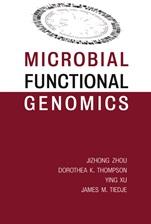
Microbial Functional Genomics
ISBN 9780471071907
Autor: Jizhong Zhou, Dorothea K. Thompson, Ying Xu, James M. Tiedje
Wydawca: Wiley
Dostępność: 3-6 tygodni
Cena: 876,75 zł
Przed złożeniem zamówienia prosimy o kontakt mailowy celem potwierdzenia ceny.
ISBN13: |
9780471071907 |
ISBN10: |
0471071900 |
Autor: |
Jizhong Zhou, Dorothea K. Thompson, Ying Xu, James M. Tiedje |
Oprawa: |
Hardback |
Rok Wydania: |
2004-04-16 |
Ilość stron: |
624 |
Wymiary: |
258x184 |
Tematy: |
PS |
The completion of sequences for over one hundred microbial genomes, with more than 200 additional projects now under way, has vastly multiplied the potential avenues for research using genetic, biochemical, and bioinformatics tools, and has created the new field of functional genomics. These advances have laid the foundation for understanding key principles applicable to human genome research.
Microbial Functional Genomics, the first comprehensive treatment of this subject, provides a much–needed synthesis of genome–wide studies on gene networks and functions, as well as the use of genomic data and technology in addressing a host of biological problems. Topics covered include: Genomics: introduction, history, and current challenges and scopeMicrobial diversity and evolution from a genomics perspectiveComputational methods for genome annotation and functional prediction of genesDNA microarray technology and its application to gene expression data analysis, mutation analysis, and microbial detectionMutagenesis as a genomic tool for studying gene functionThe functional genomics of model organisms, bacterial pathogens, and environmentally significant microorganismsThe impact of genomics on antimicrobial drug discovery and toxicology
Microbial Functional Genomics represents a timely summary of the principles, approaches, and applications at the forefront of this exciting and rapidly progressing field.
Spis treści:
Foreword.
Preface.
Acknowledgments.
1. Genomics: Toward a Genome–level Understanding of the Structure, Functions, and Evolution of Biological Systems (Jizhong Zhou, Dorothea K. Thompson, and James M. Tiedje).
1.1 Introduction.
1.2 Definitions and Classifications.
1.2.1 Classification based on system attributes.
1.2.2 Classification based on relationships to other scientific disciplines.
1.2.3 Classification bas
ed on types of organisms studied.
1.3 Historical Perspective of Genomics.
1.4 Challenges of Studying Functional Genomics.
1.4.1 Defining gene function.
1.4.2 Indentifying and characterizing the molecular machines of life.
1.4.3 Delineating gene regulatory networks.
1.4.4 System–level understanding of biological systems beyond individual cells.
1.4.5 Computational challenges.
1.4.6 Multidisciplinary collaborations.
1.5 Scope and General Approaches.
1.5.1 Structural Genomics.
1.5.2 Transcriptomics.
1.5.3 Proteomics.
1.6 Importance of Microbial Functional Genomics to the Study of Eukaryotes.
1.7 Summary.
2. Microbial Diversity and Genomics (Konstantinos Konstantinidis and James M. Tiedje).
2.1 Introduction.
2.2 Biochemical Diversity.
2.3 Genetic Diversity.
2.3.1 The unseen majority.
2.3.2 How many prokaryotic species are there?
2.4 The Challenge of Describing Prokaryotic Diversity.
2.4.1 Methods to study microbial diversity.
2.4.2 Limitations of culture–independent methods.
2.4.3 Interesting findings from culture–independent approaches.
2.5 Diversity of Microbial Genomes and Whole–Genome Sequencing.
2.5.1 Genomic diversity within species.
2.5.2 Genome structure and its relation to the ecological niche.
2.5.3 General trends in genome functional content.
2.5.4 Biases in the collection of sequenced species: a limit to understanding.
2.6 Summary.
3. Computational Genome Annotation (Ying Xu).
3.1 Introduction.
3.2 Prediction of Protein–Coding Genes.
3.2.1 Evaluation of coding potential.
3.2.2 Identification of translation start.
3.2.3 Ab initio gene prediction through information fusion.
3.2.4 Gene identification through comparative analysis.
3.2.5 Interpretation of gene prediction.
3.3 Prediction of RNA–Coding Genes.
3.4 Identification of Promoters.
3.4.1 Promoter prediction through feature recognition
.
3.5 Operon Identification.
3.6 Functional Categories of Genes.
3.7 Characterization of Other Features in a Genome.
3.8 Genome–Scale Gene Mapping.
3.9 Existing Genome Annotation Systems.
3.10 Summary.
4. Microbial Evolution from a Genomics Perspective (Jizhong Zhou and Dorothea K. Thompson).
4.1 Introduction.
4.2 Identification of Orthologous Genes.
4.3 Genome Perspectives on Molecular Clock.
4.3.1 Historical overview.
4.3.2 Current genomic view on molecular evolutionary clock.
4.3.3 Timing genome divergence.
4.4 Genome Perspectives on Horizontal Gene Transfer.
4.4.1 Historical overview of horizontal gene transfer.
4.4.2 Identification of HGT.
4.4.3 Mechanisms underlying HGT.
4.4.4 Types of genes subjected to HGT.
4.4.5 Classification and scope of HGT.
4.4.6 Evolutionary impact of HGT.
4.5 Genomic Perspectives on Gene Duplication, Gene Loss, and Other Evolutionary Processes.
4.5.1 Gene and genome duplication.
4.5.2 Genomic perspectives on gene loss.
4.5.3 Genomic perspectives on other evolutionary processes.
4.6 Universal Tree of Life.
4.6.1 Establishment of a universal tree of life.
4.6.2 Challenges and current view of the universal tree.
4.6.3 Genome–based phylogenetic analysis.
4.7 Minimal Genomes.
4.8 Genomic Insights into Lifestyle Evolution.
4.9 Genome Perspective of Mitochondrial Evolution.
4.10 Summary.
5. Computational Methods for Functional Prediction of Genes (Ying Xu).
5.1 Introduction.
5.2 Methods for Gene Function Inference.
5.2.1 Gene functions at different levels.
5.2.2 Searching for clues to gene function.
5.3 From Gene Sequence to Function.
5.3.1 Hierarchies of protein families.
5.3.2 Searching family trees.
5.3.3 Orthologous vs. paralogous genes.
5.3.4 Genes with multiple domains.
5.4 Identification of Sequence Motifs.
5.5 Structure–Based Function Prediction.
5.5.1 Protein fold rec
ognition through protein threading.
5.5.2 From structure to function.
5.5.3 Disordered vs. ordered regions in proteins.
5.6 Nonhomologous Approaches to Functional Inference.
5.7 Functional Inference at a Systems Level.
5.8 Summary.
6. DNA Microarray Technology (Jizhong Zhou and Dorothea K. Thompson).
6.1 Introduction.
6.2 Types of Microarrays and Advantages.
6.2.1 Concepts, principles, and history.
6.2.2 Microarray types and their advantages.
6.3 Microarray Fabrication.
6.3.1 Microarray fabrication substrates and modification.
6.3.2 Arraying technology.
6.3.3 Critical issues for microarray fabrication.
6.4 Microarray Hybridization and Detection.
6.4.1 Probe design, target preparation, and quality.
6.4.2 Hybridization.
6.4.3 Detection.
6.4.4 Critical issues in hybridization and detection.
6.5 Microarray Image Processing.
6.5.1 Data acquisition.
6.5.2 Assessment of spot quality and reliability, and background subtraction.
6.6 Using Microarrays to Monitor Gene Expression.
6.6.1 General approaches to revealing differences in gene expression.
6.6.2 Specificity, sensitivity, reproducibility, and quantitation of microarray–based detection for monitoring gene expression.
6.6.3 Microarray experimental design for monitoring gene expression.
6.7 Summary.
7. Microarray Gene Expression Data Analysis (Ying Xu).
7.1 Introduction.
7.2 Normalization of Microarray Gene Expression Data.
7.2.1 Sources of systematic errors.
7.2.2 Experimental design to minimize systematic variations.
7.2.3 Selection of reference points for data normalization.
7.2.4 Normalization methods.
7.3 Data Analysis.
7.3.1 Data transformation.
7.3.2 Principle component analysis.
7.4 Identification of Differentially Expressed Genes.
7.5 Identification of Coexpressed Genes.
7.5.1 Basics of gene expression data clustering.
7.5.2 Clustering of gene expression data.
7.5.3 Cl
Koszyk
Książek w koszyku: 0 szt.
Wartość zakupów: 0,00 zł
Informacje


Kontakt
Gambit
Centrum Oprogramowania
i Szkoleń Sp. z o.o.
Al. Pokoju 29b/22-24
31-564 Kraków
Siedziba Księgarni
ul. Kordylewskiego 1
31-542 Kraków
+48 12 410 5991
+48 12 410 5987
+48 12 410 5989
Subskrypcje
Administratorem danych osobowych jest firma Gambit COiS Sp. z o.o. Na podany adres będzie wysyłany wyłącznie biuletyn informacyjny.
Autoryzacja płatności

Informacje na temat autoryzacji płatności poprzez PayU.

© Copyright 2012: GAMBIT COiS Sp. z o.o. Wszelkie prawa zastrzeżone.
Projekt i wykonanie: Alchemia Studio Reklamy