


Wydawcy
Katalog tematyczny
- Archeologia (109)
- Ekonomia, finanse, business (13704)
- Filozofia (1445)
- Historia (3040)
- Języki i językoznawstwo (2356)
- Lifestyle, hobby i rozrywka (475)
- Medycyna (9704)
- Nauki humanistyczne (4)
- Nauki o Ziemi i środowisku (2638)
- Geografia (299)
- Nauki o Ziemi (1661)
- Geologia (414)
- Hydrologia (237)
- Meteorologia i klimatologia (114)
- Paleontologia (33)
- Wulkanologia i sejsmologia (44)
- Planowanie przestrzenne (53)
- Środowisko (607)
- Nauki ścisłe (20412)
- Nauki społeczne (8486)
- Nauki techniczne (13450)
- Prawo (1696)
- Publikacje informacyjne i interdyscyplinarne (1288)
- Religia i wierzenia (917)
- Technika komputerowa (4067)
- Zdrowie, relacje międzyludzkie i rozwój osobisty (657)





Informacje szczegółowe o książce
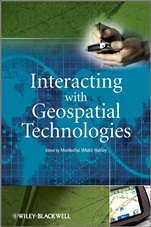
Interacting with Geospatial Technologies
ISBN 9780470998243
Autor: Mordechai (Muki) Haklay
Wydawca: Wiley
Dostępność: 3-6 tygodni
Cena: 507,15 zł
Przed złożeniem zamówienia prosimy o kontakt mailowy celem potwierdzenia ceny.
ISBN13: |
9780470998243 |
ISBN10: |
0470998245 |
Autor: |
Mordechai (Muki) Haklay |
Oprawa: |
Hardback |
Rok Wydania: |
2010-03-26 |
Ilość stron: |
312 |
Wymiary: |
254x181 |
Tematy: |
RB |
This book provides an introduction to HCI and usability aspects of Geographical Information Systems and Science. Its aim is to introduce the principles of Human–Computer Interaction (HCI); to discuss the special usability aspects of GIS which designers and developers need to take into account when developing such systems; and to offer a set of tried and tested frameworks, matrices and techniques that can be used within GIS projects.
Geographical Information Systems and other applications of computerised mapping have gained popularity in recent years. Today, computer–based maps are common on the World Wide Web, mobile phones, satellite navigation systems and in various desktop computing packages. The more sophisticated packages that allow the manipulation and analysis of geographical information are used in location decisions of new businesses, for public service delivery for planning decisions by local and central government. Many more applications exist and some estimate the number of people across the world that are using GIS in their daily work at several millions. However, many applications of GIS are hard to learn and to master. This is understandable, as until quite recently, the main focus of software vendors in the area of GIS was on the delivery of basic functionality and development of methods to present and manipulate geographical information using the available computing resources. As a result, little attention was paid to usability aspects of GIS. This is evident in many public and private systems where the terminology, conceptual design and structure are all centred around the engineering of GIS and not on the needs and concepts that are familiar to the user.
This book covers a range of topics from the cognitive models of geographical representation, to interface design. It will provide the reader with frameworks and techniques that can be used and description of case studies in which these techniques have been used for computer mapp
ing application.
Spis treści:
Preface.
About the authors.
How to use this book.
Acknowledgements.
SECTION I THEORY.
1 Human–computer interaction and geospatial technologies – context(Mordechai (Muki) Haklay and Artemis Skarlatidou).
1.1 Human–computer interaction and usability engineering background.
1.2 Geographic Information Systems and science history.
1.3 Human–Computer Interaction and GIScience research.
Summary.
Further reading.
Revision questions.
2 Human understanding of space (Clare Davies, Chao (Lily) Li and Jochen Albrecht).
2.1 Introduction.
2.2 Spatial cognition: screen versus geography.
2.3 Geographic spatial cognition – learning, understanding and recall.
2.4 GIS in the outside environment: matching maps to geography.
Summary.
Further reading.
Revision questions.
3 Cartographic theory and principles (Catherine (Kate) Emma Jones).
3.1 Principles of cartographic representation.
3.2 Impact of projections on map design.
3.3 Impact of cartographic scale on map design.
3.4 Generalization.
Summary.
Further reading.
Revision questions.
4 Computer–mediated communication, collaboration and groupware (Mordechai (Muki) Haklay).
4.1 Computer–mediated communication.
4.2 Social dynamics and group decision–making issues.
4.3 Computer Supported Collaborative Work and Groupware (CSCW).
4.4 Principles of collaborative GIS.
Summary.
Further reading.
Revision questions.
SECTION II FRAMEWORK.
5 User–centred design (Mordechai (Muki) Haklay and Annu–Maaria Nivala).
5.1 Background.
5.2 Principles.
5.3 Applying user–centred design in geospatial technologies.
5.4 Participatory design.
Summary.
Further reading.
Revision questions.
6 Usabi
lity engineering (Mordechai (Muki) Haklay, Artemis Skarlatidou and Carolina Tob´on).
6.1 Background.
6.2 Usability engineering and product development process.
6.3 Understanding user requirements and needs.
6.4 Application development.
6.5 Evaluation and deployment.
6.6 Usability engineering in research.
Summary.
Further reading.
Revision questions.
SECTION III PRACTICALITIES AND TECHNIQUE.
7 Application planning (Jochen Albrecht and Clare Davies).
7.1 GIS interface complexity.
7.2 Task analysis in GIS.
7.3 Formalized analysis of GIS user interfaces.
7.4 User experience considerations.
7.5 Task analysis as the basis for workflow management.
7.6 Geo–scientific workflows and process models.
7.7 Ontologies in support of application planning for the semantic web.
Summary.
Further reading.
Revision questions.
8 Practical cartography (Catherine (Kate) Emma Jones).
8.1 The role of symbology in map making.
8.2 The role of colour in map making.
8.3 Data classification – types of maps and thematic mapping.
8.4 Mapping conventions – map elements and layout.
Summary.
Further reading.
Revision questions.
9 Principles of interaction (Jessica Wardlaw).
9.1 Key elements of the theory of interaction for geospatial technologies.
9.2 Basic elements of GUI.
9.3 Some guidelines for designing a GIS interface.
Summary.
Revision questions.
10 Evaluation and deployment (Stephanie Larissa Marsh and Mordechai (Muki) Haklay).
10.1 Evaluation options – from usability laboratory to guerrilla usability.
10.2 Evaluation techniques.
10.3 Methodological consideration of usability techniques.
Summary.
Further reading.
Revision questions.
11 Single user environments: desktop to mobile (Mordechai (Muki) Haklay and (Lily) Chao Li).
11.1 Technological co
nsiderations.
11.2 Understanding the user context.
11.3 Designing desktop applications.
11.4 Mobile devices.
Summary.
Further reading.
Revision questions.
12 Web–mapping applications and HCI considerations for their design(Artemis Skarlatidou).
12.1 Overview of Web–mapping.
12.2 Web–mapping design and HCI considerations.
Summary.
Further reading.
Revision questions.
Bibliography.
Index.
Koszyk
Książek w koszyku: 0 szt.
Wartość zakupów: 0,00 zł
Informacje


Kontakt
Gambit
Centrum Oprogramowania
i Szkoleń Sp. z o.o.
Al. Pokoju 29b/22-24
31-564 Kraków
Siedziba Księgarni
ul. Kordylewskiego 1
31-542 Kraków
+48 12 410 5991
+48 12 410 5987
+48 12 410 5989
Subskrypcje
Administratorem danych osobowych jest firma Gambit COiS Sp. z o.o. Na podany adres będzie wysyłany wyłącznie biuletyn informacyjny.
Autoryzacja płatności

Informacje na temat autoryzacji płatności poprzez PayU.

© Copyright 2012: GAMBIT COiS Sp. z o.o. Wszelkie prawa zastrzeżone.
Projekt i wykonanie: Alchemia Studio Reklamy