


Wydawcy
Katalog tematyczny
- Archeologia (109)
- Ekonomia, finanse, business (13704)
- Filozofia (1445)
- Historia (3040)
- Języki i językoznawstwo (2356)
- Lifestyle, hobby i rozrywka (475)
- Medycyna (9704)
- Nauki humanistyczne (4)
- Nauki o Ziemi i środowisku (2638)
- Nauki ścisłe (20412)
- Nauki społeczne (8486)
- Nauki techniczne (13450)
- Prawo (1696)
- Publikacje informacyjne i interdyscyplinarne (1288)
- Religia i wierzenia (917)
- Technika komputerowa (4067)
- Zdrowie, relacje międzyludzkie i rozwój osobisty (657)





Informacje szczegółowe o książce
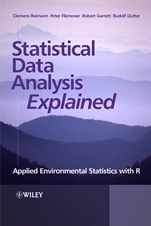
Statistical Data Analysis Explained: Applied Environmental Statistics with R
ISBN 9780470985816
Autor: Clemens Reimann, Peter Filzmoser, Robert Garrett, Rudolf Dutter
Wydawca: Wiley
Dostępność: 3-6 tygodni
Cena: 491,40 zł
Przed złożeniem zamówienia prosimy o kontakt mailowy celem potwierdzenia ceny.
ISBN13: |
9780470985816 |
ISBN10: |
047098581X |
Autor: |
Clemens Reimann, Peter Filzmoser, Robert Garrett, Rudolf Dutter |
Oprawa: |
Hardback |
Rok Wydania: |
2008-04-07 |
Ilość stron: |
362 |
Wymiary: |
253x180 |
Tematy: |
AT |
Statistical Data Analysis Explained<br>Applied Environmental Statistics with R
Statistical Data Analysis Explained provides an accessible guide to practical data analysis for applied environmental sciences, using many of today′s advanced Statistical. Written in a concise and logical manner, the book avoids complex Statistical jargon and can be easily understood by non–statisticians. Mathematical formulae is avoided where possible with explanations carried out using relevant examples.
Opening with the simplest of statistical concepts, the book carefully moves on to introduce the reader to a more comprehensive understanding of he use of statistics within the environmental sciences. Clearly structured throughout, the book links the application of Statistical and other computer methods to the management, analysis and presentation of spatial data.
Many of the examples used in the book are taken from applied geochemistry,although he principles and ideas apply equally to other natural sciences, for example, environmental science, hydrology, geography, forestry and ecology. The book will be an invaluable reference to anyone working with spatially–dependent data.Approaches statistics without excessive formulae and avoids statistical jargon for the non–statisticianAccompanying website includes example data and the software package, DAS+R, as well as GUI and R–scripts. http://www.statistik.tuwien,ac.at/StatDA/Features an abundance of examples the reader can follow and duplicate, using R softwareTakes an interdisciplinary approach combining the expertise of two geochemists and two statisticiansFocuses on exploratory data analysis for spatial data
Spis treści:
Preface.
Acknowledgements.
About the Authors.
1. Introduction.
1.1 The Kola Ecogeochemistry Project.2. Preparing the Data for Use in R and DAS+R.
2.1 Required data format for import into R and DAS+R.
2.2 The detection limit problem.
2.3 Missing Values.
2.4 Some “typical” problems encountered when editing a laboratory data report file to a DAS+R file.
2.5 Appending and linking data files.
2.6 Requirements for a geochemical database.
2.7 Summary.
3. Graphics to Display the Data Distribution.
3.1 The one–dimensional scatterplot.
3.2 The histogram.
3.3 The density trace.
3.4 Plots of the distribution function.
3.5 Boxplots.
3.6 Combination of histogram, density trace, one–dimensional scatterplot, boxplot, and ECDF–plot.
3.7 Combination of histogram, boxplot or box–and–whisker plot, ECDF–plot, and CP–plot.
3.8 Summary.
4. Statistical Distribution Measures.
4.1 Central value.
4.2 Measures of spread.
4.3 Quartiles, quantiles and percentiles.
4.4 Skewness.
4.5 Kurtosis.
4.6 Summary table of statistical distribution measures.
4.7 Summary.
5. Mapping Spatial Data.
5.1 Map coordinate systems (map projection).
5.2 Map scale.
5.3 Choice of the base map for geochemical mapping
5.4 Mapping geochemical data with proportional dots.
5.5 Mapping geochemical data using classes.
5.6 Surface maps constructed with smoothing techniques.
5.7 Surface maps constructed with kriging.
5.8 Colour maps.
5.9 Some common mistakes in geochemical mapping.
5.10 Summary.
6. Further Graphics for Exploratory Data Analysis.
6.1 Scatterplots (xy–plots).
6.2 Linear regression lines.
6.3 Time trends.
6.4 Spatial trends.
6.5 Spatial distance plot.
6.6 Spiderplots (normalized multi–element diagrams).
6.7 Scatterplot matrix.
6.8 Ternary plots.
6.9 Summary.
7. Defining Background and Threshold, Identification of Data Outliers and Element Sources.
7.1 Statistical m
ethods to identify extreme values and data outliers.
7.2 Detecting outliers and extreme values in the ECDF– or CP–plot.
7.3 Including the spatial distribution in the definition of background.
7.4 Methods to distinguish geogenic from anthropogenic element sources.
7.5 Summary.
8. Comparing Data in Tables and Graphics.
8.1 Comparing data in tables.
8.2 Graphical comparison of the data distributions of several data sets.
8.3 Comparing the spatial data structure.
8.4 Subset creation – a mighty tool in graphical data analysis.
8.5 Data subsets in scatterplots.
8.6 Data subsets in time and spatial trend diagrams.
8.7 Data subsets in ternary plots.
8.8 Data subsets in the scatterplot matrix.
8.9 Data subsets in maps.
8.10 Summary.
9. Comparing Data Using Statistical Tests.
9.1 Tests for distribution (Kolmogorov–Smirnov and Shapiro–Wilk tests).
9.2 The one–sample t–test (test for the central value).
9.3 Wilcoxon signed–rank test.
9.4 Comparing two central values of the distributions of independent data groups.
9.5 Comparing two central values of matched pairs of data.
9.6 Comparing the variance of two test.
9.7 Comparing several central values.
9.8 Comparing the variance of several data groups.
9.9 Comparing several central values of dependent groups.
9.10 Summary.
10. Improving Data Behaviour for Statistical Analysis: Ranking and Transformations.
10.1 Ranking/sorting.
10.2 Non–linear transformations.
10.3 Linear transformations.
10.4 Preparing a data set for multivariate data analysis.
10.5 Transformations for closed number systems.
10.6 Summary.
11. Correlation.
11.1 Pearson correlation.
11.2 Spearman rank correlation.
11.3 Kendall–tau correlation.
11.4 Robust correlation coefficients.
11.5 When is a correlation coefficient significant?
11.6 Working with many variabl
es.
11.7 Correlation analysis and inhomogeneous data.
11.8 Correlation results following addictive logratio or central logratio transformations.
11.9 Summary.
12. Multivariate Graphics.
12.1 Profiles.
12.2 Stars.
12.3 Segments.
12.4 Boxes.
12.5 Castles and trees.
12.6 Parallel coordinates plot.
12.7 Summary.
13. Multivariate Outlier Detection.
13.1 Univariate versus multivariate outlier detection.
13.2 Robust versus non–robust outlier detection.
13.3 The chi–square plot.
13.4 Automated multivariate outlier detection and visualization.
13.5 Other graphical approaches for identifying outliers and groups.
13.6 Summary.
14. Principal Component Analysis (PCA) and Factor Analysis (FA).
14.1 Conditioning the data for PCA and FA.
14.2 Principal component analysis (PCA).
14.3 Factor Analysis.
14.4 Summary.
15. Cluster Analysis.
15.1 Possible data problems in the context of cluster analysis.
15.2 Distance measures.
15.3 Clustering samples.
15.4 Clustering variables.
15.5 Evaluation of cluster validity.
15.6 Selection of variables for cluster analysis.
15.7 Summary.
16. Regression Analysis (RA).
16.1 Data requirements for regression analysis.
16.2 Multiple regression.
16.3 Classical least squares (LS) regression.
16.4 Robust regression.
16.5 Model selection in regression analysis.
16.6 Other regression methods.
16.7 Summary.
17. Discriminant Analysis (DA) and Other Knowledge–Based Classification Methods.
17.1 Methods for discriminant analysis.
17.2 Data requirements for discriminant analysis.
17.3 Visualisation of the discriminant function.
17.4 Prediction with discriminant analysis.
17.5 Exploring for similar data structures.
17.6 Other knowledge–based classification methods/
17.7 Summary.
18. Quality Control (QC).
18.1 Randomised samples.
18.2 Trueness.
Koszyk
Książek w koszyku: 0 szt.
Wartość zakupów: 0,00 zł
Informacje


Kontakt
Gambit
Centrum Oprogramowania
i Szkoleń Sp. z o.o.
Al. Pokoju 29b/22-24
31-564 Kraków
Siedziba Księgarni
ul. Kordylewskiego 1
31-542 Kraków
+48 12 410 5991
+48 12 410 5987
+48 12 410 5989
Subskrypcje
Administratorem danych osobowych jest firma Gambit COiS Sp. z o.o. Na podany adres będzie wysyłany wyłącznie biuletyn informacyjny.
Autoryzacja płatności

Informacje na temat autoryzacji płatności poprzez PayU.

© Copyright 2012: GAMBIT COiS Sp. z o.o. Wszelkie prawa zastrzeżone.
Projekt i wykonanie: Alchemia Studio Reklamy