


Wydawcy
Katalog tematyczny
- Archeologia (109)
- Ekonomia, finanse, business (13704)
- Filozofia (1445)
- Historia (3040)
- Języki i językoznawstwo (2356)
- Lifestyle, hobby i rozrywka (475)
- Medycyna (9704)
- Nauki humanistyczne (4)
- Nauki o Ziemi i środowisku (2638)
- Nauki ścisłe (20412)
- Astronomia (294)
- Biologia (5119)
- Biochemia (575)
- Biologia człowieka (14)
- Biologia komórkowa (377)
- Biologia molekularna (398)
- Biologia rozwoju (130)
- Biologia, ogólnie (1277)
- Botanika (280)
- Hydrobiologia (92)
- Mikrobiologia (363)
- Mykologia (22)
- Zoologia (303)
- Chemia (6540)
- Fizyka (3309)
- Matematyka (4574)
- Nauki ścisłe, ogólnie (503)
- Nauki społeczne (8486)
- Nauki techniczne (13450)
- Prawo (1696)
- Publikacje informacyjne i interdyscyplinarne (1288)
- Religia i wierzenia (917)
- Technika komputerowa (4067)
- Zdrowie, relacje międzyludzkie i rozwój osobisty (657)





Informacje szczegółowe o książce
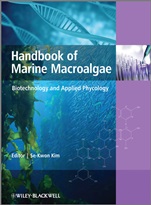
Handbook of Marine Macroalgae: Biotechnology and Applied Phycology
ISBN 9780470979181
Autor: Se–Kwon Kim
Wydawca: Wiley
Dostępność: 3-6 tygodni
Cena: 989,10 zł
Przed złożeniem zamówienia prosimy o kontakt mailowy celem potwierdzenia ceny.
ISBN13: |
9780470979181 |
ISBN10: |
0470979186 |
Autor: |
Se–Kwon Kim |
Oprawa: |
Hardback |
Rok Wydania: |
2011-11-22 |
Ilość stron: |
592 |
Wymiary: |
271x205 |
Tematy: |
PS |
The Handbook of Macroalgae: Biotechnology and Applied Phycology describes the biological, biotechnological and the industrial applications of seaweeds. Vast research into the cultivation of seaweeds is currently being undertaken but there is a lack of methodological strategies in place to develop novel drugs from these sources. This book aims to rectify this situation, providing an important review of recent advances and potential new applications for macroalgae. Focusing on the chemical and structural nature of seaweeds the book brings the potentially valuable bioactive nature to the fore. Novel compounds isolated from seaweeds are reviewed to provide an invaluable reference for anyone working in the field.
Spis treści:
List of Contributors
Preface
Editor
PART I Introduction to Algae and Their Importance
1 Biological Importance of Marine Algae
Ali A. El Gamal
1.1 Introduction
1.2 Interesting natural products and their biological activities from macroalgae (seaweeds)
1.2.1 Chlorophyta (green algae)
1.2.2 Phaeophyta (brown algae)
1.2.3 Rhodophyta (red algae)
Acknowledgment
References
2 Seaweeds: The Wealth of Oceans
Upadhyayula Suryanarayana Murty and Amit Kumar Banerjee
2.1 Introduction
2.2 Need for marine resources
2.3 Various marine resources
2.4 Producers in the marine environment
2.5 Emergent plants
2.6 Seaweed diversity
2.7 Uses of seaweeds
2.8 Marine farming: global scenario
2.9 SEAPURA: an EU effort
2.10 Seaweed farming: an Indian scenario
2.11 Expanding the existing knowledge base: current research trends in exploring seaweeds
2.11.1 Metagenomics in understanding seaweeds
2.11.2 Role of bioinformatics
2.11.3 Data storage and retrieval
2.11.4 Different kind of information analysis
2.11.5 Phylogeographical and evolutionary analysis
2.12 Future prospects
2.13 Conclusion
Reference
s
vi CONTENTS
3 Eco–Biochemical Studies of Common Seaweeds in the Lower Gangetic Delta
Rajrupa Ghosh, Kakoli Banerjee and Abhijit Mitra
3.1 Seaweeds: an overview
3.2 Commercial uses of seaweeds
3.3 Indian scenario
3.4 Biochemical composition of seaweeds with special reference to
Indian Sundarbans
References
4 Chemodiversity and Bioactivity within Red and Brown Macroalgae Along the French coasts, Metropole and Overseas Departements and Territories
Nathalie Bourgougnon and Valerie Stiger–Pouvreau
4.1 Introduction
4.2 Exploitation of marine algal resources
4.2.1 International context
4.2.2 French and Breton context
4.3.3 French research network on marine bioactive compounds extracted from macroalgae
4.3 Why a focus on red and brown seaweeds?
4.4 Marine red seaweeds and biological activities
4.4.1 Polysaccharides
4.4.2 Phycoerythrin
4.5 Marine brown seaweeds and biological activities
4.5.1 Polysaccharides
4.5.2 Phenolic compounds (phloroglucinol and derived products)
4.5.3 Terpenes
4.6 The use of metabolites from marine red and brown algae for their chemical defense
4.6.1 Biotic interactions of marine red and brown algae (pathogens, grazing, etc.)
4.6.2 Biofouling
4.7 The use of metabolites as chemomarkers for taxonomy
4.8 Industrial uses of metabolites from marine red and brown algae
4.8.1 Algae for nutritional foods
4.8.2 Algae for health and cosmetics
4.8.3 Algae against microorganisms
4.10 Conclusion
Acknowledgments
References
5 Physiological Basis for the use of Seaweeds as Indicators of Anthropogenic Pressures:
The Case of Green Tides
Jesus M. Mercado
5.1 Introduction
5.2 Light absorption
5.3 Photosynthesis at sub– and saturating irradiance
5.4 Inorganic carbon acquisition
5.5 Does the high capacity for using bicarbonate favor the development of gree
n tides?
5.6 Conclusions
Acknowledgments
References
6 Significance of the Presence of Trace and Ultratrace Elements in Seaweeds
Antonio Moreda–Pi˜neiro, Elena Pe˜na–V´azquez and Pilar Bermejo–Barrera
6.1 Introduction
6.2 Mineral content in seaweed
6.3 Trace and ultratrace elements in seaweeds
6.3.1 Legislation concerning seaweed consumption
6.3.2 Trace and ultratrace elements in seaweed: studies concerning seaweed edibility
6.3.3 Radionuclides in edible seaweed
6.4 Trace and ultratrace elements in seaweed: pollution biomonitoring
6.4.1 Seaweeds as bioindicators
6.4.2 Trace and ultratrace elements in seaweed: studies concerning environmental monitoring
6.4.3 Seaweeds as bioindicators of radioactive pollution
6.5 Chemical speciation
6.5.1 Importance of the chemical species of an element
6.5.2 Sources of organometallic species in the environment and foodstuffs
6.5.3 Organometallic compounds (elemental chemical species) in algae
6.5.4 Analytical chemistry of elemental speciation in algae
References
PART II Isolation and Chemical Properties of Molecules Derived from Seaweeds
7 Chemical Composition of Seaweeds
Ladislava Mi?surcov´a
7.1 Introduction
7.2 Various components of seaweeds
7.2.1 Proteins and amino acids
7.2.2 Minerals
7.2.3 Vitamins
7.2.4 Lipids
7.2.5 Dietary fiber
7.3 Conclusion
References
8 Structural Peculiarities of Sulfated Polysaccharides from Red Algae Tichocarpus crinitus
(Tichocarpaceae) and Chondrus pinnulatus (Gigartinaceae) Collected at the Russian Pacific Coast
Anna O. Barabanova and Irina M. Yermak
8.1 Introduction
8.2 Carrageenan sources in the Russian Far East
8.3 The polysaccharide composition of algae in relation to the phase of its life cycle
8.3.1 The polysaccharides of Chondrus pinnulat
us (Gigartinaceae)
8.3.2 The polysaccharides of Tichocarpus crinitus (Tichocarpaceae)
8.3.3 Influence of environmental conditions on polysaccharide composition of T. crinitus
8.4 The rheological and viscosity properties of carrageenan from C. pinnulatus and T. crinitus
References
viii CONTENTS
9 Extraction and Characterization of Seaweed Nanoparticles for Application
on Cotton Fabric
Sivalingam Thambidurai
9.1 Introduction
9.2 Textile materials
9.2.1 Cotton fiber
9.2.2 Cotton yarn
9.2.3 Cotton fabric
9.2.4 Preparatory process
9.3 Antimicrobial agents
9.3.1 Organic chemicals
9.3.2 Inorganic nanoparticles
9.3.3 Oxygen bleach
9.3.4 Plant products
9.3.5 Chitin and chitosan
9.4 Seaweeds
9.4.1 Bioactive compounds from seaweed
9.5 Extraction and characterization
9.5.1 Crude extract
9.5.2 Nanoparticle extraction
9.5.3 Characterization of nanoparticles
9.6 Antibacterial finishing
9.6.1 Padding of extract
9.6.2 Antibacterial test
9.6.3 Antibacterial property
9.7 Permanent finish
Acknowledgments
References
10 Enzyme–assisted Extraction and Recovery of Bioactive Components from Seaweeds
You–Jin Jeon, W.A.J.P Wijesinghe and Se–Kwon Kim
10.1 Introduction
10.2 Extraction of bioactive compounds from seaweeds
10.3 Role of cell wall degrading enzymes
10.4 Importance of enzyme treatment prior to extraction of bioactive compounds
10.5 Selection of the enzyme/s and the extraction conditions
10.6 Bioactive peptides from seaweeds
10.6.1 Polyphenols and brown algal phlorotannins
10.6.2 Carotenoids
10.6.3 Polysaccharides
10.7 Conclusions
References
11 Structure and Use of Algal Sulfated Fucans and Galactans
Vitor H. Pomin
11.1 Introduction
11.2 Phylogenetic distribution
11.3 Common methods for extraction and structural analyses<
br>11.3.1 Methods for isolation
11.3.2 Methods for detection, quantization, and purity control
11.3.3 Methods for molecular weight determination
11.3.4 Methods for structural characterization
11.4 General structural features related to phylogenetic occurrence
11.4.1 Phylogenetic implications: how has the 3–linked, ß–galactopyranose unit occurred in the marine environment throughout the course of evolution?
11.4.2 Restricted occurrence of SFs in brown algae
11.4.3 SGs in green algae
11.4.4 Red algal SGs occur usually in disaccharide repeating units within heterogeneous sulfation patterns: carrageenans and agarans
11.5 Industrial applications
11.5.1 SFs/fucoidans as food supplements and cosmetic hydrators
11.5.2 Carrageenans and agarans: the most industrially used SG molecules
11.6 Pharmacological properties
11.6.1 Antiviral actions
11.6.2 The use of SFs and SGs in therapy for preventing thrombosis and coagulation
11.6.3 Inhibiting inflammation
11.6.4 Pro– and antiangiogenic actions of SFs/fucoidans
11.6.5 Algal SPs helping the fight against tumor
11.6.6 Combating infection of parasites with algal SPs: a new avenue against parasitoses
11.6.7 Effects on cellular growth, migration and adhesion
11.7 Major conclusions
Acknowledgments
References
12 Bioactive Metabolites from Seaweeds
Jing Hu, Bin Yang, Xiuping Lin, Xue–Feng Zhou, Xian–Wen Yang, and Yonghong Liu
12.1 Introduction
12.2 Chemical constituents
12.2.1 Sesquiterpenes
12.2.2 Diterpenes
12.2.3 Other skeletons
12.2.4 Meroterpenoids
12.2.5 C15–acetogenins
12.2.6 Phlorotannins
12.2.7 Steroids
12.3 Conclusions
References
13 Seaweed Digestibility and Methods Used for Digestibility Determination
Ladislava Mi?surcov´a
13.1 Digestibility
13.1.1 Protein digestibility
13.2 Methods of seaweed digestibility assessment
13.2.1
In vivo methods of digestibility assessment
13.2.2 In situ methods of digestibility assessment
13.2.3 In vitro methods of digestibility assessment
13.3 Factors influencing digestibility of seaweed and seaweed products
13.3.1 Endogenous factors influencing seaweed digestibility
13.3.2 Exogenous factors influencing seaweed digestibility
13.4 Evaluation of seaweed digestibility
13.5 Contribution of seaweed to food and feed digestibility ONTENTS
13.6 Conclusion 297
References 297
14 Metallation of Seaweed Fucus vesiculosus Metallothionein: As3+ and Cd2+ binding
Thanh T. Ngu and Martin J. Stillman
14.1 Introduction
14.2 Characterization of the rfMT
14.3 Equilibrium metallation studies of rfMT studied using ESI–MS and UV–visible
absorption techniques
14.3.1 Equilibrium data for cadmium binding
14.3.2 Equilibrium data for arsenic binding
14.4 Dynamic metallation studies of rfMT studied using ESI–MS techniques
14.5 Conclusions
Acknowledgments
References
PART III Biological Properties of Molecules Derived from Seaweeds
15 In Vivo and in Vitro Toxicity Studies of Fucoxanthin, a Marine Carotenoid
Yoshimi Niwano and Fumiaki Beppu
15.1 Introduction
15.2 In vivo oral toxicity study
15.3 In vitro and in vivo mutagenicity study
15.4 Conclusion
References
16 Brown Seaweed Lipids as Potential Source of Omega–3 PUFA in Biological Systems
Kazuo Miyashita, Bhaskar Narayan, Takayuki Tsukui, Hiroyuki Kamogawa, Masayuki Abe, and Masashi Hosokawa
16.1 Introduction
16.2 Omega–3 and omega–6 PUFA
16.3 Importance of omega–3 PUFA on human health
16.4 Brown seaweed lipids
16.5 Bioconversion of LN to DHA
16.6 Hepatic DHA enhancement in mice by fuc
oxanthin
16.7 Conclusion
References
17 Immune Regulatory Effects of Phlorotannins Derived From Marine
Brown Algae (Phaeophyta)
Phuong Hong Nguyen, il–Whan Choi, Se–Kwon Kim and Won–Kyo Jung
17.1 Introduction
17.2 Anti–inflammatory effects of phlorotannins on RAW264.7 macrophage cells
17.3 Neuroprotective effects of phlorotannins on BV2 microglial cells
17.4 Anti–allergic effects of phlorotannins
17.4.1 Anti–asthma
17.4.2 Anti–rheumatoid arthritis (RA)
17.4.3 Other phlorotannins
17.5 Conclusion
Acknowledgments
References
CONTENTS xi
18 In Vivo and In Vitro Studies of Seaweed Compounds
Raquel Dom´inguez Gonzalez, Vanessa Romaris Hortas and Pilar Bermejo Barrera
18.1 Introduction
18.2 Methods to study compound bioaccessibility
18.2.1 In vivo methods
18.2.2 In vitro methods
18.3 In vivo versus in vitro methods
18.4 Methods with cell culture models
18.5 Conclusions
References
19 Brown Seaweed–Derived Phenolic Phytochemicals and Their Biological Activities for
Functional Food Ingredients with Focus on Ascophyllum nodosum
Emmanouil Apostolidis and Chong M. Lee
19.1 Introduction: seaweed–derived functional food ingredients
19.2 Major commercial brown seaweeds
19.2.1 Ecology and characteristics
19.2.2 Health benefits
19.3 Brown seaweeds and phenolic phytochemicals
19.3.1 Brown seaweed phenolic phytochemicals and health benefits
19.3.2 Ecklonia cava health benefits
19.4 Ascophyllum nodosum: importance and health benefits
19.4.1 Health benefits
19.4.2 Ascophyllum nodosum phenolic phytochemical–mediated type 2 diabetes management
19.4.3 Future directions
19.5 Conclusions
References
20 Antiob
esity and Antidiabetic Effects of Seaweeds
Chang–Suk Kong and Se–Kwon Kim
20.1 Introduction
20.2 Antiobesity and antidiabetic effects of seaweed
20.2.1 Brown seaweed
20.2.2 Active components
20.3 Conclusions
References
21 Health Beneficial Aspects of Phloroglucinol Derivatives from Marine Brown Algae
Noel Vinay Thomas and Se–Kwon Kim
21.1 Introduction
21.2 Phloroglucinol derivatives (phlorotannins) from marine brown algae
21.3 Health beneficial aspects of brown algal phlorotannins
21.3.1 Anti–inflammatory activity
21.3.2 Antioxidant activity
21.3.3 Anti–photoaging activity
21.3.4 Antitumor activity
21.3.5 MMP inhibition activity
21.3.6 Additional health beneficial aspects of phlorotannins
21.4 Conclusions and future prospects
References
xii CONTENTS
22 Biological Effects of Proteins Extracted from Marine Algae
Taek–Jeong Nam
22.1 Introduction
22.2 Stimulatory effect of a glycoprotein from LAMINARIA Japonica on cell proliferation
22.3 Chemoprotective effect of marine algae extracts against acetaminophen toxicity
22.3.1 Effect of a glycoprotein from Hizikia fusiformis on acetaminophen–induced liver injury
22.3.2 Chemoprotective effects of a protein from the red algae Porphyra yezoensis in drug–induced liver injury
References
23 Functional Ingredients from Marine Algae as Potential Antioxidants in the Food Industry
Isuru Wijesekara, Mahinda Senevirathne, Yong–Xin Li and Se–Kwon Kima
23.1 Introduction
23.2 Marine algae–derived functional ingredients and their antioxidant effect
23.2.1 Phlorotannins
23.2.2 Sulfated polysaccharides
23.2.3 Carotenoids
23.3 Conclusion
References
24 Algal Carotenoids as Potent Antioxidants
Kazuo Miyashita, M. Airanthi K. Widjaja–Adhi, Masayuki Abe, and Mas
Koszyk
Książek w koszyku: 0 szt.
Wartość zakupów: 0,00 zł
Informacje


Kontakt
Gambit
Centrum Oprogramowania
i Szkoleń Sp. z o.o.
Al. Pokoju 29b/22-24
31-564 Kraków
Siedziba Księgarni
ul. Kordylewskiego 1
31-542 Kraków
+48 12 410 5991
+48 12 410 5987
+48 12 410 5989
Subskrypcje
Administratorem danych osobowych jest firma Gambit COiS Sp. z o.o. Na podany adres będzie wysyłany wyłącznie biuletyn informacyjny.
Autoryzacja płatności

Informacje na temat autoryzacji płatności poprzez PayU.

© Copyright 2012: GAMBIT COiS Sp. z o.o. Wszelkie prawa zastrzeżone.
Projekt i wykonanie: Alchemia Studio Reklamy